Thursday, September 12, 2013

Partly Cloudy: Poems of Love and Longing by Gary Soto


From the author of The Afterlife and Novio Boy, comes this small book of love poems written in the voices of teens.  The first half of Partly Cloudy is verse from a female perspective, including “Black Books,” about a young woman’s search for Mr. Not a Jerk, and “Obsession” which ends with the line, “Young lady, there’s a picture of a boy at the back of your retinas.”  In the second half, Soto explores young love from the male point of view.  In “Beautiful Trouble” a deacon’s son yearns for a red-lipped, bangle-clad bad girl.  “Driftwood” is a sad lament of rejection that makes poetry out of a frozen river.  The poetry is accessible and captures the vulnerability of eager young hearts, without conjuring up fiery passion or utter heartbreak.  Partly Cloudy is a good introduction to poetry for younger teens and tweens and well-suited to instructional use. --Regan Schwartz

Soto, Gary. Partly Cloudy: Poems of Love and Longing. New York: Houghton Mifflin Harcourt, 2009. Print.

Monday, September 9, 2013

Welcome back + a Fabulous List


Welcome back!  

And to those of you who never went away, it’s nice to see you again.  Today is the first day of our students’ new school year and we are excited to tell you about the books we’ve been reading.  Before we get started, though, we’d like to share with you a list we’ve all been waiting for:  Andrea Swenson’s recommended titles for NYC LGBTQ youth and their allies.  Andrea recently shared on our NYC listserv that she created this list in conjunction with a Collaborative Collection Development Grant she received for books related to and for the LGBTQ students and allies in our communities.  In her own words:

My lists have some very specific goals:  they are meant to go in NYC urban public school libraries; they are meant to be appealing to as many students as possible students, GLBTQ or allies; they need to fit a wide range of reading levels; and they need to be easily purchased from a library vendor.  I will be leaving off some award-winners, either to provide diversity of characters, or because I don’t think they’re as appealing as some other books.  I reached out to experts around the country and in New York City for advice & suggestions.  I know that making lists is always challenging, so I don’t expect to please everyone!”  

If you don’t know Andrea, please allow me to tell you that her school library is a true sanctuary for LGBTQ youth; a beacon and model for the rest of us.  Without further ado, here it is!
--Jessica Fenster-Sparber


Wednesday, August 7, 2013

Big Guys Don’t Shrink: Basketball’s Best Quotes & Quips by Eric Zweig


“These young guys are playing checkers.  I’m out there playing chess.” - Kobe Bryant


This collection of deep thoughts, sarcastic quips, brags, and ponderings from some of basketball’s biggest personalities is full of attitude, humor, and, at times, wisdom.  Big Guys Don’t Shrink is a stylish book, making good use of typography and white space, including eye-catching punches of color, and with full page color photos sprinkled generously throughout.  Including over 400 quotes, this low-stress read is popular with sports fans and offers a unique look at the sport over the last few decades.  Organized thematically, the table of contents includes sections such as, “Foul Play,” “Gettin Old,” “Snappy Answers,“ and “Weakest Link.”  Looking for a quote from a specific player?  No problem - they are indexed by player name. --Regan Schwartz

Zweig, Eric. Big Guys Don’t Shrink: Basketball’s Best Quotes & Quips. Buffalo, NY: Firefly Books, 2008. Print.

Friday, July 26, 2013

My Book of Life by Angel by Martine Leavitt


Angel’s been running away from home ever since her mom died, but she usually only goes so far as the mall before she returns home or the police pick her up for shoplifting.  After Angel is seduced by an ambitious pimp who feeds her addictive drugs, Angel’s distraught father makes the grave mistake of telling Angel not to come home until she cleans up her act.  Call, a pimp remarkable for his intent to lead a grassroots effort to legalize prostitution, seizes the the opportunity to take over Angel’s life and move her into downtown Vancouver. Initially terrorized by Call, Angel eventually becomes preoccupied with protecting a younger girl from the life Call has given her and fighting the attendant drug addiction.  Told in haunting verse, the end of the book roots Leavitt’s fiction in the real-life disappearances of forty-nine women.  School librarians will want to know that the depiction of minors sexually abused by adults makes this book appropriate for more emotionally mature audiences.--Jessica Fenster-Sparber


Macmillian offers a discussion guide here.  Click here to read School Library Journal’s interview with author Martine Leavitt.

Leavitt, Martine.  My Book of Life by Angel.  New York:  Farrar, Straus, Giroux, 2012. 

Thursday, June 27, 2013

ALA 2013

Two of us, Claudio and Regan, are presenting at the American Library Association's annual conference in Chicago this Saturday.  The topic? Arts programs in school libraries serving detained youth.  If you are attending, find us and say hello!

In other news, yesterday marked the end of the Passages Academy school year.  Posting here will slow down over the summer as we prepare for another great school year.

Monday, June 17, 2013

The Boy in the Striped Pajamas: a fable by John Boyne


The Fury has come for dinner and decided Bruno’s father is destined for greatness, so the family is moving to Out-with.  Told from the perspective of nine-year old Bruno, Boyne’s tale is a brilliantly written short novel which offers an engaging counterpoint or supplement to the textbook teachings on the Holocaust for middle and high school students.  While most fiction for adolescents features an adolescent protagonist, The Boy in the Striped Pajamas requires a more sophisticated reader to appreciate the clever wordplay referring to Hitler and Auschwitz.   Readers of all ages stand to benefit from the discussions the book will be sure to inspire, including the importance of questioning one’s surroundings, following a moral compass, and genocide.  The ending packs a quiet punch--wait to see the movie if you can.  Originally published in 2006, back matter in the 2011 edition includes eight discussion questions from Pat Scales and an interview with the author.  --Jessica Fenster-Sparber


Oxford University Press has published an 88-page teacher guide written by Hayley Davies-Edwards.  You can get it for free here.

Boyne, John.  The Boy in the Striped Pajamas: a fable.  New York: Random House, 2011.  Print.

Friday, June 14, 2013

Jokelopedia compiled by Ilana Weitzman, Eva Blank, Alison Benjamin, and Rosanne Green


Nothing brings people together like a joke so silly that it just cracks you up.  Luckily, Jokelopedia is chock full of them.


“Why was the margarine unhappy when she gave birth to marmalade?
She was expecting something butter”
“What did the 0 say to the 8?
Nice belt.”
“What’s the fastest way to crash a computer?
Let an adult use it.”


Now, I admit, that last one hit a little too close for this librarian’s comfort, but it is the wealth of jokes like these that pulls groups of disparate teens together for shared reading, laughing, and groaning.  Interspersed with the one-liners are pages of comedy history, comedy biographies, step-by-step procedures for a multitude of practical jokes, ample cartoons and illustrations, and longer-form narrative jokes.  Jokelopedia is an engaging, low-stress read, sure to elicit a smile (or an amused grimace). --Regan Schwartz

Weitzman, Ilana, et al, eds. Jokelopedia. New York: Workman Publishing, 2006. Print.

Tuesday, June 11, 2013

Science Ink by Carl Zimmer

“Miss, you got any tattoo books?” is asked at least once a day, every day, here inside Passages’ libraries.  But until now, there have not been any absolutely fabulous tattoo books that marry tattoos and... science.  Thank you Carl Zimmer and Mary Roach!  239 glorious matte color pages of science tattoos make their subjects one of immediate intrigue and coolness.  The handsome hardcover volume includes a half or whole page of text providing context for each tattoo image.  Zimmer gives accessible, well-crafted introductions to the topic along with a few words about the person wearing the tattoo and his or her connection to the subject at hand.  The book is organized by theme with chapters on physics, chemistry, evolution, neuroscience, DNA, and the like.  Back matter includes a handy visual index, as well as information about the authors and a standard index.  Science teachers, rejoice! --Jessica Fenster-Sparber


Zimmer, Carl.  Science Ink.  New York: Sterling, 2011.  Print.

Click here for seventeen slides from the book provided via the New York Times.

Monday, June 10, 2013

Guest post: Chulito: A Novel by Charles Rice-Gonzalez and Street Dreams by Tama Wise


Chulito’s been best friends with Carlos since they were 5, but Carlos goes away to college, while Chulito runs for the local Hunts Point dealer, Kamikaze, and has dropped out of school. When Chulito and Carlos reconnect, Chulito realizes that his feelings for his friend may be deeper than he's ready to admit. This book is full of sex, drugs and real life on the streets of the Bronx, but it’s also a story about betrayal, loyalty, choosing love and not losing everything. Only collections that include other adult urban fiction books will find this book appropriate, but it’s high-quality writing, and shows men being tough and truly loving at the same time. Librarians andteachers looking for a more school-appropriate book should get Street Dreams, by Tama Wise. Set in urban New Zealand, it has some unfamiliar local vocabulary, but is for every fan of hip-hop, graffiti, and breakdancing. Tyson, the main character, falls in with a local crew of rappers and graffiti artists and falls for their promoter, Marc. Will he be able to connect with him without alienating the leader of the crew, Seige, and his best friend? One or both of these books should be included in any high school library collection--GLBTQ students need to see themselves in urban lit.  -- Andrea Swenson

Rice-Gonzalez, Charles. Chulito: a Novel. New York: Magnus Books, 2011. Print.


Wise, Tama. Street Dreams. Valley Falls: Bold Strokes Books, 2012. Print.


Andrea Swenson is the school media specialist at East Side Community, a 6-12th grade public school in New York City. She loves to talk about books (no surprise!).  Andrea was recently recognized for her work with the chemistry teacher at East Side by the American Chemical Society Committee on Environmental Improvement for incorporation of sustainability into chemistry education.

Andrea is curating a list of books with LGBTQ characters, themes and issues that are recommended for middle and high schools in New York City. You can find her lists and links here.

Friday, June 7, 2013

Tears of a Tiger by Sharon Draper


Andrew Jackson’s life is changed forever the night he and his friends make the tragic decision to drink and drive to celebrate their high school basketball team victory. Andrew, B.J., and Tyrone look on in horror as the car Andy is driving bursts into flames with team captain, Robert Washington, trapped helplessly inside. Andy is finding it easier to deal with the consequences of having his license revoked until he is twenty-one and having a two year suspended sentence on his record than the guilt he feels over causing the death of his best friend. His parents tell him to be strong. Coach tells him he can’t blame himself forever. His friends and girl try to be supportive, but Andy still struggles. The story hinges on the question of will he ever be able to forgive himself? Sharon Draper deals with a variety of issues in Tears of a Tiger in a format that offers the reader a variety of insights into the issues. She uses a conversational format for most of the book but then includes student assignments, letters, and diary entries to provide further character insight. Also included is a reader’s guide with discussion topics as well as activities and research ideas. The first book in the Hazelwood High trilogy, this book is for the reader who is not afraid to deal with the tough issues of teen life. -- Bernardine E. Lowery-Crute

Draper, Sharon. Tears of a Tiger. New York, NY: Simon Pulse, 1994. Print.

Wednesday, June 5, 2013

Claudette Colvin: Twice Toward Justice by Phillip Hoose


Just when you thought you knew that Rosa Parks sparked what later came to be known as the Civil Rights Movement in December, 1955, Phillip Hoose cracks open the previously almost silent vault of Claudette Colvin.  Divided into two parts to encompass Colvin’s two major efforts to fight injustice as a teen, Hoose gives us Colvin’s voice, along with his own narrated tale, engaging and brief sidebars, and historical photographs.  Adolescent readers may be intrigued to learn of Colvin’s arrest and placement in an adult jail, her meetings with Rosa Parks before Parks made history, and her subsequent experiences as a pregnant teen. Readers will never see Parks in the same way again.  Backmatter in the paperback edition includes an epilogue, afterword, interview, bibliography, notes, acknowledgements, photo credits and an index, all of which help the reader see this work of non-fiction as a well-documented inquiry project.  A riveting, inspiring non-fiction read, this book will be of interest to social studies and ELA teachers alike, as well as their students. --Jessica Fenster-Sparber


Social Studies teachers may be interested in these lesson plans developed by The State of Rhode Island and librarians may want to familiarize themselves with this pathfinder from Eduscape’s website.


Hoose, Philip.  Claudette Colvin:  Twice Toward Justice.  New York: Macmillan, 2009. Print.

Tuesday, June 4, 2013

Almost Home by Jessica Blank

Elly is twelve and too terrified to tell anyone that her step-brother rapes her almost every night.  After her peers mercilessly bully her and assault her one day after school, she is rescued by a mysterious teen who teaches her how to dumpster dive and sleep on pavement.  Elly crosses paths with similarly traumatized and presently homeless teens and Blank’s narrative switches narrators each time a new chapter begins.  This gritty young adult novel, set in L.A., will be too much for some, and all too familiar for others.  Almost Home can be viewed as a cautionary tale that ultimately conveys that leaving danger does not always mean finding safety.   School librarians will want to be aware that this unblinking depiction of teen homelessness includes sexual exploitation, rape, and drug abuse.  Recommended for independent reading for older teens. --Jessica Fenster-Sparber

Blank, Jessica.  Almost Home.  New York: Hyperion, 2007. Print.

Hyperion has published a discussion guide authored by Tracie Vaughn Zimmer which includes discussion questions, project ideas, and a short interview with the author.  Access it here.

Monday, June 3, 2013

Getting Away With Murder: the True Story of the Emmett Till Case by Chris Crowe


In 1955, fourteen-year-old Emmett Till’s gruesome death by the hands of the husband of a white woman he dared to whistle at would force the nation to face the realities of segregation and trigger the long Civil Rights battle that would define the next decade.  Getting Away With Murder tells this story in a compelling and accessible narrative.  After setting the scene in the first chapter, the book follows a mostly chronological path, from Emmett’s arrival in Mississippi, to his murder and through the trial to the the final chapter, “Aftershocks.”  Author Chris Crowe makes good use of many powerful photographs and quotes, and includes in the back matter a timeline of Civil Rights events, a bibliography, and three lists of additional resources and materials related to the Emmett Till case.  All of which makes this book an engaging and useful tool for teaching about the Civil Rights movement, and a good starting point for related student inquiry projects.  --Regan Schwartz

*Teachers and librarians will want to be prepared for a photo of Emmett’s decomposing body on page 67.


Crowe, Chris. Getting Away With Murder: the True Story of the Emmett Till Case. New York: Dial Books for Young Readers, 2003. Print.

Friday, May 31, 2013

Fitz by Mick Cochrane


Fifteen-year old Fitz has acquired a gun for the sole purpose of getting his absent father to answer some questions and spend some “quality time” with him.  A provocative premise and short chapters will appeal to reluctant readers.  Less appealing, however, are the author’s choice to employ third-person narration, a protagonist who is remains fuzzy about his self-understanding throughout the book, and a literary affectation that never feels authentic.  This book is best suited to more sophisticated teen readers and those who can easily connect with the plight of a teen who has many unanswered questions about an absent parent.  Fitz pairs interestingly with 50 Cent’s Playground and Morgenroth’s Jude.  The lack of urban grit makes it a tougher sell to urban readers, but for those willing to cross geographical boundaries, the Minnesota setting may be a breath of fresh air.--Jessica Fenster-Sparber

Random house has made an excerpt available here.


Cochrane, Mick.  Fitz.  Alfred A. Knopf:  New York, 2012. Print.

Thursday, May 30, 2013

Shooter by Walter Dean Myers


What causes Leonard Gray to go on a rampage before the start of school on April 22nd? In Shooter, Myers chooses an interview format to give the reader an inside view of the incident that occurred on April 22 at Madison High School in Harrison County. The interviews are conducted with Cameron Porter, a 17 year old African-American youth from a financially stable, two parent household, and Carla Evans, now 18, Caucasian, a young woman with a somewhat tumultuous past and a history of difficulties. Both Cameron and Carla have survived the incident and are reported to be closest to Leonard Gray.  In an effort to add a bit of authenticity, Myers includes copies of newspaper reports of the incident, the police report and medical examiner’s report, the Miranda statements of the interviewees and the diary of Leonard Gray that was found in his home after the incident that provides insight to his state of mind in the days and weeks leading up to the shooting. Those interested in crime and drama will likely be attracted to Shooter. In classroom discussions it can surely be a possible springboard to a variety of topics from bullying to drug use and beyond. - Bernardine E. Lowery-Crute

Myers, Walter Dean. Shooter. Harper Collins Children’s Books: New York, 2004. Print.

Monday, May 20, 2013

1,001 Video Games You Must Play Before You Die edited by Tony Mott


Featuring a wide range of games, from classic Atari games such as Breakout and Asteroids to modern phenomenons like World of Warcraft and Halo, this compendium is a hit with serious and casual gamers alike.  Each game is given a short professional review and most include a full-color screen shot.  Including games for arcades, consoles, computers, handheld devices, and phones, the reader is almost sure to stumble across a game they’ve connected with.  The conversations sparked by group browsing of the book tend to lead to impromptu student reviews and recommendations, leading this reader to think that it would be well-used as a model text for review writing. --Regan Schwartz

Mott, Tony (ed.). 1,001 Video Games You Must Play Before You Die. New York: Universe, 2010. Print.

Friday, May 17, 2013

Retaliation by Yasmin Shiraz


After innocent Tashera is jumped by three unknown girls, her family wants revenge  As they search for her attackers, we learn that Tashera was targeted as payback for her boyfriend’s use and dismissal of former girlfriend, Jessica.   Retaliation motivates most characters in this extremely fast-paced and dramatic tale, illustrating the vicious cycle of violence.  Tashera and boyfriend Ahmed attempt to escape the violence via athletic and academic scholarships, not always a possibility for our students.  However, the volume does contain tips for conflict resolution and an interview with the author.  While the pace of events, such as the scheduling of court trials, is unrealistic, students may appreciate the page-turning twists and turns that culminate in tragedy for many that sought retaliation. --Anne Lotito-Schuh

Shiraz, Yasmin. Retaliation: A Novel. Chantilly, VA: Rolling Hills, 2007. Print.

Thursday, May 16, 2013

The Knife and the Butterfly by Ashley Hope Perez


Azael wakes up behind bars and he can’t remember why he’s there.  He narrates his days and memories in alternating short chapters following the same structural format as Angela Johnson’s The First Part Last.  The reader visits scenes from Azael’s past in Houston, Texas, as a Salvadoran middle schooler who joins a local group of MS-13 boys.  Piecing together these memories, the reader tries, along with Azael, to piece together the reasons for his current status as a detainee, and the reasons for his bizarre participation in a therapeutic program which allows him to watch another detainee through one-way glass.  The powerful ending will leave incarcerated teen readers with much to consider.  A strong pick for bilingual older male teens asking for an independent reading novel in incarcerated settings.  The text contains numerous untranslated phrases in Spanish.  Fans of the Outsiders may also enjoy this new title.  --Jessica Fenster-Sparber

Perez, Ashley Hope.  The Knife and the Butterfly.  Minneapolis:  Carolrhoda Lab, 2012.  Print.

Monday, May 13, 2013

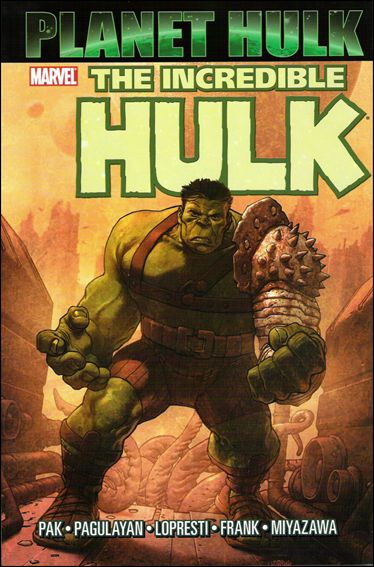
Planet Hulk By Greg Pak


When Namor, Dr. Strange, Dr. Xavier, Reed Richards and Tony Stark decide to ship the Hulk to a faraway planet, their plan fails. The Hulk's shuttle enters a wormhole and lands in a completely different place than intended.  Planet Skaar is ruled by the Red King who captures the Hulk and makes him fight in the gladiator arena.  The Incredible Hulk will have to muster all of his strength, of which he has plenty, to fight his way to freedom and escape the grasp of the Red King, who rules Skaar with an iron fist. The story depicts a more human side of the Hulk, leaving Bruce Banner, the Hulk’s alter ego, completely out of the story.  It allows the reader to see, and perhaps understand, that there is more to the green beast than we’re usually led to believe.  Comic book fans will not be disappointed here.  Anyone who likes comics, especially Hulk fans, should pick this one up.  If the ending leaves you wanting more, make sure to follow up with the action packed World War Hulk. -- Claudio Leon


Greg Pak. Hulk: Planet Hulk. New York: Marvel Worldwide Inc, 2011. Print.

Friday, May 10, 2013

Graffiti Alphabets by Claudia Walde


Easily one of the three most popular reference books in our library, Walde’s Graffiti Alphabets is a heavy, hardcover volume which offers an international collection of fonts inspired by graffiti.  Some of the fonts are designed by writers who stick strictly to the art form, and others are attributed to working graphic designers and artists’.  Each two-page spread shows the writer’s tag, followed by his or her location (city, country), affiliations (i.e. crews), favorite letter, web address, and then a short paragraph describing the writer’s favorite mediums and materials, philosophy, or what s/he loves about graffiti.  The majority of the 150+ writers included are based in Europe, but Asian, American, and South American writers are also included.  Images include one full page dedicated to the alphabet and usually a half-page photograph of a piece or two.  All color images are reproduced in full matte color.  This book is also available in French.--Jessica Fenster-Sparber

Walde, Claudia.  Graffiti Alphabets.  New York:  Thames & Hudson, 2011.  Print.

Wednesday, May 8, 2013

Save the Date--April 4th, 2014

Yes, unbelievably, we are already looking forward to the 3rd Annual (un)Conference on school library services to incarcerated and detained youth.  It was wonderful to see those of you who could attend this year's event.  If you provide school library services to incarcerated and detained youth, please save the date and plan to join us in New York City.

Tuesday, May 7, 2013

Custom Cars by Matt Doeden


What do channeling, shaving, sectioning, and scallops have in common?  The complex world of custom cars.  For readers interested in cars and customization, Custom Cars delivers a comprehensive overview in just forty-seven eye-catching pages.  The first half of the book explores the history of cars and customization, beginning with the Model T and progressing chronologically to the present day.  The latter half explores customization types and techniques illustrated with glossy, full-color photos.  Sidebars throughout the text include interesting facts, in-depth definitions, mini-bios, and other related information.  Front matter includes a limited table of contents and backmatter includes a glossary, index, selected bibliography, further reading, related web resources, and information about the author. --Regan Schwartz

Doeden, Matt.  Custom Cars . Minneapolis: Lerner Publications Comnay, 2008. Print.

Thursday, May 2, 2013

Flight Volume Six edited by Kazu Kibuishi


What do a Ninja that can't get a job, a gunslinging female detective and an astronaut have in common? Flight! This eight volume set of graphic novel short stories features a multitude of great artwork. Each story has its own unique art style which seems to match the story perfectly and make it come alive.  Like every short story compilation, it has it's hits and misses.  But, in volume six, the hits far outnumber the misses.  The stories cover a wide range of genres but the one thing that brings them all together is the concept of flight.  Although in some stories it is difficult to understand how the theme of flight is represented, this offers a great opportunity for students to figure out the connection, and for teachers to explain the concept of theme.  One favorite in this volume was "The Excitingly Mundane Life of Kenneth Shuri," a story about a ninja freshly graduated from ninja school that can't find a job.  The employment office is no help, his wife complains about him not finding a job and his son wants to be figure skater. In a twist of fate it all works out in the end and the story is filled with hilarious moments.  Among other good ones are "Dead at Noon," a story about a cowboy with amnesia, and "Magnus the Misfit,” a Viking that, unlike the rest of his clan, is not very ferocious.  A definite must read for any comic book fan or short story lover.  Each story is only a few pages, and they range from having no text to plenty of it. --Claudio Leon

Kibuishi, Kazu, ed. Flight Vol 6. New York: Random House Inc, 2009. Print

Wednesday, May 1, 2013

100 Most Dangerous Things on the Planet: What to Do if it Happens to You by Anna Claybourne


Did you know that hippos kill more people than sharks do?  Would you know what to do if either of those animals was coming for you?  If you’d like to be prepared, 100 Most Dangerous Things on the Planet is a great place to start your survival training.  Each entry in this slim volume features full-color photographs, a risk rating, a survival rating, and instructions on dealing with each particular danger in a variety of situations.  The comprehensive and well-organized table of contents allows the reader to find any information they are looking for quickly, while the engaging text entices them to read straight through.  Teachers may find 100 Most Dangerous Things on the Planet a useful resource for the early stages of inquiry projects.  It is a strong pick for reluctant readers with a taste for nonfiction. --Regan Schwartz

Claybourne, Anna. 100 Most Dangerous Things on the Planet. New York: Scholastic, 2011. Print.