Showing posts with label history. Show all posts

Friday, February 7, 2025

My Name is Marcus by Geoffrey Philp, illustrated by Shaquille Cross and Marcel Hemmings


For many years my Belmont colleague has asked  for a text for students about Marcus Garvey, and until now, there has been little to recommend beyond biographical entries in reference works.  This previous dearth of texts about Garvey, whose significance cannot be overstated, now makes this graphic novel for middle school readers remarkable.  


Although the book lacks a  bibliography or table of contents,  teachers who have been hungering for a book about Garvey will be delighted by this slick and richly colored slim volume.  Crosse and Hemmings’ serviceable digital illustrations get the job done,  and youth reading it in detention may appreciate the depiction of Garvey’s time in an American prison and the abuse he endured there.  They may also appreciate learning about President Biden’s recent posthumous pardon of Garvey, and teachers may use this newsworthy development as an introduction to Marcus Garvey’s role in American history and world history.  Backmatter includes a list of 75  facts about Garvey and 20 quotes without any further context provided. --Jessica Fenster-Sparber


Philp, Geoffrey.  My Name is Marcus.  Kingston: Blue Banyan Books, 2024.  Print.


Friday, October 14, 2022

Che Guevara’s Face: How a Cuban Photographer’s Image Became a Cultural Icon by Danielle Smith-Llera

How did one image of the revolutionary leader Che Guevara’s face become so popular?  Students who have seen the iconic image - originally a photo by the Cuban photographer Alberto Korda - may be very interested in this picture book-sized volume. 


The author tells the story of Che’s famous photographic portrait in four chapters that draw the reader in by setting the scene in which the original photo was taken-- a memorial service for the 100 killed and 200 wounded by a 1960 explosion in Havana Harbor that destroyed a ship carrying grenades and munitions.


Using historical photographs as well as Korda’s photographic contact sheet from that day,  author Smith-Llera provides context for this shocking and gruesome moment, inviting the reader to imagine the life of a photographer working in Havana at the time.


The author also includes a summary of Cuban history with many historical photographs,  however other than Korda’s,  the images are not credited within the text.--Jessica Fenster-Sparber


Smith-Llera, Danielle.  Che Guevara’s Face: How a Cuban Photographer’s Image Became a Cultural Icon.  Minnesota: Capstone, 2017.


Wednesday, February 16, 2022

Programming Spotlight: Author & Activist Jamal Joseph

Dr. Joseph reads to students at Belmont from his memoir


Humanitarian, activist, veteran Black Panther, professor, director, playwright, filmmaker, author, poet,  screenwriter Jamal Joseph visited with students at Belmont yesterday.  It was impossible not to feel moved by his brilliant storytelling, hard-won insight, and deep compassion.  Two groups of placement students who have been studying the Black Panther Party for the last six weeks with their Social Studies, ELA, Art teachers and reading specialist, speech language pathologist and school librarian as part of an interdisciplinary collaborative unit participated in the program. 


We are extremely grateful to Dr. Joseph for making the time to visit and to Dietrice Bolden for all of her assistance, and to Robert Galinsky for connecting us and Literacy for Incarcerated Teens for generously supporting the visit.--Jessica Fenster-Sparber

Monday, June 25, 2018

Queer, There and Everywhere: 23 People Who Changed the World by Sarah Prager and Zoe More O’Ferrall


Full disclosure: I received this book in conjunction with a meet-the-author event at Andrea Swenson’s amazing school library.  And I’m so glad I did because I think every school librarian serving high school students will want a copy of Prager’s chatty collective biography of queer history on their shelves.  Brief as they are, her twenty-two biographical chapters on twenty-three historical figures are intriguing and leave the reader wanting to know more.  Through the brief lives examined, the casual reader will start to grasp the bigger outlines of queer histories.  Prager’s considered and inclusive stance will aid younger readers in exploring multiple perspectives in a world wracked with adversarial and exclusionary politics.--Jessica Fenster-Sparber


-->
Prager, Sarah and Zoe More O’Ferrall.  Queer, There and Everywhere:23 People Who Changed the World.  New York: HarperCollins, 2018.

Wednesday, November 9, 2016

Child Soldier: When Boys and Girls are Used in War by Jessica Dee Humphreys & Michel Chikwanine Illustrated by Claudia Davila


Michel was a fierce-spirited five-year-old when he disobeyed his parents to play soccer with his best friend one day after school in his neighborhood in the Democratic Republic of Congo.  Snatched by rebels, tortured and forced to kill his best friend, Michel recounts his harrowing experiences in a way that younger readers can understand, leaving out the graphic details while showing the story via sequential art.  This moving, true story is followed with excellent backmatter, all of which address the older elementary reader as a future changemaker.  Notably, the authors connect Michel’s unique story to the estimated 250,000 child soldiers serving in armed forces and rebel groups around the world without omitting the fact that sixteen- and seventeen-year-olds may join the armed forces in some countries (with parental permission) and the fact that “children in these countries are sometimes recruited into armed gangs and other violent criminal groups.” (43)  Recommended for mature younger readers and those who do not shy away from serious topics.  I would recommend this to a student demanding a read like Yummy, though the first few pages, which outline the cultural and geographical context for the reader, may require a bit of scaffolding for less-experienced readers.--Jessica Fenster-Sparber

Humphreys, Jessica Dee and Michel Chikwanine.  Child Soldiers:  When Boys and Girls are Used in War.  Toronto: Kids Can Press, 2015.  Print.


Click here for the teacher’s guide or discussion guide on the publisher’s website.

Friday, September 30, 2016

100 Suns by Michael Light


How many times did the United States test atomic bombs?  Where did they test them?  What did the explosions look like?  As Passages’ Living Environment curriculum gets underway and students consider the atom, librarians may supplement instruction with this stunning and disturbing pictorial documenting the testing of nuclear bombs first on the mainland and subsequently on unlucky islands.  Author Michael Light keeps the text to a bare minimum for much of the book, allowing the reader’s curiosity to be piqued and then extended as the images of explosions pile up.  The backmatter reveals Light’s well-researched captions as well as a powerfully succinct timeline of the progression of the development of atomic bombs and key events of World War II.  Notes on stockpiling highlight the escalation of the arms race between the U.S. and the former U.S.S.R.  Struggling readers will appreciate the chance to access the text via the reading of images, and more sophisticated readers may enjoy the initial mystery of the buried captions and will find much to chew on once the backmatter is uncovered. --Jessica Fenster-Sparber

Light, Michael.  100 Suns.  New York: Knopf, 2003.  Print.

Click here for an interview with Michael Light on 100 Suns which was published in afterimage's July/August 2005 issue.

Monday, April 13, 2015

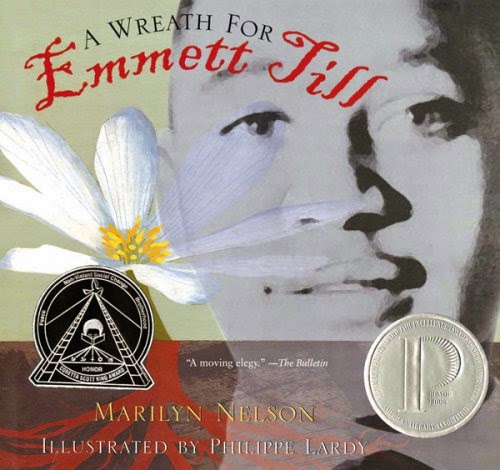
A Wreath for Emmett Till by Marilyn Nelson, illustrated by Philippe Lardy


This haunting and thought-provoking collection of sonnets is both an elegy for Emmett Till and a call to action.  Nelson urges the reader to remember and to bear witness to our country’s shame and horror and offers A Wreath for Emmett Till as a potential starting point.  In the book’s introduction, Nelson describes the heroic crown structure she used and her purpose in selecting such a strict poetic form.  Each of the fifteen interconnected poems is illustrated in vivid color by Lardy’s dynamic and symbol-laden paintings.  This book is not easy to read for many reasons including the difficulty of the subject matter and the complicated form full of literary and historical references.   Helpful backmatter includes a brief history of Emmett Till’s murder and the subsequent trial, notes on the allusions in each sonnet, and an artist’s note.  A Wreath for Emmett Till is a powerful resource for educators looking to tackle the murder of Emmett Till, the birth of the Civil Rights movement and the current state of race relations in the United States.--Regan Schwartz


A teacher’s guide from the publisher is available here.  A guide from Teaching Tolerance is available here.

Nelson, Marilyn, and Philippe Lardy. A Wreath For Emmett Till. Boston: Houghton Mifflin, 2005. Print
.

Monday, March 30, 2015

Sneak Preview: Ghetto Brother: Warrior to Peacemaker by Julian Voloj, Illustrated by Claudia Ahlering


In the last five years there has not been an obvious response to reader demand for another book “just like Yummy,” and that is set to change in May with the publication of Ghetto Brother.  The story of Benjamin Melendez’s founding of, and later departure from, the South Bronx-based gang builds a bit slowly while author Julian Voloj takes the time to lay the foundation for what is yet to come. The true history of the gang’s founding and its role in brokering a peace is all the more surprising in light of later revelations due to the care taken in the first part of the story.  Voloj does Melendez’s tale justice by prioritizing the narrative storytelling over factual minutia, and the black and white artwork by Claudia Aherling utilizes fine detail and watercolor to eschew a cartoonish-ness that might otherwise make this street-language-filled edition appeal to younger readers.  Themes of maturity, identity, and responsibility recommend this book to older teens. 

 Ghetto Brother depicts a fascinating slice of New York City/ South Bronx history that pairs well with Panther Baby and touches on Columbus’s arrival in the western hemisphere and the Spanish Inquisition.  Back matter includes eight pages of photographs and the author’s recounting of the “story behind the story,” where Voloj explains that the book is primarily based on interviews with former activists.  He goes on to list additional resources consulted and includes photos of Melendez himself during the years of his gang involvement as well as Melendez now, forty plus years later.--Jessica Fenster-Sparber


This review is of an advance reader’s copy provided by the publisher to the reviewer.  This title is scheduled for release in May.

Click here to see Melendez talking about GB's former storefront right in front of former Passages' site Summit(?!).  (around 2:26)
 
Julian Voloj and Benjamin Melendez will be signing books at MoCCA Fest 2015 on April 11th (both from 1:30-3pm, and Julian Voloj alone from 5 to 6pm) and 12th (Julian Voloj alone from 12-1pm, and both Julian Voloj and Benjamin Melendez from 3:30-5pm).   

Tuesday, February 10, 2015

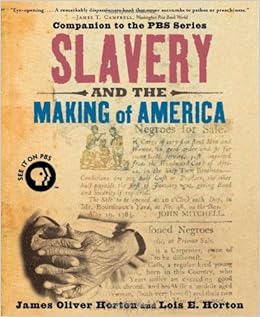
Slavery and the Making of America by James Oliver Horton and Lois E. Horton


I had the opportunity to read Slavery and the Making of America. This is an explicit account of the slave trade from the late 1400s to the 1960s, and it brings the horrors of that era to life. This book’s topic is a part of American history that all people, young and old, of all races should take the time to read. Slavery and the Making of America should be integrated into Global History for all ages in different stages. From Nat Turner's rebellion to the Civil War, this book made me reflect on what African Americans endured over a 400 plus year time span. I recommend this book. Such a great read. --Andre Saintilien Jr.

PBS has produced a television series which this book is a companion to.  Click here for a timeline of key events in the history of slavery.  Click here for additional print and electronic resources on slavery, including the WPA texts that chronicle the experiences of people who survived slavery and shared their remembrances.  Click here for related lesson plans.

Andre Saintilien Jr. works with youth placed in group home detention as a youth counselor.  He loves to read and is particularly fond of  non-fiction books  that are both instructive and focused on a single topic. He enjoys writing music in his free time.

Tuesday, November 25, 2014

The Harlem Hellfighters by Max Brooks, Illustrated by Caanan White


103 years ago African Americans in New York could not simply join up as soldiers in the Federal military. When African American men were finally able to establish an infantry unit, they had to do so within the disrespectful confines of segregation.  The Harlem Hellfighters is the story of Harlem’s highly-decorated trail-blazing unit as told by Max Brooks.  In his author’s note, Brooks explains his personal relationship to this lesser-known part of World War I history and his quest to bring it to light, first through a screenplay and now, here, as a graphic novel with detailed black and white illustrations by Caanan White.  More sophisticated readers will be better equipped to undertake the work of fitting together all of the pieces of the story and tracking characters.  The minimal text (usually less than five sentences per page), however, makes this a useful one for literacy instruction on comprehension strategies for older readers working with ELA teachers, reading specialists, or in pairs of peers. 

Here is a social studies lesson plan created by Thomas Malcolm for eighth graders in 1997.  It does not include Brooks' text, but may be of interest to educators nonetheless.  Here are documentary photographs of the Hellfighters, some of which Brooks includes in his backmatter.  --Jessica Fenster-Sparber


Brooks, Max.  Illustrated by Caanan White.  The Harlem Hellfighters.  New York: Broadway Books, 2014. Print.

N.B. At the time of this writing, Passages' libraries do not yet own a copy of The Harlem Hellfighters.  The copy reviewed for this post was lent to us via the MyLibraryNYC pilot program.  Thank you, MyLibraryNYC! 

Thursday, October 30, 2014

Bootleg: Murder, Moonshine, and the Lawless Years of Prohibition by Karen Blumenthal


While almost all of our students know what the word “bootleg” means in contemporary slang, few, if any, know of prohibition, the eighteenth amendment, or that Al Capone was born in Brooklyn.  This engaging narrative history begins in 1875 with the birth of Morris Sheppard, later known as The Grandfather of Prohibition, and takes the reader through American history, highlighting key figures in the story like Carrie Nation (Chapter 3), the notorious bar smasher, Al Capone (Chapter 8), infamous gangster, and ending with MADD and Red Ribbon Week.  Throughout, Blumenthal refrains from any final judgement on the “wets” and the “drys,” focusing on the dual messages that “each of us is responsible for our own behavior” and that “the experience of prohibition continues to color our laws, our debates and our personal lives.”  Rich backmatter includes a glossary, discussion questions from the author, an interview with the author, additional resources, source notes, acknowledgements and an index.  Recommended for independent reading, as a teaching text for non-fiction ELA units, an enrichment text for American history, and even a book club. .--Jessica Fenster-Sparber

Blumenthal, Karen.  Bootleg:  Murder, Moonshine, and the Lawless Years of Prohibition.  New York: Roaring Brook Press, 2011.

Wednesday, June 5, 2013

Claudette Colvin: Twice Toward Justice by Phillip Hoose


Just when you thought you knew that Rosa Parks sparked what later came to be known as the Civil Rights Movement in December, 1955, Phillip Hoose cracks open the previously almost silent vault of Claudette Colvin.  Divided into two parts to encompass Colvin’s two major efforts to fight injustice as a teen, Hoose gives us Colvin’s voice, along with his own narrated tale, engaging and brief sidebars, and historical photographs.  Adolescent readers may be intrigued to learn of Colvin’s arrest and placement in an adult jail, her meetings with Rosa Parks before Parks made history, and her subsequent experiences as a pregnant teen. Readers will never see Parks in the same way again.  Backmatter in the paperback edition includes an epilogue, afterword, interview, bibliography, notes, acknowledgements, photo credits and an index, all of which help the reader see this work of non-fiction as a well-documented inquiry project.  A riveting, inspiring non-fiction read, this book will be of interest to social studies and ELA teachers alike, as well as their students. --Jessica Fenster-Sparber


Social Studies teachers may be interested in these lesson plans developed by The State of Rhode Island and librarians may want to familiarize themselves with this pathfinder from Eduscape’s website.


Hoose, Philip.  Claudette Colvin:  Twice Toward Justice.  New York: Macmillan, 2009. Print.

Monday, June 3, 2013

Getting Away With Murder: the True Story of the Emmett Till Case by Chris Crowe


In 1955, fourteen-year-old Emmett Till’s gruesome death by the hands of the husband of a white woman he dared to whistle at would force the nation to face the realities of segregation and trigger the long Civil Rights battle that would define the next decade.  Getting Away With Murder tells this story in a compelling and accessible narrative.  After setting the scene in the first chapter, the book follows a mostly chronological path, from Emmett’s arrival in Mississippi, to his murder and through the trial to the the final chapter, “Aftershocks.”  Author Chris Crowe makes good use of many powerful photographs and quotes, and includes in the back matter a timeline of Civil Rights events, a bibliography, and three lists of additional resources and materials related to the Emmett Till case.  All of which makes this book an engaging and useful tool for teaching about the Civil Rights movement, and a good starting point for related student inquiry projects.  --Regan Schwartz

*Teachers and librarians will want to be prepared for a photo of Emmett’s decomposing body on page 67.


Crowe, Chris. Getting Away With Murder: the True Story of the Emmett Till Case. New York: Dial Books for Young Readers, 2003. Print.