Showing posts with label Latino/a History Month. Show all posts

Monday, March 3, 2025

Who Was Selena? by Kate and Max Bisantz

Who Was Selena,  part of the Who Was? biography series,  provides a cogent overview and empathetic perspective of the life of Selena Quintanilla,  the beloved Texas-born  singer of Latin music,  known as the Queen of Tejano.  Students will be interested to learn how she skyrocketed to fame at an early age, had to  learn Spanish as a second language, and tragically died young.  

Significantly, the first chapter outlines the discrimination faced by Texans with Mexican ancestry like Selena.  In keeping with the series, this volume includes sidebars on schema-building topics like the Corpus Christi City Directory, Tejano Music, Laura Canales, and Gloria Estefan.  Black and white illustrations and white space make this an especially attractive choice for newly independent readers.  Backmatter includes Selena’s discography, a timeline of her life, and what was happening in the world during those years including the opening of Walt Disney World in Orlando, Florida,  and the presidential campaign of Shirley Chisholm, the first Black woman elected to the US congress.  --Jessica Fenster-Sparber


Bisantz, Kate and Max.  Who Was Selena?  New York City: Penguin Wrrkshop, 2018.  Print.

Tuesday, September 18, 2018

Programming Spotlight: Hispanic Heritage Month


Today at Belmont four groups of students engaged in multi-dimensional learning in a program honoring Hispanic Heritage Month.  

Kicking off four weeks of study, we asked students to activate schema around Latin America, and then challenged them to put together a Latin America geography puzzle.  When the puzzle was completed we asked students what they noticed and then instructed them to generate a list of questions they have about Latin America and its people.  --Lori Ikawa and Jessica Fenster-Sparber


Monday, March 30, 2015

Sneak Preview: Ghetto Brother: Warrior to Peacemaker by Julian Voloj, Illustrated by Claudia Ahlering


In the last five years there has not been an obvious response to reader demand for another book “just like Yummy,” and that is set to change in May with the publication of Ghetto Brother.  The story of Benjamin Melendez’s founding of, and later departure from, the South Bronx-based gang builds a bit slowly while author Julian Voloj takes the time to lay the foundation for what is yet to come. The true history of the gang’s founding and its role in brokering a peace is all the more surprising in light of later revelations due to the care taken in the first part of the story.  Voloj does Melendez’s tale justice by prioritizing the narrative storytelling over factual minutia, and the black and white artwork by Claudia Aherling utilizes fine detail and watercolor to eschew a cartoonish-ness that might otherwise make this street-language-filled edition appeal to younger readers.  Themes of maturity, identity, and responsibility recommend this book to older teens. 

 Ghetto Brother depicts a fascinating slice of New York City/ South Bronx history that pairs well with Panther Baby and touches on Columbus’s arrival in the western hemisphere and the Spanish Inquisition.  Back matter includes eight pages of photographs and the author’s recounting of the “story behind the story,” where Voloj explains that the book is primarily based on interviews with former activists.  He goes on to list additional resources consulted and includes photos of Melendez himself during the years of his gang involvement as well as Melendez now, forty plus years later.--Jessica Fenster-Sparber


This review is of an advance reader’s copy provided by the publisher to the reviewer.  This title is scheduled for release in May.

Click here to see Melendez talking about GB's former storefront right in front of former Passages' site Summit(?!).  (around 2:26)
 
Julian Voloj and Benjamin Melendez will be signing books at MoCCA Fest 2015 on April 11th (both from 1:30-3pm, and Julian Voloj alone from 5 to 6pm) and 12th (Julian Voloj alone from 12-1pm, and both Julian Voloj and Benjamin Melendez from 3:30-5pm).   

Monday, September 15, 2014

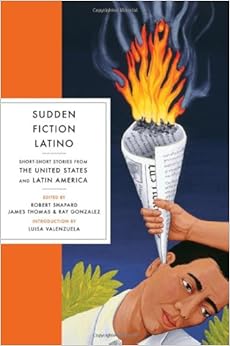
Sudden Fiction Latino: Short Short stories from the United States and Latin America


For Passages Academy it seems that Latino History Month and our ELA short story curricular unit are destined to occur at the same time each Fall. Thus, teachers seeking extremely short fiction, totalling about four pages or less, and stories with a connection to Latino/a history, may be interested in this volume.  Although many of the stories will not appeal to reluctant adolescent readers, short pieces by literary greats like Rudolfo Anaya (“The Native Lawyer”) and Gabriel Garica Marquez (“Light is Like Water”), may serve as a worthy introduction to these canonical authors.   “Day Ah Dallas Mare Toes,” by Luna Calderon, and “Counterfeit,” by Edmundo Paz Soldan, on the other hand, have a charm all their own and might just provoke meaningful discussion on themes of truth, deceit, family, and death and the role of names in literary texts and life.  This link from the publisher allows readers to view the entire table of contents, some of which are hyperlinked to permit previews of the text.  --Jessica Fenster-Sparber


Shapard, James Thomas and Ray Gonzalez (Eds.)  Sudden Latino Fiction:  Short-short stories form the United States and Latin America.  New York:  W. W. Norton & Company, 2010.

Monday, May 12, 2014

Mixed: Portraits of Multiracial Kids by Kip Fulbeck


This paperback volume containing arresting portraits of multiracial kids is picked up at least once a day in our library at Belmont.  Students pore over the small, matte images, regularly expressing their surprise and delight with the mixture lists, often the only text present in addition to the subject’s name.  Some of the portraits are accompanied by drawings done by the subjects themselves.  Occasionally, a portrait appears side-by-side with a quote from a parent about their child or thoughts on multiraciality.  These images and minimal text are bookended by an introduction from Fulbeck, a filmaker/photographer/spoken word performer/author, and a quote from Cher.  Adult readers may be interested in the foreword penned by Dr. Maya Soetoro-Ng, sister of President Barack Obama.  Student readers just go right to the portraits.  A great stress-free read for school libraries and conversation starter for teachers strategizing conversations on multiraciality. --Jessica Fenster-Sparber


Fulbeck, Kip.  Mixed: Portraits of Multiracial Kids.  San Francisco: Chronicle Books, 2010. Print.

Wednesday, September 18, 2013

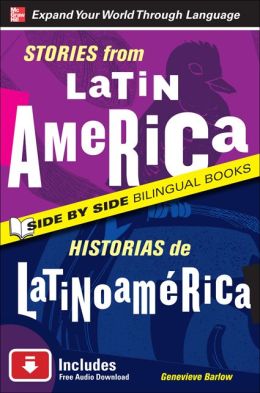
Stories from Latin America by Genevieve Barlow


This slim bilingual volume of sixteen folktales and legends spans thousands of years and ten countries.  From Columbia’s “Poor Fool!” - the story of haughty Don Ramiro’s amusing comeuppance - to Venezuela’s “The Empty Boat” - the tale of a man’s moral transformation - each story is written simply and elegantly, in language accessible to second language learners and developing readers.  The Spanish and English versions are presented side by side for easy back and forth comprehension checks and back matter includes thorough translated vocabulary lists.  Stories from Latin America also includes a map of Latin America and directions to accessing free MP3 audio recordings of four selected stories in Spanish. --Regan Schwartz

Barlow, Genevieve. Stories from Latin America. New York: McGraw-Hill, 2010. Print.


Thursday, September 12, 2013

Partly Cloudy: Poems of Love and Longing by Gary Soto


From the author of The Afterlife and Novio Boy, comes this small book of love poems written in the voices of teens.  The first half of Partly Cloudy is verse from a female perspective, including “Black Books,” about a young woman’s search for Mr. Not a Jerk, and “Obsession” which ends with the line, “Young lady, there’s a picture of a boy at the back of your retinas.”  In the second half, Soto explores young love from the male point of view.  In “Beautiful Trouble” a deacon’s son yearns for a red-lipped, bangle-clad bad girl.  “Driftwood” is a sad lament of rejection that makes poetry out of a frozen river.  The poetry is accessible and captures the vulnerability of eager young hearts, without conjuring up fiery passion or utter heartbreak.  Partly Cloudy is a good introduction to poetry for younger teens and tweens and well-suited to instructional use. --Regan Schwartz

Soto, Gary. Partly Cloudy: Poems of Love and Longing. New York: Houghton Mifflin Harcourt, 2009. Print.

Friday, September 28, 2012

Cesar Chavez: A Photographic Essay by Ilan Stavans


It is possible that there is another more perfect photograph in a library book for sharing with students when Yom Kippur, a holiday they may have never heard of, occurs smack-dab in the middle of Latino/a History Month, but on page 62 of Ilan Stavan’s Cesar Chavez: A Photographic Essay, there is a wonderful image for sparking students’ curiosity and wonderings.  Here is a picture of Cesar Chavez holding a shofar.  Why is Cesar Chavez holding a shofar?

Serendipitous events aside, this book is essential for readers who have yet to wonder or have just begun to ask the question Who was Cesar Chavez?  With a minimum of text, this volume is an invitation to consider the life of the six-year old boy, his eighth-grade graduation photo, the farmworkers and farm life he concerned himself with, and the battles he fought to establish the humanity and dignity of farm workers.  Highly recommended as a supplement to Steinbeck’s Grape of Wrath, Zola’s Germinal, or units of study on child labor, human rights, activism, civil rights, labor movements, and revolution.  This book will also be of interest to instructors searching for accessible photobiographies with social relevance which include a higher degree of text-complexity than usually accompanies so much white space. --Jessica Fenster-Sparber

Stavans, Ilan.  Cesar Chavez:  A Photographic Essay.  El Paso:  Cinco Puntos Press, 2010. Print.