Thursday, April 4, 2024
Programming Spotlight: Playwriting with the New Victory Theater
Friday, October 14, 2022
Che Guevara’s Face: How a Cuban Photographer’s Image Became a Cultural Icon by Danielle Smith-Llera
The author tells the story of Che’s famous photographic portrait in four chapters that draw the reader in by setting the scene in which the original photo was taken-- a memorial service for the 100 killed and 200 wounded by a 1960 explosion in Havana Harbor that destroyed a ship carrying grenades and munitions.
Using historical photographs as well as Korda’s photographic contact sheet from that day, author Smith-Llera provides context for this shocking and gruesome moment, inviting the reader to imagine the life of a photographer working in Havana at the time.
The author also includes a summary of Cuban history with many historical photographs, however other than Korda’s, the images are not credited within the text.--Jessica Fenster-Sparber
Smith-Llera, Danielle. Che Guevara’s Face: How a Cuban Photographer’s Image Became a Cultural Icon. Minnesota: Capstone, 2017.
Tuesday, June 18, 2019
Famous Ladies Vol. I-III by Alexandra Beguez
-->
Thursday, November 16, 2017
Programming Spotlight: Pre-theater and Post-Theater Visits from the New Victory Theater
![]() |
| Stepping during a pre-theater visit on 11/6/17. |
![]() |
| A gallery walk during a post-theater visit on 11/13/17. |
Wednesday, October 25, 2017
The Great Migration: An American Story Paintings by Jacob Lawrence
Wednesday, March 22, 2017
Programming Spotlight: Malcolm X & Julius Caesar
| New Victory Teaching Artists Janet Onyenuchea and Chad Beckim pose with students after a pre-theater workshop. Photo credit: Jessica Fenster-Sparber |
To get students ready to see X: Or, Betty Shabazz vs. The Nation in repertory with Shakespeare’s Julius Caesar, placement advisory classes have been reading Myers’ Malcolm X: By Any Means Necessary for the last two and a half weeks. Part of a larger interdisciplinary collaboration with Social Studies and Art teachers, and heavily supported by Belmont's speech and reading specialists, placement students at Belmont have approached the historical figure and his context with a variety of lenses. Last Monday, songwriter Janet Onyenuchea and playwright Chad Beckim deepened the unit of study further when they visited Belmont to conduct pre-theater workshops with all placement groups in their roles as teaching artists with the New Victory Theater. Chad and Janet engaged students’ growing base of knowledge of Malcolm X’s life and death and then invited students to create tableaux and portraying a variety of roles relating to the play they are rescheduled to attend at the end of the week. We can’t wait! --Jessica Fenster-Sparber
Monday, January 23, 2017
Programming Spotlight: Muhammad Ali at the New York Historical Society
Muhammad Ali training at Madison Square Garden, 1967
Chromogenic print from original scanned film
Courtesy George Kalinsky
Tuesday, December 23, 2014
Programming Spotlight: Bookmarks and Greeting Cards
Holidays can be difficult when one is separated from loved ones. With that in mind, we librarians have been collaborating with colleagues to offer crafting programs. These programs give students the opportunity to utilize library resources and art supplies to make custom bookmarks and greeting cards. Said C. (17), earlier this morning while crafting five original bookmarks, "I think, out of all of the activities, this is really dooooooope!" D. (15), is pictured above copying inspirational quotes out of a library book, for subsequent use on her bookmarks.
We wish you all happy holidays and hope you find your fair share of what's good to read in 2015! We'll see you in January.
Love, Passages Academy Libraries
Wednesday, November 19, 2014
DC Comics: The Ultimate Character Guide
Monday, June 23, 2014
Graffiti School: A Student Guide With Teacher’s Manual by Chris Ganter
Ganter, Chris. Graffiti School: A Student Guide with Teacher’s Manual. New York: Thames & Hudson, 2013. Print.
Wednesday, June 18, 2014
Before I Die by Candy Chang
Thursday, April 4, 2013
Steal Like an Artist: 10 Things Nobody Told You About Being Creative by Austin Kleon
Kleon, Austin. Steal Like an Artist:10 Things Nobody Told You About Being Creative. New York: Workman Publishing, 2012. Print.
Monday, March 11, 2013
Pavement Chalk Artist: The three dimensional drawings of Julian Beever by Julian Beever
There is nothing quite like 3D pavement art - those mind bending works of street art that, from just the right perspective, appear to leap off the sidewalk. In Pavement Chalk Artist, Julian Beever showcases over fifty of his own creations - often including himself and passersby in a creative, and often very amusing, tableau. Each photograph is accompanied by a brief description of the project, often including a bit of art instruction. In addition to the luscious, full-color photographs, the book contains a biographical introduction and a brief description of Beever’s anamorphic drawing technique. This is a captivating book of creative art, as well an in-depth look at one man’s artistic journey. Students pore over the pictures, often expressing disbelief at what they are seeing and eagerness to try it for themselves. Pavement Chalk Artist is would make excellent supplementary non-fiction reading for a unit on perspective or for a unit on media and advertising, as that is how Beever generates much of his sidewalk art income.--Regan Schwartz
Beever, Julian. Pavement Chalk Artist: The three dimensional drawings of Julian Beever. Buffalo, NY: Firefly Books, 2010. Print
Friday, November 18, 2011
Illustrations from the Inside by The Beat Within

Monday, November 14, 2011
Stan Lee's How to Draw Comics by Stan Lee

Wednesday, September 21, 2011
Programming Spotlight: Our first MoMA field trip of the school year!
Monday, March 28, 2011
Back in the Days by Jamel Shabazz

Shabazz, Jamel. Back in the Days. New York: powerHouse Books, 2001.
Monday, November 22, 2010
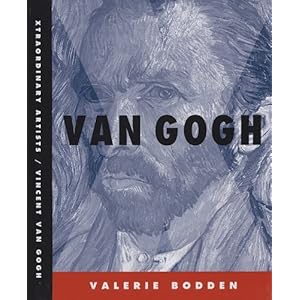
Vincent van Gogh by Valerie Bodden

He experienced life as an outcast, he shot himself, he died in relative obscurity, and one of his paintings recently sold for almost $82 million dollars. Hard not to be interested in this guy. Perhaps this is why Lauren Adelman, outreach educator at the Museum of Modern Art, chose to start her session in Bridges’ library last week with Vincent van Gogh’s Starry Night, a highlight of MoMA’s permanent collection. Whatever the reason, students were quickly captivated by the art-looking she facilitated and were subsequently eager to pore over this volume on van Gogh from the Xtraordinary Artists series. A short 48 pages with 25 full-color reproductions and studies of van Gogh’s art, this book is approachable and full of information to start students on an inquiry project. The author has thoughtfully included several excerpts from van Gogh’s numerous letters so that the reader can encounter the painter in his own (albeit translated) words. Endnotes contain a one-page timeline, a one-page glossary, an index and a bibliography.
Click here to read Tupac’s Starry Night. Connection made by Passages’ student Avian M.
Bodden, Valerie. Vincent van Gogh. Mankato: Creative Education, 2009.
Tuesday, September 28, 2010
Guest Blog Post: Jeff Wall by Peter Galassi

My visits to Passages classrooms usually progress along the following lines: Firstly, we start with an introduction, discussing our own artistic interests and backgrounds. About half the students say they aren’t artistic at all or interested in any sort of art making and, even when we expand upon our definition of what art is (culinary arts, martial arts, graffiti, tattooing, etc.), there are still a number of teens who don’t want to admit to any feelings on the subject at all. No problem, it’s understandable: Art is subjective, and emotional, and demands that those who create it lay their feelings on the table for others to possibly reject. It’s scary. After that, we start looking at art and the teens start opening up, even if only slightly. It’s easier to have an opinion on someone else’s work than to talk about ourselves, so the discussion begins to flow. We talk about Frida Kahlo’s thick eyebrows, Picasso’s pregnant looking girlfriend, and how super painfully skinny Andrew Wyeth’s Christina looks from the back. At the very end of all this, I like to pull out my reproduction of Jeff Wall’s After “Invisible Man” by Ralph Ellison, the Prologue (1999-2000). The image depicts an African-American man, an actor posing as the narrator of Ellison’s book, sitting in his cluttered basement apartment, listening to a record as he cleans a dish. Above him, thousands of light bulbs shine down against his back. What’s he thinking? Why is he there? Why does his room look like it does?
I love the mixture of the mundane and the fantastical in Jeff Wall’s work. If each picture tells a story, then Jeff Wall’s stories are mystery novels. You recognize the world that his subjects inhabit as our own, and yet they feel like nothing you have seen and nowhere you have ever been before. Jeff Wall’s photography book is a great prompt for creative writing projects, discussions, art making and more. I wholeheartedly recommend it to all Passages Academy educators. -- Calder Zwicky
--Calder Zwicky is the Associate Educator, Teen and Community Programs at the Museum of Modern Art. He has been working within Juvenile Detention Centers and running art making workshops with Passages Academy students since 2007.
Galassi, Peter. Jeff Wall. New York: Museum of Modern Art, 2007.