Showing posts with label lesson plan. Show all posts

Thursday, May 28, 2015

The Great American Cereal Book: How Breakfast Got Its Crunch by Marty Gitlin and Topher Ellis


What is your favorite kind of cereal?  The Great American Cereal Book documents this quintessentially American invention from its very first ready-to-eat cold and boxed appearance in 1863 (Granula) through the present, with a focus on varieties produced by Kellogg’s, Post, General Mills, and their ilk.  Most cereal entries contain the name of the cereal, its producer, the start and end date of production, notable spokescharacters, and interesting facts.  The more familiar (Cheerios, Rice Krispies, Frosted Flakes) are all here along with the obscure (Freakies, Quisps, Klondike Pete’s Crunchy Nuggets, Barbie Fairytopia.)  Occasional features are sprinkled throughout on topics like Marbits (freeze-dried marshmallows found in cereals like Lucky Charms), the origins of Rice Krispie Treats, and The Trix Rabbit Story.  Whether browsing the images of the boxes or reading the features, this volume offers a rich source of advertising examples and stories for analysis and will appeal to students and their teachers immersed in introductions to media studies.  Backmatter includes acknowledgements, credits, and an index, and information about the authors and photographers. --Jessica Fenster-Sparber


Gitlin, Marty and Topher Ellis.  The Great American Cereal Book:  How Breakfast Got Its Crunch.  New York: Abrams Image, 2011.

Click here and here
for examples of a lesson plan inviting students to create their own cereals and advertisements and to analyze the nutritional value of different cereals. 

Thursday, December 11, 2014

Adventure Time Vol. 1 by Ryan North


A hapless snail has freed the evil Lich from his bag of holding and he is on a mission to destroy everyone and everything in the Land of Ooo.  It is up to Finn and his best friend Jake the magical dog, with the help of their friends, to defeat the Lich and save Ooo.  If you’ve never seen an episode of Adventure Time, the previous sentences may have sounded like gibberish, but fans of the popular television cartoon series will enjoy seeing it brought so faithfully to comic book form.  The art and dialogue are full of lively action, nonsense humor, and wordplay.  Adventure Time is a vibrant option for readers looking for humorous comics and offers a welcome entry point to the format for those turned off by mainstream superhero comics. --Regan Schwartz

Click here for an ELA lesson plan from Diamond Bookshelf.

North, Ryan. Adventure Time Vol. 1. Los Angeles: KaBoom!, 2013. Print.

Wednesday, December 3, 2014

Scholastic Ultimate Guide to Football by James Buckley Jr.


Scholastic Ultimate Guide to Football by James Buckley Jr.

Did you know that passing was not allowed in American football until 1906?  Taking an informal tone, Buckley’s Guide mixes history, random facts, statistics, photographs, and cartoonish drawings to provide an introduction to America’s most popular sport.  Assuming some prior knowledge of the game, the Guide alternates between informational pages on each of the National Football League’s 32 teams and features on football trivia like superstitious practices used by NFL players, regrettable quotes and actions from NFL coaches, classic referee signals currently in use, and touchdown heroes.  Each team’s two-page spread includes the year the team formed, a highlight and low point for the team, their home venue, number of Superbowls won, best seasons and additional team facts.  Backmatter includes a few additional print and web-based resources for information on American football and an index.  Teens may not appreciate Buckley’s corny jokes, but those with an interest in broadening the scope of their knowledge of the sport will be glad to have so much information in one lightweight volume. --Jessica Fenster-Sparber

Buckely Jr., James.  Scholastic Ultimate Guide to Football. Santa Barbara: Shoreline Publishing, 2010.  Print.

Click here for a link to Edutopia's lesson plans for a variety of subject areas incorporating American football.

Monday, December 1, 2014

Why Are We Still Getting HIV? Teens Respond to the AIDS Epidemic Edited by Laura Longhine


35.3 million people are living with HIV around the world, according to UNAIDS, cited on HIVaware.org.uk.  35.3 million.  Asking anyone to contemplate the size of that number is a challenge, and Youth Communication’s Why Are We Still Getting HIV? offers numerous angles from which teachers, parents, and other youth workers (including peer educators) can approach the topic through interviews and personal narratives.  This collection includes both anonymous and credited teen authors’ perspectives on HIV, ranging from what it’s like to go for a first HIV test (“What If…” by Anonymous), to having a peer or adult share their positive status (“Saying Goodbye to Uncle Nick,” by Josbeth Lebron, “A Sad Silence,*” by Desiree Guery), to receiving notification of one’s own HIV positive status (“Date with Destiny” by Anonymous,) as well as dealing with a loved one dying from AIDS (My Uncle Died of AIDS” by Anonymous), and living a long life while HIV positive (“All Too Real: Teens Living with HIV*” by NYC Writers and “Twenty Years Living Positive” interview with Dave Nisbett.)  Back matter includes separate notes to teens and staff trainers as well as a discussion guide for teachers and staff on how to use the book effectively.  While the writing varies in style and tone, it is generally very accessible to teens who are reading proficiently and a worthwhile resource in spite of the fact that there have been some significant updates to the American conversation taking place around AIDS since many of these stories were written. --Jessica Fenster-Sparber


*These two stories are available for free in full-text and with lesson plans provided by YC Teen.


Longhine, Laura (Ed.)  Why Are We Still Getting HIV? Teens Respond to the AIDS Epidemic.  New York: Youth Communication, 2010.  Print.

Tuesday, November 25, 2014

The Harlem Hellfighters by Max Brooks, Illustrated by Caanan White


103 years ago African Americans in New York could not simply join up as soldiers in the Federal military. When African American men were finally able to establish an infantry unit, they had to do so within the disrespectful confines of segregation.  The Harlem Hellfighters is the story of Harlem’s highly-decorated trail-blazing unit as told by Max Brooks.  In his author’s note, Brooks explains his personal relationship to this lesser-known part of World War I history and his quest to bring it to light, first through a screenplay and now, here, as a graphic novel with detailed black and white illustrations by Caanan White.  More sophisticated readers will be better equipped to undertake the work of fitting together all of the pieces of the story and tracking characters.  The minimal text (usually less than five sentences per page), however, makes this a useful one for literacy instruction on comprehension strategies for older readers working with ELA teachers, reading specialists, or in pairs of peers. 

Here is a social studies lesson plan created by Thomas Malcolm for eighth graders in 1997.  It does not include Brooks' text, but may be of interest to educators nonetheless.  Here are documentary photographs of the Hellfighters, some of which Brooks includes in his backmatter.  --Jessica Fenster-Sparber


Brooks, Max.  Illustrated by Caanan White.  The Harlem Hellfighters.  New York: Broadway Books, 2014. Print.

N.B. At the time of this writing, Passages' libraries do not yet own a copy of The Harlem Hellfighters.  The copy reviewed for this post was lent to us via the MyLibraryNYC pilot program.  Thank you, MyLibraryNYC! 

Tuesday, October 28, 2014

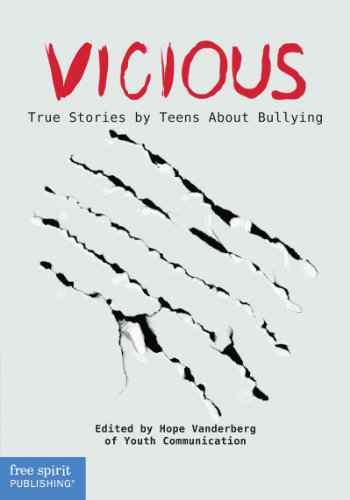
Vicious: True Stories by Teens About Bullying


Vicious: True Stories by Teens About Bullying Edited by Hope Vanderberg

Bullying seems to be a universal experience to the students I’ve gotten to know where I work.  Whether they’ve been bullied, been a bully, or been a bystander, the topic is never unfamiliar.  This collection of writings from teenagers and young adults will let any reader who has experienced bullying know that he or she is not alone.  One of the collection’s strengths is its authenticity; these are the true voices and experiences of contemporary survivors.  The stories are accessible to developing teen readers and their brevity may appeal to both student readers and their teachers.  Recommended for independent reading for teens and educators looking for short stories addressing bullying.  Diverse sub-themes include sexual harassment (“Can I Holla Atcha” by Allajah Young”), LGBTQ (“Gay on the Block” by Jeremiyah Spears and “A Place to Belong” by Lavell Pride), the immigrant experience (“I Showed My Enemies-- and Hurt My Friends, Too” by Elie Elius), and multiple perspectives from foster homes, treatment centers, and residential facilities (like “Standing My Ground” by Xavier Reyes).--Jessica Fenster-Sparber

Vanderberg, Hope (editor).  Vicious: True Stories by Teens About Bullying.  Minneapolis: Free Spirit Publishing, 2012.

Youth Communication provides assorted stories from this collection (and more) on the topic of bullying here.  Titles displaying an apple icon include lesson plan and discussion ideas for teachers.

Monday, September 23, 2013

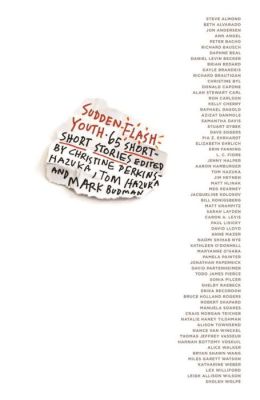
Sudden Flash Youth: 65 Short Short Stories Edited by Christine Perkins Hazuka, Tom Hazuka, and Mark Budman


In need of a short story? An extremely short story?  Check out Sudden Flash Youth.  65 short short stories—none of them longer than four pages— is a worthwhile place to start looking for the shortest fiction that is closer to the “highly sophisticated” end of the text complexity spectrum.  Readers with a preference for an urban voice can go straight to “A Whole Other,” which deftly reveals the differences between what we think and what we say and do.  Those who enjoy the Twist anthologies can  check out “Little Brother ™,” by Bruce Holland Rogers.  Readers in search of  literary experiments may enjoy Voskuil’s eerie “Currents.”  Coming of age themes abound, notably relevant for LGBTQ youth in Konigsberg’s “After” and Soares’ “Haircut.”   Other noteworthy shorts include Hazuka’s “Homeward Bound,” and Dagolds’ fable “The Two Rats and the BB Gun.” Strongly recommended for English Language Arts teachers seeking a fresh crop of very short stories to share with their students. –Jessica Fenster-Sparber

Perkins-Hazuka, Christine, Tom Hazuka and Mark Budman.  Sudden Flash Youth:  65 Short Short Stories.  New York: Persea Books, 2011.  Print.


Click here to view the table of contents and read “Currents.”  Click here to view the publisher’s lesson plan for “Currents.”