Showing posts with label guest blogger. Show all posts

Friday, April 30, 2021

Guest Post: I Could Pee on This and Other Poems by Cats by Francesco Marciuliano


I Could Pee on This and Other Poems by Cats offers us a sweet, humorous, and rather  bold look at how cats view their interactions with us humans and with the world around them.  I personally enjoyed the obnoxious "Man's Best Friend" and the adorable "Cute Bed Jump.”   But it’s the title poem that for me seals the deal and blows my mind as I imagine cats actually having those thoughts. 

Readers of all ages will find enjoyment between the covers of this book,  and educators will find the poems,  with their use of humor and irony,  an excellent way 

to engage students -   even those struggling  with literacy - in writing poems of their own. --E. Latham


Guest Blogger E. Latham currently teaches at Passages Academy.

Thursday, September 28, 2017

Guest Post: The Sounds of My Village by Ishmael Beah

Ishmael Beah by Sarah Stacke.  Image from www.themoth.org

Best known for his experiences as a child soldier in the memoir A Long Way Gone, Ishmael Beah’s pre-war childhood in a rural village of Sierra Leone deserves as much attention. This story is an audio recording of Beah’s performance for The Moth, a group which organizes live storytelling events worldwide. In recounting his upbringing, Beah pays homage to his community and its traditions.


When he was nine, Beah’s grandmother told him that “each person’s mind is their own personal library, and as life breathes its moments before you, those moments become memories, and those memories become narratives [...] that you put on a shelf in your own personal library.”  Inspired by her words to create his own rich narrative, Beah inscribes the rhythms of his village in his mind: the morning cry of the birds, the evening communal meal, and the elders’ nightly stories. With tenderness and humor, Beah narrates how his life, once anchored by the warmth of tradition, is torn apart by the unending impact of war. He draws attention to how each victim’s death is the loss of a storyteller and intimates that war does not just destroy the individual but wipes out the collective memory of a culture. War creates a past without storytellers, a tradition without practitioners, and survivors without access to the narratives they need to understand their place in civilization. This story provides an engaging introduction to Beah’s memoir and implants the idea that a young adult’s life is rich enough to compose a personal library.


While this story, suitable for students ages 9 and up, is easily accessible to English speakers, Beah’s dialect may require additional support and scaffolding to aid students in their understanding.


You can access “The Sounds of My Village” here on The Moth’s website. --Esther Kau

Esther Kau currently teaches middle school English in New Jersey. Her current roster of books include Garth Greenwall’s What Belongs to You, her daughter’s favorite, Ben Clanton’s Narwhal: Unicorn of the Sea, and her son’s favorite, Steve Light’s Cars Go.

Monday, March 28, 2016

Words Unlocked Guest Blog Post


With National Poetry Month just a few days away, I’m already full with anticipation as teachers across the country prepare to embark on Words Unlocked 2016! I imagine the conversations young people will have with one another, the understandings they will dis-cover, and the connections they will make in places most people will never truly know. Words Unlocked is designed with young people held in secure, locked facilities and their teachers. The Words Unlocked website is packed with free resources including downloadable lesson plans, student handouts, poetry resources, and how-to guides. My favorite resources by far are the Words Unlocked Anthologies. These collections give all who venture in a glimpse into the hearts and minds of our young people held in confinement. 
 
words unlocked evolve
glimpses into times of change
pause, transformation

Last year’s theme was transformation. Words Unlocked 2015 Focus Poet and Lead Reviewing Artist, Jimmy Santiago Baca, had this to say about the poems he read:

“You hear their lives and feel their faces and you want to sometimes hold them and protect them from the cruelty and injustice in our world, and you can.”

Experiencing poetry, whether through reading or listening, unlocks words once held by others and allows us a doorway into worlds beyond our physical reach. Just this morning I was watching Words Unlocked 2016 Focus Poet and Reviewing Artist, Donté Clark, perform his piece, "Let Me Breathe” imagining the faces of thousands of young people captivated by his words and sharing an experience.

The theme for Words Unlocked 2016 is interconnectedness. We each interact with one another, making understanding impossible if we are simply considered alone. What bold truths will our young people share about being mutually connected—to others, to communities, to systems, to the world? Words Unlocked assures that bold truths permeate facility walls and travel into the consciousness of those of us living our lives on the outside. As Jimmy Baca wrote “...you can.” Listen to the words of our young people. How might they move you into action?--Christy Sampson-Kelly

Christy Sampson-Kelly is a tireless advocate for a particularly vulnerable group of young people—those with special needs held in locked juvenile and adult facilities. She is also the author of reMembering Mulatta, a book of poetry that exposes her journey through the lived experience of being neither this nor that as a woman of mixed ancestry. She currently serves as the Director of Practitioner Support at CEEAS, leads Words Unlocked, and provides direct coaching to schools in the areas of curriculum, instruction, assessment, and student engagement.

Monday, March 10, 2014

Thirteen Reasons Why by Jay Asher


High school student Hannah Baker has committed suicide, and protagonist Clay is trying to discover why via thirteen cassette tapes Hannah recorded prior to her death.  Each tape incriminates another person at the school, explaining how that person played a part in Hannah’s suicide.  Hannah makes it clear from the first tape that if you received the tapes, it means there is one about you—and Clay has no idea why he received them. Inspired by museum audio-tours, one unique feature of the novel is the inclusion of a map that goes along with the tapes, marking the locations where Hannah’s stories occurred.  Another unique and impressive component is the structure of the novel: Hannah and Clay’s point of views are woven together throughout the storyline, so that the reader has access to Clay’s immediate reactions after hearing Hannah’s stories.  Exploring themes of sexual abuse, bullying, and teen relationships, this novel is recommended for high school students, specifically females as Hannah focuses on many painful situations that young women may face.--Mackenzie Magee

Asher, Jay. Thirteen Reasons Why. New York: Penguin Group, 2007.  Print.

Mackenzie Magee is a first year ELA teacher at Passages Academy-Belmont. She grew up in Portland, Oregon and enjoys writing, running, and reading. Her favorite books include The Brothers Karamazov by Fyodor Dostoevsky and Of Human Bondage by Somerset Maugham.

Thursday, February 13, 2014

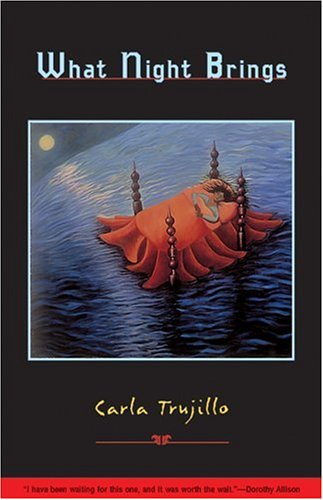
What Night Brings by Carla Trujillo


Marci Cruz, 11, is determined, sincere, and funny without meaning to be.  She speaks Spanglish sometimes and makes up her own terms for sex stuff.  Like many kids, she notices how the community treats people who are different and people who ask questions that no one wants to answer.   

Marci and her younger sister, Corin, get frequent beatings from their father.  Their mother is aware, but is blind to his faults.  Marci prays to god to get her father out of her life forever.  She doesn’t go as far as wanting her dad to be dead because she doesn’t want god to think badly of her.  She needs god's help to change her into a boy, which she believes will allow her to live out her attraction to girls.
Although the well-described beatings continue and helpful adults seem to be missing, all is not hopeless. The two girls, Marci and Corin, work together on inventive ways to help their mother come to her senses about their dad.   Marci also manages to get to the library, make a garden, and have a crush.--Joy Ferguson

Joy Ferguson has worked with detained youth as both an outreach librarian and a facility staff member.  She currently serves students as a school librarian  at PS 261 Phillip Livingston School.

Monday, September 9, 2013

Welcome back + a Fabulous List


Welcome back!  

And to those of you who never went away, it’s nice to see you again.  Today is the first day of our students’ new school year and we are excited to tell you about the books we’ve been reading.  Before we get started, though, we’d like to share with you a list we’ve all been waiting for:  Andrea Swenson’s recommended titles for NYC LGBTQ youth and their allies.  Andrea recently shared on our NYC listserv that she created this list in conjunction with a Collaborative Collection Development Grant she received for books related to and for the LGBTQ students and allies in our communities.  In her own words:

My lists have some very specific goals:  they are meant to go in NYC urban public school libraries; they are meant to be appealing to as many students as possible students, GLBTQ or allies; they need to fit a wide range of reading levels; and they need to be easily purchased from a library vendor.  I will be leaving off some award-winners, either to provide diversity of characters, or because I don’t think they’re as appealing as some other books.  I reached out to experts around the country and in New York City for advice & suggestions.  I know that making lists is always challenging, so I don’t expect to please everyone!”  

If you don’t know Andrea, please allow me to tell you that her school library is a true sanctuary for LGBTQ youth; a beacon and model for the rest of us.  Without further ado, here it is!
--Jessica Fenster-Sparber


Monday, June 10, 2013

Guest post: Chulito: A Novel by Charles Rice-Gonzalez and Street Dreams by Tama Wise


Chulito’s been best friends with Carlos since they were 5, but Carlos goes away to college, while Chulito runs for the local Hunts Point dealer, Kamikaze, and has dropped out of school. When Chulito and Carlos reconnect, Chulito realizes that his feelings for his friend may be deeper than he's ready to admit. This book is full of sex, drugs and real life on the streets of the Bronx, but it’s also a story about betrayal, loyalty, choosing love and not losing everything. Only collections that include other adult urban fiction books will find this book appropriate, but it’s high-quality writing, and shows men being tough and truly loving at the same time. Librarians andteachers looking for a more school-appropriate book should get Street Dreams, by Tama Wise. Set in urban New Zealand, it has some unfamiliar local vocabulary, but is for every fan of hip-hop, graffiti, and breakdancing. Tyson, the main character, falls in with a local crew of rappers and graffiti artists and falls for their promoter, Marc. Will he be able to connect with him without alienating the leader of the crew, Seige, and his best friend? One or both of these books should be included in any high school library collection--GLBTQ students need to see themselves in urban lit.  -- Andrea Swenson

Rice-Gonzalez, Charles. Chulito: a Novel. New York: Magnus Books, 2011. Print.


Wise, Tama. Street Dreams. Valley Falls: Bold Strokes Books, 2012. Print.


Andrea Swenson is the school media specialist at East Side Community, a 6-12th grade public school in New York City. She loves to talk about books (no surprise!).  Andrea was recently recognized for her work with the chemistry teacher at East Side by the American Chemical Society Committee on Environmental Improvement for incorporation of sustainability into chemistry education.

Andrea is curating a list of books with LGBTQ characters, themes and issues that are recommended for middle and high schools in New York City. You can find her lists and links here.

Wednesday, August 15, 2012

Guest Post: American Born Chinese by Gene Luen Yang


A 3-in-1 graphic novel, American Born Chinese intertwines three narratives that converge to reveal the author’s message of self-acceptance.

The first narrative revolves around Jin Wang, the only Chinese-American student in his high school.  He is bullied and lonely and in love with beautiful, blonde Amelia Harris.  All of a sudden, his life changes when a Chinese boy moves to town with his family.  Jin now has a friend, but accepts Wei-Chen’s friendship begrudgingly, since he would only cast greater light on Jin’s own other-ness.

The second narrative is based on a traditional Chinese fable: the story of the Monkey King.  Pompous and stubborn, the Monkey King wishes to raise from the status of king to that of a god.  He trains and becomes seemingly invincible.  Tze-Yo-Tzuh, the creator of all existence, takes umbrage at the Monkey Kings arrogance and traps him under an immense pile of boulders where he remains for a long time.

The final narrative is that of Danny, a popular, blond, all-American teenager.  The only atypical thing about Danny is his cousin, Chin-Kee, whose name is a play on a slur.  Chin-Kee is a cultural stereotype brought to life.  From the illustration which brings to mind propaganda posters of the ‘40s to the way he speaks in broken and accented English, Chin-Kee is the embodiment of all that embarrasses Danny and does so to such an extent that Danny is forced to transfer schools every year after Chin-Kee’s annual visit.

Each of the protagonists is struggling to discover how he can be accepted and content, while still being a part of his own culture.  At the end, the stories converge and each realizes that the key to happiness is in self-acceptance.  Each has his own role in life, and, by embracing that role, he will be satisfied.  Yang incorporates both visual and written humor, cultural traditions, and honest expression of emotion to fuse together this compelling and complex, yet very understandable, graphic novel.  --Julie Weber


Guest blogger Julie Weber currently teaches at Passages Academy.

Tuesday, June 19, 2012

Guest Post: Feed by MT Anderson


Imagine a world where you don't need a computer to get onto the Internet. You're always on, because it is wired directly into your brain; this is the world of Feed by MT Anderson. Feed is set in a not-too distant future where going to the Moon is as easy as going downtown and where almost everyone has the Feed installed into their brains at birth.

The Feed is like having Facebook and Google Instant Messenger just by thinking about it. Don’t know what to buy? The Feed will tell you. Don’t know what to wear? The Feed will tell you. Don’t know what to say? The Feed will tell you.

This makes school pretty much a joke. You can look up anything you don’t know on the feed, so you really don’t need to study.

This is the world where Titus lives. He’s a 15 year old, bored, and looking for fun. He and his friends take a trip to the Moon for the weekend, but the moon turns out to totally suck...until he meets Violet.

Violet isn’t like anyone he’s ever met before. She didn’t have the Feed installed until she was older, so she can think for herself. She doesn’t just buy what the feed tells her is cool or use the slang the Feed tells her everyone is using. She asks questions that the Feed doesn’t want her to ask. Like why is the rest of the world so angry at us? Why am I only a good person if I buy things? And what is causing these strange, bloody, oozing, pussy lesions that everyone is getting on their bodies?

As Titus talks to Violet at a club on the moon, a hacker breaks into the Feed and hijacks their minds. The police beat him down, call him a terrorist, but Titus can’t shake the feeling that something is wrong. It’s not just in his mind. Something has gone wrong with his Feed, and it looks like it might destroy him and Violet unless he can resist it.

But how do you fight your mind? How do you break out of the insanity that everyone around you thinks is normal? How do you save the girl you love from a world that wants to destroy her, and you, with it if you won’t obey.

Welcome to the Feed.

Fans of Scott Westerfeld's Uglies series and readers who have enjoyed The Maze Runner trilogy by James Dashner will find a lot to like in FEED. It's funny, exciting, and unforgettable. While the dystopian universe isn't nearly as violent as the world in Suzanne Collins' The Hunger Games, it is in a way far scarier: it looks an awful lot like our own. I definitely recommend this book for anyone who's ever looked around and wondered if all our phones and gadgets are actually controlling us. --C. Alexander London

Guest blogger Mr. London is an acclaimed author of middle grade fiction and adult nonfiction.  Find out more at http://www.calexanderlondon.com/

Thursday, September 23, 2010

Guest Blog Post: Speak by Laurie Halse Anderson


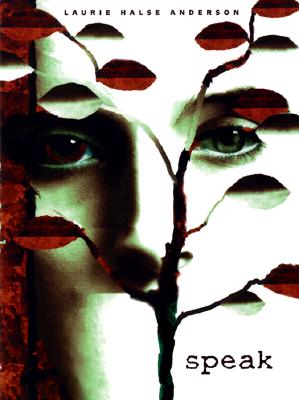
The implicit accusation that I would bring pornography into my classroom offends me to my core. Melinda, the protagonist of this brilliantly funny and poignant young adult novel, was raped by Andy, a popular upperclassman athlete, the summer before her freshman year in high school; the scene is brief and non-explicit, but visceral. Melinda is then ostracized and becomes both mute and reclusive, expressing herself through her year-long artproject- creating trees out of various media- until she gains the strength to confront her rapist, very loudly. I have taught Speak in my mixed junior high/high school English/Language Arts class and every student- from the shyest, Melinda-est girl to the most aggressive, Andy-est boy- loved it. We completed Melinda's art assignments with her, each of us - myself included- taking an object and drawing it from a new perspective and with new purpose each day before we began our official lessons. As Melinda grew with her tree, so did our class grow with Melinda. Each student, though hesitant to do so at first, came to love sharing his or her literary/art journal with the rest of the class; some even wrote accompanying free-write entries explaining how Melinda's ordeal helped them begin to process injustices they or their loved ones may have experienced. After we finished the novel and our projects, all of the students wrote ebullient letters of thanks to our DonorsChoose benefactors for enabling us to complete this educational unit by providing us with a classsroom set of this title. -- Julia Weber

Guest blogger Julia Weber is an English teacher at Passages Academy's Boys Town site. You can find teaching resources for Speak here.

Friday, December 4, 2009

Guest Blog Post: Where'd You Get Those by Bobbito Garcia


Where’d You Get Those? is Bobbito Garcia’s sociological thesis on sneakers. Part history, part fashion, this oversized volume details New York City sneaker culture from 1960-1987. The 264-page magazine style book is organized chronologically by era. Each section is rich with lively anecdotes, photographs (mostly taken by Mr. Garcia) and vintage advertisements of the times. Mr. Garcia’s writing is an exemplar of voice, cultural capital, and the many journalistic functions of literacy. His book can be used as supplemental text in English, Literacy, Creative writing, Gym and Art classes. Where’d You Get Those? also makes a great addition to a classroom library during independent reading time. --L.A. Gabay