Tuesday, November 25, 2014

The Harlem Hellfighters by Max Brooks, Illustrated by Caanan White


103 years ago African Americans in New York could not simply join up as soldiers in the Federal military. When African American men were finally able to establish an infantry unit, they had to do so within the disrespectful confines of segregation.  The Harlem Hellfighters is the story of Harlem’s highly-decorated trail-blazing unit as told by Max Brooks.  In his author’s note, Brooks explains his personal relationship to this lesser-known part of World War I history and his quest to bring it to light, first through a screenplay and now, here, as a graphic novel with detailed black and white illustrations by Caanan White.  More sophisticated readers will be better equipped to undertake the work of fitting together all of the pieces of the story and tracking characters.  The minimal text (usually less than five sentences per page), however, makes this a useful one for literacy instruction on comprehension strategies for older readers working with ELA teachers, reading specialists, or in pairs of peers. 

Here is a social studies lesson plan created by Thomas Malcolm for eighth graders in 1997.  It does not include Brooks' text, but may be of interest to educators nonetheless.  Here are documentary photographs of the Hellfighters, some of which Brooks includes in his backmatter.  --Jessica Fenster-Sparber


Brooks, Max.  Illustrated by Caanan White.  The Harlem Hellfighters.  New York: Broadway Books, 2014. Print.

N.B. At the time of this writing, Passages' libraries do not yet own a copy of The Harlem Hellfighters.  The copy reviewed for this post was lent to us via the MyLibraryNYC pilot program.  Thank you, MyLibraryNYC! 

Monday, November 24, 2014

Volcano: Iceland’s Inferno and the Earth’s Most Active Volcanoes edited by Ellen J. Prager


There is little on earth to rival the sheer majesty and destruction of a volcano.  They are a fact of life for so many people (did you know that 1 in 12 people live in an active volcano zone?), yet  for many of our students they are only the stuff of history books and remote news reports.  Volcano brings their power, danger, and beauty to brilliant life on every page.  Beginning with an overview of the geology of volcanoes, the text is organized geographically, highlighting major volcanoes from each region.  The one-page history on each volcano is accompanied by a sidebar listing brief facts and pages of dynamic, full-color photographs with informative captions depicting both the volcano and the people living in its shadow.  Backmatter includes sources and credits.  While the text recommends the book to confident readers, the high-interest subject matter, photographs, and large-font quotes make it a popular choice for anyone interested in natural disasters.--Regan Schwartz

Prager, Ellen, ed. Volcano: Iceland’s Inferno and the Earth’s Most Active Volcanoes. Washington DC: National Geographic, 2010. Print.

Thursday, November 20, 2014

The Wolf Almanac by Robert H. Busch


Stunning photographs liberally illustrate The Wolf Almanac, a detailed and well-researched overview of all things wolf - from their biology and behavior to folklore, from big game hunting to zoos and conservation.  The text is a bit dense, but makes judicious use of maps, charts, and graphs to present scientific information and a thorough table of contents and index allow the reader to pinpoint the information they are looking for.  With a thorough bibliography and list of wolf conservation organizations rounding out the back matter, this title is ideally suited to student inquiry. --Regan Schwartz

Busch, Robert H. Wolf Almanac, New and Revised: A Celebration Of Wolves And Their World.  Guilford, CT: Lyons Press, 2007. Print.

Wednesday, November 19, 2014

DC Comics: The Ultimate Character Guide


Can you tell the difference between The Green Lantern and The Green Arrow, or Mister Terrific and Mister Mxyzptlk?  You may be in need of DC Comics: The Ultimate Character Guide.  This handy volume is extremely popular at our Belmont site where teens and adults alike are eager to expand their DC comics lexicon.  Prefaced by the shortest of introductions and a table of contents, over 200 heroes and villains from “the DC Universe” are listed and then presented in alphabetical order, beginning with Adam Strange and ending with Zoom.  Each character or group receives its own page.  Layout consistently features the character’s name, a one to three sentence summary of the character, vital stats (real name, occupation, height, weight, base, allies and foes), and boxed text describing the character’s powers.  The best-loved element are the accompanying illustrations, although they are only credited in the back as part of a mass “artists credits,” which is, in fact, the only backmatter.  Perfect for comic book fans, developing readers, and developing schema, this book may also be of interest to educators looking for a hi-lo non-fiction text for an introductory lesson on features of informational text and the sub-genre of visually busy non-fiction that DK practically invented. --Jessica Fenster-Sparber

Snider, Brandon T.   DC Comics: The Ultimate Character Guide.  New York:  DK Publishing, 2011.  Print.

Friday, November 7, 2014

Programming Spotlight: Torrey Maldonado


Middle school students at Bronx Hope met author Torrey Maldonado yesterday and were captivated by his charm, his energy and his childhood stories. For the last three weeks, they read his book Secret Saturdays and prepared for his visit. All of them were quick to point out the similarities between the author's real life and his novel. Thanks for making such a memorable experience for our students, Torrey!  --Anja Kennedy

Wednesday, November 5, 2014

Taking Flight by Michaela DePrince with Elaine DePrinc


From eighteen year-old Michaela DePrince comes a memoir which will be of interest to students seeking true stories of survival and triumph.  The DePrince co-authors (mother and daughter) use simple and accessible language to tell Michaela’s tale of her early life in Sierra Leone during the country’s violent conflict.  Orphaned at age three and adopted by the American DePrince family at age four, Michaela relays what she can remember about her experiences as a bright little girl, her biological parents’ only child, born with vitiligo and a precocious ability with languages.  That little girl survived abuse as an orphan, and her memoir spends a fair amount of time narrating her difficult early years and her incredible survival and adjustment to life in the United States.  Readers will be heartened as they follow Michaela’s pursuit of her dream to become a professional ballet dancer and interested to learn about the challenges and obstacles she has overcome and those she still faces dancing in the U.S. (she is currently pursuing her dreams in Europe).  Social Studies teachers may find the initial chapters of the book a useful supplement in its firsthand account of a child’s experience during Sierra Leone’s civil war.  Recommended for independent reading for middle school girls. --Jessica Fenster-Sparber

Discover an interview with the co-authors published in Justine Magazine here.  (Thank you, Regan!)  Read an excerpt published in Teen Vogue here.

DePrince, Michaela and Elaine DePrince.  Taking Flight.  New York: Random House, 2014. Print.

Monday, November 3, 2014

Halloween Programming Spotlight


Raawwwr!  Papertoy Monsters came to life inside three of our libraries last week at Crossroads on Monday and at Horizon and Belmont on Friday. Said one student at Belmont, "I'm nice at this!  I'm gonna make a million monsters!"  At Bronx Hope, students made Halloween-themed bookmarks. Hope you all had Happy Halloweens!

Thursday, October 30, 2014

Bootleg: Murder, Moonshine, and the Lawless Years of Prohibition by Karen Blumenthal


While almost all of our students know what the word “bootleg” means in contemporary slang, few, if any, know of prohibition, the eighteenth amendment, or that Al Capone was born in Brooklyn.  This engaging narrative history begins in 1875 with the birth of Morris Sheppard, later known as The Grandfather of Prohibition, and takes the reader through American history, highlighting key figures in the story like Carrie Nation (Chapter 3), the notorious bar smasher, Al Capone (Chapter 8), infamous gangster, and ending with MADD and Red Ribbon Week.  Throughout, Blumenthal refrains from any final judgement on the “wets” and the “drys,” focusing on the dual messages that “each of us is responsible for our own behavior” and that “the experience of prohibition continues to color our laws, our debates and our personal lives.”  Rich backmatter includes a glossary, discussion questions from the author, an interview with the author, additional resources, source notes, acknowledgements and an index.  Recommended for independent reading, as a teaching text for non-fiction ELA units, an enrichment text for American history, and even a book club. .--Jessica Fenster-Sparber

Blumenthal, Karen.  Bootleg:  Murder, Moonshine, and the Lawless Years of Prohibition.  New York: Roaring Brook Press, 2011.

Wednesday, October 29, 2014

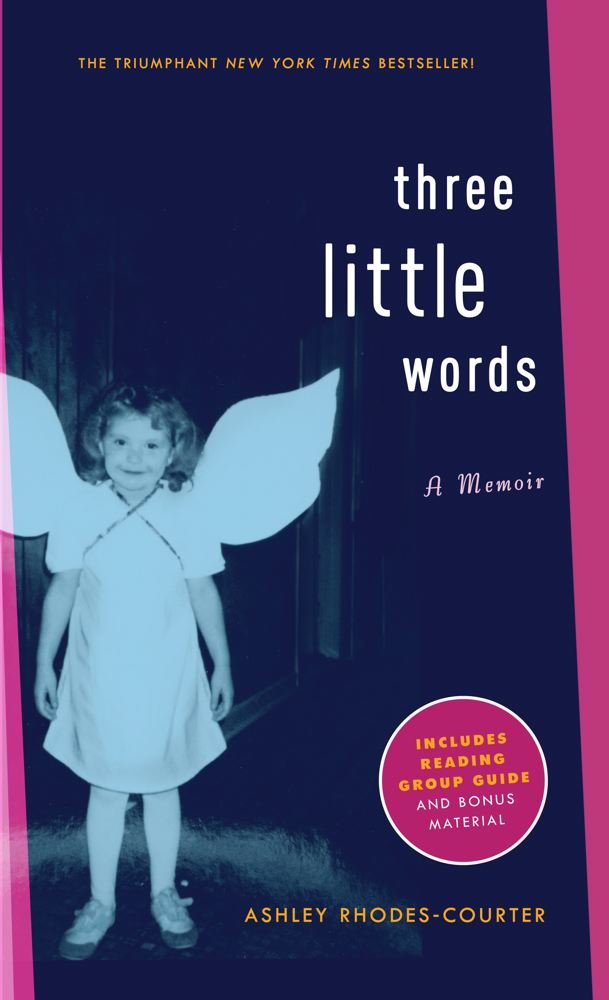
Three Little Words: A Memoir by Ashley Rhodes-Courter


Ashley Rhodes-Courter has met the President of the United States, spoken in front of groups of hundreds of people around the country, been published in newspapers and magazines, and appeared on television.  But her start in life was far from auspicious.  After being taken from her drug-addicted mother at the age of three, Ashley spent the next nine years in a series of foster and group homes, some acceptable, a few kind, one run by an abusive, cruel, and manipulative woman.  As Ashley clung to her mother’s promises and her younger brother, the foster care system failed her again and again.  In this memoir, Ashley details her journey in painstaking detail, offering an important glimpse into the many ways that emotional trauma impacts a child’s thoughts, feelings, and behavior.  Three Little Words may be a great match for sophisticated readers interested in personal stories of foster and state care.  Those looking for stories of survivors of abuse may like to know that Rhodes-Courter's account is markedly less sensational than Pelzer's series.  Backmatter includes a helpful guide for reading groups.-- Regan Schwartz

Rhodes-Courter, Ashley.  Three Little Words.  New York: Simon & Schuster, 2009. Print.


.

Tuesday, October 28, 2014

Vicious: True Stories by Teens About Bullying


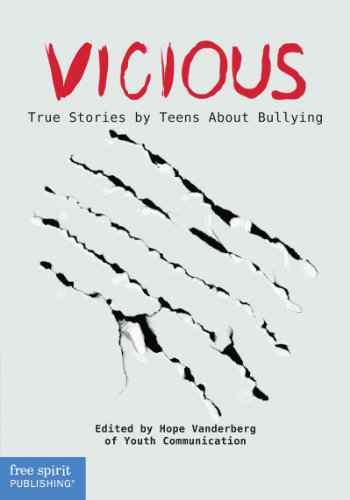
Vicious: True Stories by Teens About Bullying Edited by Hope Vanderberg

Bullying seems to be a universal experience to the students I’ve gotten to know where I work.  Whether they’ve been bullied, been a bully, or been a bystander, the topic is never unfamiliar.  This collection of writings from teenagers and young adults will let any reader who has experienced bullying know that he or she is not alone.  One of the collection’s strengths is its authenticity; these are the true voices and experiences of contemporary survivors.  The stories are accessible to developing teen readers and their brevity may appeal to both student readers and their teachers.  Recommended for independent reading for teens and educators looking for short stories addressing bullying.  Diverse sub-themes include sexual harassment (“Can I Holla Atcha” by Allajah Young”), LGBTQ (“Gay on the Block” by Jeremiyah Spears and “A Place to Belong” by Lavell Pride), the immigrant experience (“I Showed My Enemies-- and Hurt My Friends, Too” by Elie Elius), and multiple perspectives from foster homes, treatment centers, and residential facilities (like “Standing My Ground” by Xavier Reyes).--Jessica Fenster-Sparber

Vanderberg, Hope (editor).  Vicious: True Stories by Teens About Bullying.  Minneapolis: Free Spirit Publishing, 2012.

Youth Communication provides assorted stories from this collection (and more) on the topic of bullying here.  Titles displaying an apple icon include lesson plan and discussion ideas for teachers.

Friday, October 17, 2014

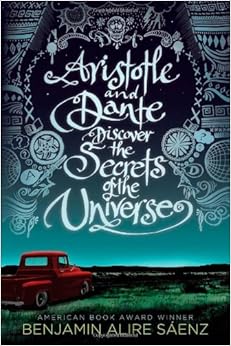
Aristotle and Dante Discover the Secrets of the Universe by Benjamin Alire Saenz


While desperately trying to discover the secrets of the universe outside of himself, a boy called Ari stumbles upon the secrets within himself. Ari is a typical young teenage boy dealing with the pain and glory of youth, just as all teenagers do, when he finds an unlikely confidante in another teen, Dante, at a local pool. Dante and Ari set out to discover what the world has to offer them and encounter some of its dangers along the way. Through the struggles and joy of their friendship, the two uncover deeper truths about the world, themselves, and what they mean to each other. I would highly recommend this wonderfully captivating book to teens, male or female, who are also trying to discover themselves, the world around them, and how to navigate it all.--Jenny Caliendo


Teachers and librarians may want to note that this is a significant LGBTQ book, addressing class differences, Latino identity, and queer identity in a way that is non-threatening to a teen reader.  Vamos A Leer has put together a teaching guide for this novel here.--Jessica Fenster-Sparber


Jenny Caliendo is a special education educator at Passages Academy's Belmont site.  She enjoys co-teaching ELA classes.  Jenny is also an author as well as a talented songwriter and musician and can be seen and heard performing at Belmont on special occasions.

Tuesday, October 7, 2014

On a Clear Day by Walter Dean Myers


What will the Bronx be like in 2035?  In this posthumously published novel, Walter Dean Myers takes readers on a journey into a vision of the near future.  That vision includes cars that drive themselves, a concentration of power in the hands of a few, the rise of gated communities, microchips embedded in humans at birth, and a spunky protagonist named Dahlia.  A fifteen-year-old math whiz whose mother recently passed away, Dahlia lives on her own in a house with neighbors she considers family in a western part of the Bronx.  What does Dahlia need to know to determine whether she and other bright teens can make a difference while societies around the world seem to be heading towards total atomization and increasingly giving up autonomy to the rule of a few corporations?  This new novel will be of interest to fans of the late, great Myers, as well as readers interested in dystopian futures and the role of teenagers in averting disaster by becoming engaged citizens.  With this text Myers seems to have taken all of his contemporary concerns about young people and woven them into a novel with his tried-and-true structure.  Seasoned readers will find his experiment with a teenaged girl’s voice to be of interest.  We eagerly await students’ verdicts. --Jessica Fenster-Sparber

Myers, Walter Dean.  On A Clear Day.  New York: HarperCollins, 2014.

Monday, October 6, 2014

Chess Rumble by G. Neri

Chess Rumble is the story of a young teen named Marcus who, after the death of his sister and the absence of his father, finds himself unable to cope with his anger.  This leads to Marcus often lashing out at those around him at the slightest provocation.  His uncontrollable fits of anger develop into displays of aggressive behavior, fights at school, picking on his two younger brothers and, at one point, he almost strikes his mother.  Looking for a way to help Marcus deal with his anger, the school principal introduces Marcus to a chess program.  There, he meets ex-convict CM, who teaches Marcus that it’s more beneficial to keep your emotions under control and remain calm even in the worst situations. The text, which is written in one or two columns per page, is accompanied by black and white illustrations which help bring the characters to life.  Thanks to the illustrator, Jesse Joshua Watson, emotions can easily be read on the characters’ faces.  


Chess Rumble can be a good way to get students thinking about anger issues and may be useful as an introduction to the game of chess. Readers of Autobiography of my Dead Brother and Yummy should give Chess Rumble a chance; all three titles deal with living in the hood, dealing with gang life and death, and all contain black and white illustrations. --Claudio Leon


Neri, Greg, and Jesse Joshua Watson. Chess Rumble. New York, NY: Lee & Low, 2007. Print.

Thursday, October 2, 2014

Dogalog by Dr. Bruce Fogle


“Miss, what kind of dog is it that has those wrinkles/a purple tongue/lion fur/any number of interesting or odd characteristics?” These are all questions I have been asked a surprising number of times.  Every time, I am grateful that I have Dogalog to turn to.  With over 400 breeds profiled in full-color, two-page spreads, it is an engaging and informative resource for dog-lovers and those curious about dogs.  Each profile includes a full-body photograph captioned with details about the breed’s physical characteristics, an overview with a brief history of the breed, and a sidebar with key facts.  The dogs are organized into broad categories, such as terriers and working breeds, which can make finding a specific breed tricky.  Luckily, there is a comprehensive index and table of contents.  A great resource on its own, this volume is also a valuable tool for teaching the features and structure of nonfiction texts. --Regan Schwartz

Fogle, Bruce. Dogalog. New York: DK Publishing, 2000.

Monday, September 29, 2014

Who Am I Without Him? Short Stories About Girls and the Boys in Their Lives by Sharon G. Flake

Engaging short stories written in African American voices for teens are always in demand and not always easy to find.  Enter Sharon G. Flake, author of The Skin I’m In and Money Hungry, with this collection geared toward girls, originally suggested to me by my colleague Chrystal Stewart.  While this book makes for an enjoyable read from start to finish, three stories recommend themselves to ELA faculty.  “Don’t Be Disrespecting Me,”  one of the collection’s few stories written with third-person narration, would serve as an accessible lesson on characterization and offers a good match with a Venn diagram or other compare and contrast  graphic organizers. This tale meaningfully contrasts two teen males, Erin and Noodles, who are friends striving to make it through high school in the face of poverty and who approach their frustrations differently.  Another stand-out is the last story, written in epistolary form and entitled “A Letter to My Daughter.”  Articulated in the voice of an absent father returned from prison after a decade or so, the narrator speaks to his daughter from a distance about her experiences becoming a young woman.  Full of admonitions, this story pairs interestingly with Lupe Mendez’s “What Should Run in the Mind of Caballeros” and Jamaica Kincaid’s “Girl” for students learning to think critically about voice, form, and purpose.  Chrystal additionally favors the collection’s first story, “So I Ain’t No Good Girl.” This book works well as an independent read for middle school and younger high school girls, but the true beauty of a collection like this one is that students are likely to become motivated to read it on their own after reading one or two of its stories with an engaging teacher. --Jessica Fenster-Sparber

Flake, Sharon G.  Who Am I Without Him?  New York: Jump at the Sun, 2007.


Click here for the author's discussion guide to the book found on her website.

Wednesday, September 24, 2014

The Most Dangerous Game by Richard Connell


Sanger Rainsford is a celebrated hunter from New York City.  He travels the world in search of big game.  When he falls off a yacht in the middle of the Caribbean, he swims for the closest shore and discovers a single palatial home built on an unfamiliar island surrounded by craggy rocks.  He is given sanctuary by the home’s singular owner, General Zaroff, who recognizes him immediately and invites him to rest and dine with him.  Over a glass of port, the two men discuss their shared hobby of hunting and the question of “what is the most dangerous game?”  This well-loved short story is useful for teaching setting, character, conflict and foreshadowing, and this edition may interest teachers because it is an unabridged short story bound into a single volume.  Interesting language abounds and readers who persevere through the start of the story are likely to be hooked by page 16.  Offering a great deal of white space, a four-page analysis of the story, and another four pages of back matter dedicated to the author’s biography, including images, this series is packaged for English teachers. The design and layout of the text can be viewed here.  Lesson plan ideas for teaching this classic text from ELA Common Core Lesson Plans can be viewed here.  Currently available at our Belmont site.--Jessica Fenster-Sparber

Connell, Richard.  The Most Dangerous Game.  Mankato: Creative Education, 2011.

Tuesday, September 23, 2014

The Pact: Three Young Men Make a Promise and Fulfill a Dream

The journey to become a doctor is not an easy path for anyone, let alone for a young person growing up in a crime-ridden neighborhood surrounded by negative influences. Yet three best friends facing those exact challenges succeeded in obtaining medical degrees. How?

Drs. Sampson Davis, George Jenkins and Rameck Hunt met as students in Newark, New Jersey. Told in alternating voices in each chapter, each of the three shares his story with the reader from childhood to the present (as of 2002, the time of publication). While each man has a different story to tell (one was arrested and spent time in juvenile detention, another managed to stay out of fights and avoid conflict throughout his childhood), the common thread is that they worked incredibly hard throughout high school, college and medical school to get to where they are now. Each reached points where he felt he might give up -- whether it was problems in his family, academic failure, financial hardships or just plain stress, and his friends were there to support him and encourage him to get back on track. This message is an important one for our students. Young people are frequently lectured on the negative effects of peer pressure and how destructive it can be to “hang out with the wrong crowd.” This memoir sheds light on the flip side of that pressure, and the opportunities that come from surrounding oneself with positive thinkers and ambitious, hard-working friends.  --Anja Kennedy

Davis, Sampson, George Jenkins, and Rameck Hunt.  The Pact: Three Young Men Make a Promise and Fulfill a Dream.  New York: Penguin.  2002.  Print.

Thursday, September 18, 2014

Jon Scieszka Presents Guys Write for Guys Read


Bizarre sports initiation rituals, dating, fathers, brothers - the list of topics expounded on in this nonfiction collection goes on and on.  Written by men, for young men, the all-star lineup of authors and illustrators includes Walter Dean Myers, Chris Crutcher, Jack Prelutsky, Ned Vizzini, Marc Aronson, Dave Pilkey, and Jack Gantos, and Matt Groening, to name a few.  Each of the ninety short biographical stories weigh in at two pages or less, making them a good fit for classroom use.  With the wide range of topics and styles offered, Guys Write for Guys Read is a versatile tool for teachers and librarians.  Particular stories recommended by my English teaching colleague include Walter Dean Myers’ “Daydreams,” Will Weaver’s “Training the Bear,” and David Shannon’s “No, David!”  Each selection includes biographical information about the author and a short selected bibliography. --Regan Schwartz

Scieszka, Jon, ed. Guys Write for Guys Read. New York: Viking, 2008. Print.

Monday, September 15, 2014

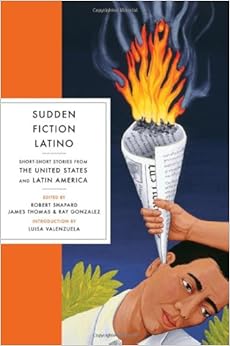
Sudden Fiction Latino: Short Short stories from the United States and Latin America


For Passages Academy it seems that Latino History Month and our ELA short story curricular unit are destined to occur at the same time each Fall. Thus, teachers seeking extremely short fiction, totalling about four pages or less, and stories with a connection to Latino/a history, may be interested in this volume.  Although many of the stories will not appeal to reluctant adolescent readers, short pieces by literary greats like Rudolfo Anaya (“The Native Lawyer”) and Gabriel Garica Marquez (“Light is Like Water”), may serve as a worthy introduction to these canonical authors.   “Day Ah Dallas Mare Toes,” by Luna Calderon, and “Counterfeit,” by Edmundo Paz Soldan, on the other hand, have a charm all their own and might just provoke meaningful discussion on themes of truth, deceit, family, and death and the role of names in literary texts and life.  This link from the publisher allows readers to view the entire table of contents, some of which are hyperlinked to permit previews of the text.  --Jessica Fenster-Sparber


Shapard, James Thomas and Ray Gonzalez (Eds.)  Sudden Latino Fiction:  Short-short stories form the United States and Latin America.  New York:  W. W. Norton & Company, 2010.

Thursday, September 11, 2014

Above Hallowed Ground: A photographic record of September 11, 2001 by photographers of the New York Police Department


For young people who were not born yet or may have been newly born, and for older readers who want to remember or enrich their memory, Above Hallowed Ground is a serviceable pictorial which begins with crisp NYPD photographs of September 11th, 2001 and ends with the site of Ground Zero, cleared in April, 2002.  This coffee-table sized volume is punctuated by images of details and memorials and well-captioned throughout.  An introduction paints the event in the most dramatic of terms and leaves the full-color images to tell the rest of the story.  A useful text to visit during a national day of remembrance. For additional topical texts reviewed in this blog, readers may want to view The 9/11 Report and One Nation --Jessica Fenster-Sparber

Tuesday, September 9, 2014

Interview Spotlight: Principal Terrell


Welcome back!  I hope you had a wonderful summer.  I’m excited to start the new year and this new year has brought a new principal at Passages.  Ms. Terrell joined us last week and graciously took a few moments out of her extraordinarily busy schedule to give us a short interview so that we could introduce her to you.  Without further ado, please meet Ms. Avis Terrell.  


JFS:  Can you tell us a little bit about what you were doing before taking the helm at Passages?*


AT: Before Passages, I was the principal of an all boys school, Urban Assembly Academy of History and Citizenship for Young men (UAAHC), located inside the Taft Campus.


JFS: What is your favorite kind of text to read?  Where is your favorite place to read?


AT:   My favorite kind of text is fiction, books that create complex, real characters. My favorite place to read is in the bathroom (lol). Sometimes it is the only place that I can get some peace.


JFS: What was your favorite book as a teenager?


AT:  My favorite book as a teenager…..there were so many! A Catcher in the Rye, Invisible Man by Ralph Ellison and anything by Toni Morrison but my all time favorite is Song of Solomon.


JFS:  What do you like to do for fun when you're not reading?


AT:  When I’m not reading, I like to watch sports (except golf) and spend time with my children.


*Please note that the questions were shamelessly borrowed from my colleague, Regan Schwartz.

Thursday, June 26, 2014

Summer Break

Dear Readers,

Happy summer!  We will continue to provide school library services this summer, but we'll be taking a break from posting until the start of the new school year.  We wish you a wonderful summer full of good reads.

See you in September,

Anja, Regan, Claudio and Jessica

Wednesday, June 25, 2014

Pinned by Sharon Flake


Autumn is the only girl on her high school wrestling team, and she’s good.   A younger boy, Roland, would like to get to know her better, but Autumn only has eyes for Adonis.  In fact, Autumn is in love with Adonis, a fellow student who manages her wrestling team when he’s not teaching her math class, volunteering to tutor and mentor other students, taking visiting dignitaries on tours of his school, and speaking at school assemblies.  Adonis, however, disdains “regular” people who are not differently-abled (as he is in his wheelchair), and he cannot stand the way Autumn flails in academics,  nor her relentless pursual of him.  Will Autumn graduate on time, succeed in the face of mean wrestling opponents, and win Adonis’ heart?  This novel in two voices (chapters alternate between Adonis and Autumn’s different perspectives and voices) explore differences in abilities and becomes heavy-handed, at times, but will still appeal to fans of Flake and developing middle school readers looking for a bit of a love story.  --Jessica Fenster-Sparber

Flake, Sharon.  Pinned.  New York: Scholastic Press, 2012.  Print.

Tuesday, June 24, 2014

Fourth Down and Inches: Concussions and Football's Make-or-Break Moment by Carla Killough McClafferty


From the early days of brute force football to the contemporary high-flying dynasties, Fourth Down and Inches provides readers with a concise history of the American pastime and brings awareness to the dangers of the sport. The book begins with a detailed history of the origins of college football, mentioning some of the oldest team feuds and how they originated, along with the rising popularity of the sport.  Each chapter discusses  injuries and fatalities that happened in the field and the gradual progress made towards identifying and treating concussions.  As the book moves through the years, the focus shifts to the prevention of fatalities and minimization of injuries at both the college and professional level. Although the book provides many medical terms and details the high tech equipment used to keep players healthy, it never overwhelms or confuses.

Fourth Down and Inches is filled with old and new pictures of teams, athletes and past games. The diagrams are colorfully detailed and help explain some of the equipment the athletes use and the medical analysis done to help make sure football becomes a safer sport. For those looking to learn more about football and its wonderfully dangerous history, Fourth Down and Inches is a great read.--Claudio Leon

McClafferty, Carla Killough.  First Down and Inches: Concussions and Football’s Make-or-Break Moment. Minnesota: Carolrhonda Books, 2013. Print.

Monday, June 23, 2014

Graffiti School: A Student Guide With Teacher’s Manual by Chris Ganter


Acknowledging in his introduction that the graffiti scene is split into two groups:  illegal sprayers and legal sprayers, and noting that the legal sprayers need experience and ideas to create the detailed pieces worthy of a legal wall, author Chris Ganter has written the missing “how-to” book for the less experienced writer.  With the care of a teacher, Ganter covers graffiti’s relationship to society, its history, the hip-hop context, terminology, and related media before jumping into directions for designing graffiti.  These chapters are separated out into a) designing and b) dealing with spray paint.  The last chapter of the book is devoted to teachers, suggesting approaches to planning a graffiti unit and including a sample lesson plan, exercises, and corresponding “solutions.”  Back matter contains a smattering of sample alphabets (for more of these, see Walde’s Graffiti Alphabets), a European-oriented timeline of graffiti’s evolution beginning in 1970, a glossary, a bibliography for further reading, photo credits and an index.  Strongly recommended for independent use, as well as art educators.  Highly popular with Passages students at Belmont.--Jessica Fenster-Sparber

Ganter, Chris.  Graffiti School: A Student Guide with Teacher’s Manual.  New York: Thames & Hudson, 2013.  Print.

Friday, June 20, 2014

Core Reference List


Which titles are the most popular and essential reference print items in your library?  In ours, they seem to be:

1) Hip Hop Rhyming Dictionary by Kevin M. Mitchell

2) Pocket Oxford American Dictionary (Paperback) by Oxford University Press

3) Scholastic Pocket Thesaurus by John K. Bollard

4) The Occupational Outlook Handbook


7) DK’s Spanish-English Visual Bilingual Dictionary (other languages in this series are popular as well)

8) The Ultimate Scholarship Book by Gen and Kelly Tanabe

--Passages Academy Library Team