Showing posts with label animals. Show all posts

Tuesday, November 7, 2017

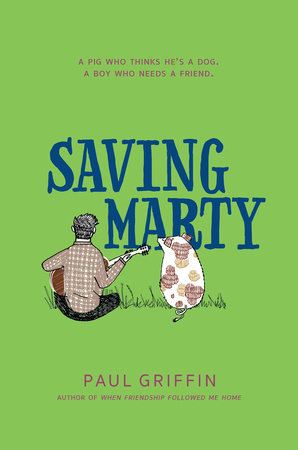
Saving Marty by Paul Griffin


It takes a runt pig, Marty, for Lorenzo the protagonist in Paul Griffin’s latest novel, Saving Marty, to reveal his belief in the importance of friendship and the value he places on it.  Lorenzo, who is an eleven year old boy, lacks confidence in his abilities and social skills.  However, he has become overwhelmed by a fervent desire to defend and protect his pet pig, that pretends to be a dog, from his mother who wants to sell the pig for much needed cash.  Marty, who is more a friend than a pet, has helped Lorenzo fill a tremendous gap in his life left void by the loss of his father.
     Lorenzo knows Marty trusts and depends on him.  Marty’s reliance on Lorenzo has compelled him to guard and keep Marty from the butcher’s knife.  Lorenzo needs to use all his resources to find a way to save Marty.  Lorenzo has to find an immediate solution to save his pet, but his resources are very limited and he has a very short time.
This book will appeal to students in middle school, grades 6 - 8, looking for realistic stories. --Elaine Roberts

Griffin, Paul. Saving Marty. Dial Books for Young Readers, Penguin Young Readers group, An Imprint of Penguin Random House LLC, 2017. Print.

Thursday, November 20, 2014

The Wolf Almanac by Robert H. Busch


Stunning photographs liberally illustrate The Wolf Almanac, a detailed and well-researched overview of all things wolf - from their biology and behavior to folklore, from big game hunting to zoos and conservation.  The text is a bit dense, but makes judicious use of maps, charts, and graphs to present scientific information and a thorough table of contents and index allow the reader to pinpoint the information they are looking for.  With a thorough bibliography and list of wolf conservation organizations rounding out the back matter, this title is ideally suited to student inquiry. --Regan Schwartz

Busch, Robert H. Wolf Almanac, New and Revised: A Celebration Of Wolves And Their World.  Guilford, CT: Lyons Press, 2007. Print.

Thursday, October 2, 2014

Dogalog by Dr. Bruce Fogle


“Miss, what kind of dog is it that has those wrinkles/a purple tongue/lion fur/any number of interesting or odd characteristics?” These are all questions I have been asked a surprising number of times.  Every time, I am grateful that I have Dogalog to turn to.  With over 400 breeds profiled in full-color, two-page spreads, it is an engaging and informative resource for dog-lovers and those curious about dogs.  Each profile includes a full-body photograph captioned with details about the breed’s physical characteristics, an overview with a brief history of the breed, and a sidebar with key facts.  The dogs are organized into broad categories, such as terriers and working breeds, which can make finding a specific breed tricky.  Luckily, there is a comprehensive index and table of contents.  A great resource on its own, this volume is also a valuable tool for teaching the features and structure of nonfiction texts. --Regan Schwartz

Fogle, Bruce. Dogalog. New York: DK Publishing, 2000.

Thursday, March 6, 2014

Predator: Life and Death in the African Bush by Mark C. Ross and David Reesor


“Who would win in a fight? A lion or a tiger?” I can’t tell you how many times students have asked me some variant of that question - cheetah and lion, hyena and leopard, anything and a crocodile - the pairings are endless and the discussion endlessly fascinating.  Predator is a natural companion to these conversations - its full color photographs with informative captions invite further investigation.  But Predator is not all style and no substance.  Written by a wildlife biologist, the book is split into five main sections, each covering one large African predator.  The prose covers each animal’s biology, behavior, development, and habitat and is engaging and informative without being overly scientific.  Still, Predator is a text for confident readers.  Backmatter includes a bibliography and index.  Predator is a compelling book for browsing and is well-suited for inquiry, though some pictures are not for the faint of heart. --Regan Schwartz

Ross, Mark and David Reesor. Predator: Life and Death in the African Bush. New York: Abrams, 2007. Print.

Monday, December 17, 2012

Encyclopedia of Sharks by Steve Parker


Sharks are older than dinosaurs and just as fascinating.  These mysterious predators come in all shapes and sizes, from the 6-8 inch dwarf lantern shark, to the 40-foot whale shark, and the Encyclopedia of Sharks has them all.  Chock-full of glossy, full-color photographs, charts, and maps, it’s clear that the immediate appeal of this book is visual.  However, the casual browser is soon roped in by the interesting snippets of information presented in sidebars and captions.  Each page of the book is a separate section, clearly organized with titles and subtitles, making it easier for fluent readers to skim for information.  These sections are grouped into chapters, such as “Shark Design” and “Hunters and Killers.”  The Encyclopedia of Sharks includes an extensive index and glossary, as well as a list of places to see sharks and shark-related resources. --Regan Schwartz

Parker, Steve. Encyclopedia of Sharks. Buffalo, NY: Firefly Books, 2008. Print.

Wednesday, June 1, 2011

Big Cats & Wild Dogs by Rhonda Klevansky and Dr. Jen Green


Ever wonder what, exactly, is the difference between a leopard and a jaguar? Or a puma and a cheetah? Where do they live? What do they eat? How fast do they run? All of these questions and more are answered in this amazing book of facts about large cats and wild dogs. Filled with many color photographs and plenty of accompanying text, the first half is dedicated to the world of carniverous canines and the second half is all about wolves and other wild dogs. Both subjects are very popular with our students, making the book a perfect choice for supplementing inquiry projects. Also use it as a follow-up to answer the many questions students will be asking after viewing David Attenborough’s Life of Mammals: Meat Eaters.

Klevansky, Rhonda and Dr. Jen Green. Big Cats & Wild Dogs. London: Anness Publishing, 2004.

Thursday, February 17, 2011

101 Freaky Animals by Melvin and Gilda Berger


If you’ve never heard of babirusas, pangolins, okapis, narwhals, or cassowaries, you’ll want to look at this book. If you’ve never seen a flannel moth caterpillar, or a giant clam, or a hooded seal, or a red-lipped batfish, you’ll want to look at this book. Each page in this full-color paperback features a headline which includes the name of an animal and an interesting tidbit like “Sea Cucumbers Shoot Out Their Insides” (#79), or “Temminck’s Tragopans Inflate their Horns” (#95), accompanied by approximately five sentences in a fairly large font. The information, organized alphabetically by the animals’ names, varies and sometimes elaborates on the headline and sometimes gives additional interesting facts. The brevity of these paragraphs makes this book a great starting point for inquiry projects or discussions about questions and questioning strategies. This is a great pick for reluctant readers who are scoring around a fourth grade reading level on the STAR exam but aren’t interested in fiction.

Berger, Melvin & Glinda. 101 Freaky Animals. New York: Scholastic, 2010.

Wednesday, January 19, 2011

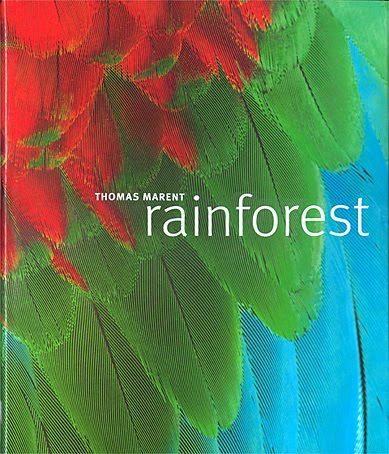
Rainforest by Thomas Marent


Few things are freakier to our New York City students than purple beetles, bright blue crayfish, and iridescent spiders. These and so many more wonderfully interesting-looking creatures are portrayed page after page in this collection of colorful and vivid photographs taken by Thomas Marent in rainforests all around the world. Thankfully, every picture gets a caption, which is often necessary for figuring out what the subject is exactly. In addition to the close-ups of animals and insects, there are pictures of waterfalls, trees and other plant-life, within the dense forest and sweeping landscape shots taken from above. The rainforest really looks like it might be paradise until the reader stumbles upon the pictures of the many varieties of tarantulas and jumping spiders that call these forests home. This book is a fantastic choice for many students, including struggling and reluctant readers -- the pictures are so captivating; it is hard to avoid getting sucked in.

Marent, Thomas. Rainforest. New York: DK Publishing, 2006.

Saturday, November 6, 2010

The Life of Mammals hosted by David Attenborough


Who doesn’t enjoy watching real, vivid, and up-close footage of animals in the wild? David Attenborough, veteran wild-life expert, hosts and narrates each segment on this DVD collection of four discs, roughly 500 total minutes of mammals. Each disc is further broken down into chapters of mammal-types, making it ideal for showing short bits to a class at a time. By far, most popular with students I have watched it with is the Meat Eaters chapter, where lions and tigers and other big beasts hunt their prey with breakneck speed and ferocity, but students are also riveted to the screen while watching the less obvious chapters on Chisellers (squirrels, marmots, beavers, etc.), Opportunists (hyenas, prairie doges, etc.), Return to the Water (whales, dolphins, seals, etc.) and the others. Like teens everywhere, presumably, our students are fascinated by animals, especially wild ones roaming in places where they have never been. This collection is a perfect tool for beginning research and inquiry projects because students naturally ask many questions while watching it. These questions, which are authentic and organic, make their research all the more valuable. ELA teachers may also use this collection for writing prompts, both creative and non-fiction.

Wednesday, October 13, 2010

Swimming With Hammerhead Sharks by Kenneth Mallory


Have you ever contemplated swimming with sharks? If not, you might enjoy the opportunity to vicariously follow author Kenneth Mallory as he takes the reader by the hand in preparing for a trip to the Cocos Islands to suss out schools of hammerheads. Supported by relevant pictures and sidebars on SCUBA, El Nino, and rebreathers, Mallory’s story is a narrative detailing his opportunity to travel with hammerhead expert Pete Klimley as he searches for answers to shark questions and attempts to get live footage for an IMAX film. Teachers will find the last pages of the book most valuable as they list as-yet-unanswered questions, related conservation issues, what you can do to help sharks, and both print and web bibliographies for further reading. This book is probably not one that students will decide to read through on their own, but will come in handy while teaching non-fiction genres, careers, and, of course, for students studying hammerhead sharks.

Click here for a web directory on hammerhead sharks by Tim Spalding including links to National Geographic lesson plans for middle school students.

Mallory, Kenneth. Swimming With Hammerhead Sharks. New York: Houghton Mifflin Harcourt, 2002.