Showing posts with label Bridges. Show all posts

Monday, November 8, 2010

Teen Astrology: The Ultimate Guide to Making Your Life Your Own by M. J. Abadie


What’s your sign? The heft of this 300 page paperback coupled with the almost-tattered appearance of this volume in our library might lead you to believe that students can’t stop reading the details of the more complex aspects contained in the pages. That would be a mistake. This book, one of the most popular in our library at Bridges, is most often used to check the basic descriptions of each sign on pages 26-37 and the “How to Find Your Sun Sign” information box on page 4. Whether searching for more information on oneself, one’s associates, or one’s love interests, students regularly approach this volume with personal motivation and often follow up with requests for more “books like this.” Abadie breaks the text up into four parts, prefaced by an explanation as to why teens deserve their own astrology book. Part one addresses the basics, Part two delves into the planetary parings of sun/moon relationships and romantic relationships. Part three covers aspects of the inner planets and the outer planets. Part four addresses teens and their relationship with their parents. Math teachers might find fodder for students to design their own word problems around identifying their chart elements. Counselors might find starting points for conversations about self-knowledge and personality traits. Mainly, though, this book draws readers like moths to a light because we are all inherently curious about mysterious forces that claim to tell us who we are and what’s going to happen next.

Abadie, M.J. Teen Astrology: The Ultimate Guide to Making Your Life Your Own
. Rochester: Bindu Books, 2001.

Thursday, November 4, 2010

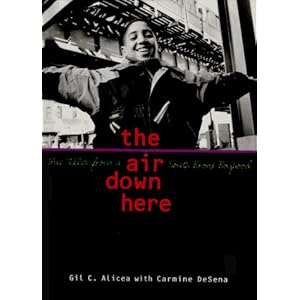
The Air Down Here: True Tales from a South Bronx Boyhood by Gil C. Alicea with Carmine DeSena


“The air in my neighborhood is harder. It’s more thicker, harder to breathe in, harder to see through.” So begins one of the only known texts published by a fourteen year old living in the South Bronx. I love the South Bronx. Not everyone feels the way I do, but you will probably fall in love with Gil C. Alicea after reading The Air Down Here: True Tales from a South Bronx Boyhood, co-written with Carmine DeSena. I first encountered this book while designing lessons for a class of high school seniors entitled Autobiography. While I often found myself wanting more from the hundred or so brief vignettes that fill the short 133 pages, the seniors I worked with usually appreciated the authors’ brevity, vernacular and humor. A single vignette frequently provided sufficient provocation for hours of writing and sharing and ultimately this text became a central one to the project of writing individual biographies. The short form and the accessible language make this book a potentially perfect fit for middle- and high-school aged New York City readers who are a little wary of committing to a 200 page book, yet searching for a true story they can relate to. Alicea hits topics as familiar as family, girls, school, cops and basketball and as serious as his mother’s terminal illness and poverty.

Alicea, Gil C. with Carmine DeSena. The Air Down Here: True Tales from a South Bronx Boyhood. San Francisco: Chronicle Books, 1995.

Monday, October 25, 2010

Lockdown by Walter Dean Myers


Lockdown. I can’t think of a title more appealing to many of the students I meet at Bridges. One copy is currently missing from our school library after I went out of my way to book talk it on the occasion of the recent announcement that it was a National Book Award finalist. (Stay tuned on November 17th when the winner is announced!) It doesn’t hurt that the cover is enticing too. Readers may have to make it to the second chapter to get hooked, but the entire novel is filled with Myers’ signature telling details, humor, and mission to transport the reader to familiar and unfamiliar territory through the eyes of a young man from Harlem.

In this iteration we meet Reese who finds himself doing time in an upstate juvenile detention facility. Unusually, Reese has been selected as the pilot participant of an experimental new work-release program, and is confronted with the very real challenges that stop him from what might seem to outsiders and policy makers to be an easy path to success.

For those who are familiar with Myers’ oeuvre, Lockdown reads like a cross betweenMonster and The Mouse Rap. Like Monster, Lockdown provides keen insight into the mentality of the denizens of the obscured world that is a secure juvenile detention center. The novel, which I can only guess has been at least several years in the making, comes at a time when more public attention is turned to New York’s state-run juvenile detention facilities than ever before. Lockdown is a timely walk in a resident’s shoes, and should appeal not only to the young people who can relate to Reese, but to the reading public who are curious and remain largely in the dark regarding what life is like for the residents of these facilities.

Adults who give this book to incarcerated young folks should expect readers to express frustration at the lack of a happy ending. Walter Dean Myers continues his remarkable service to citizens of all ages as a public intellectual.


Myers, Walter Dean. Lockdown. New York: HarperCollins, 2010.

Thursday, October 14, 2010

Guest Blog Post: The House on Mango Street by Sandra Cisneros


Esperanza longs to escape from her stifling and poverty stricken Latino neighborhood. In this series of 44 brief vignettes, Sandra Cisneros allows us a view into the intimate life of a young girl, coming of age in a large family where everyone shares and sometimes aches for clothing, food, and the attention of its members. Each story is narrated in first-person present tense and may be only a few paragraphs in length, yet completely able to be read as stand alone pieces. Some of the themes covered in this collection are culture, gender roles, responsibilities and concept of home. Simile, metaphor, personification, alliteration, and other forms of figurative language are interwoven throughout The House on Mango Street and provide for an abundance of learning activities. --Mary Lou DeLigio

Mary Lou DeLigio is a former member of Passages' library team and is currently breaking new ground heading up the PA-Bridges' intake team. She is a veteran English teacher and Special Education teacher.

Wednesday, October 13, 2010

Swimming With Hammerhead Sharks by Kenneth Mallory


Have you ever contemplated swimming with sharks? If not, you might enjoy the opportunity to vicariously follow author Kenneth Mallory as he takes the reader by the hand in preparing for a trip to the Cocos Islands to suss out schools of hammerheads. Supported by relevant pictures and sidebars on SCUBA, El Nino, and rebreathers, Mallory’s story is a narrative detailing his opportunity to travel with hammerhead expert Pete Klimley as he searches for answers to shark questions and attempts to get live footage for an IMAX film. Teachers will find the last pages of the book most valuable as they list as-yet-unanswered questions, related conservation issues, what you can do to help sharks, and both print and web bibliographies for further reading. This book is probably not one that students will decide to read through on their own, but will come in handy while teaching non-fiction genres, careers, and, of course, for students studying hammerhead sharks.

Click here for a web directory on hammerhead sharks by Tim Spalding including links to National Geographic lesson plans for middle school students.

Mallory, Kenneth. Swimming With Hammerhead Sharks. New York: Houghton Mifflin Harcourt, 2002.

Thursday, September 30, 2010

16 On the Block by Babygirl Daniels


Pretty much every day I meet new students in the library at Bridges. It’s their second day of school and I am trying to get to know them as readers. Pretty much everyday two or more new students tell me that their favorite kinds of books to read are “urban” books or “street” books. So, after we run through the Passages’ student canon (another post for another time), I usually try to suggest books in other genres with crossover appeal. I appreciated 16 on the Block because, while I don’t anticipate it joining our canon anytime soon, it is there, for better or worse, for the student who is not ready to try another genre. For this I am grateful and will probably purchase the creatively named sequel, 16 and a Half On the Block.

The story opens with Summer awaiting her judge's decision: will she be released from group care custody and get to live with her only sister? Lots of exposition in the first chapter make this less suited to the less patient. Proofreading errors mar this reader's experience, and the ending was disappointing, but brand names, dramatic circumstances, and tighter pacing during the second half of the book make this a good choice for reluctant readers.

Daniels, Babygirl. 16 on the Block. New York: Kensington, 2009.

Tuesday, September 7, 2010

Guest Post: With Their Eyes Edited by Annie Thoms


Just four blocks from Ground Zero, Stuyvesant High School students witnessed the horrors of the September 11, 2001 attack on the World Trade Center. With Their Eyes presents a collection of twenty-three stories of that day, told by members of the diverse Stuyvesant community including students, teachers and other school personnel. The work was performed in February of 2002, as a two-act play by ten Stuyvesant students and was received with resounding praise from audience members. The heartfelt stories and beautifully arranged poetry leave lasting reminders of what that day's effect has been on each and everyone of us. The illustrations, the Chronology of Events, the photos and stories are compelling and honest and serve as a wonderful springboard for engaging students to relate their own stories of 9/11. I have often used this book with Passages’ students, reading and discussing the Chronology of Events and a selection of essays and poems. After that, students begin drafting and then discussing personal recollections of the days events; ie. how old were they, what grade, what school, what borough they were in. Did they know anyone directly/indirectly involved and how were they involved? A wonderful creative writing tool to use in conjunction with honoring and memorializing the heroes and victims of 9/11. --Mary Lou DeLigio

With Their Eyes: September 11th: the view from a high school at Ground Zero. Ed. Annie Thoms. New York: HarperCollins, 2002.

Friday, September 3, 2010

Hurricane Song by Paul Volponi


If you and your students happened to not be down in New Orleans this week five years ago, it might feel a bit faraway. I might very well recommend Hurricane Song to a young adult reader looking for a realistic fiction as the five-year anniversary reports cover the fronts of news media. Author Paul Volponi (Rooftop, Black and White, Rikers High) invites the reader to step into the shoes of a young man encountering Hurricane Katrina. Volponi's writing strikes this reader as fairly wooden, but there are bright moments of fresh language that make it bearable. His talents as a writer center on his selection of subject matter, his ability to help his reader think into things like power on a variety of simple and complicated levels, and his knack for weaving disparate plots, sub-plots, and characters together and apart to a satisfying conclusion. Recommended for middle and high school boys. Pair with Spike Lee's documentary on the same subject, When the Levees Broke (at Summit) and memoirs like Soft Skull's Neighborhood Story Project (at Bridges) for a non-fiction counterpoint.

Volponi, Paul. Hurricane Song. New York: Penguin, 2008.