Tuesday, April 29, 2014

Pretty Girl 13 by Liz Coley


Angie disappeared on a camping trip several years ago and walks into her parents’ house now, three years older, with thick scars around her ankles and no explanation.  She is unaware that three years have passed and she has no memory of what has happened.  While not an urban book by any stretch, teen girl readers at Belmont continue to clamor for this book, drawn in by the horror, mystery and suspense of Angie’s situation.  Teachers and counselors will want to know that this novel includes instances of sexual abuse and a gentle exploration of Disassociative Identity Disorder (DID).  Back matter includes an author’s note explaining her authorial decisions and suggested resources for more information.  Recommended for independent reading for teens and bookclubs for teen girls. --Jessica Fenster-Sparber

Coley, Liz.  Pretty Girl 13.  New York: HarperCollins, 2013.  Print.

Wednesday, April 9, 2014

Tom Sawyer (All-Action Classics #2) adapted by Tim Mucci, illustrated by Rad Sechrist


With simple, expressive art and judicious text, this graphic novel adaptation brings the mischief and imagination of Tom Sawyer’s world to vivid life.  Though the format necessitates abridgement, the author and artist manage to include plenty of Tom’s famous adventures - from tricking his friends into whitewashing Aunt Polly’s fence to clearing Muff Potter of murder charges.  This volume is an engaging and accessible introduction to the classic novel and has brought more than one comics-loving student into the library asking, “Do you have any more books like this?”  Backmatter includes a brief and informative biography of Mark Twain, as well as a selected bibliography of his works.  Recommended for avid readers of graphic novels, ready for a new challenge, and for classroom use, as an introduction to Tom Sawyer, or a comparative counterpoint. --Regan Schwartz


Mucci, Tim. All-Action Classics #2: Tom Sawyer. New York: Sterling Publishing, 2008. Print.

Tuesday, April 8, 2014

He Said, She Said by Kwame Alexander


Omar has just been named Mr. Football of South Carolina and can’t wait to announce his plans to play for Miami when he crosses paths with Claudia, a.k.a. Beyonce, the hottest Harvard-bound senior in his high school.  Omar bets his friends that he can win over Claudia, who has declared her absolute disinterest in high school boys, especially anyone with a reputation as a “panty-dropper.”  This novel, narrated by Omar and Claudia in alternating chapters, includes text messages and Facebook posts to tell a story of teenage romance intertwined with an activist-themed plot involving a fight against budget cuts to arts and library funding.  Recommended independent reading for high school students looking for a love story like Dana Davidson’s sadly out-of-print Played. --Jessica Fenster-Sparber

Alexander, Kwame.  He Said, She Said.  New York: Amistad, 2013.  Print.

Friday, March 28, 2014

Runaway Girl: Escaping Life on the Streets, One Helping Hand at a Time by Carissa Phelps


When Carissa Phelps was just twelve years old, she was kidnapped by a pimp. This is the introduction she gives herself, later on, each time she finds herself telling her story to a new group of people. Carissa, who is now an attorney and a youth advocate, has written down her story in this memoir and it’s an inspirational ride. Her teen years were turbulent; she spent most of them running from one dangerous situation to the next. Placed in group home after group home, spending time in juvenile hall and alternative school programs, the author reflects often on the adults she met along the way who believed in her and gave her courage. Students might relate to her history of emotional and sexual abuse, but they will absolutely be able to connect with her time spent in and out of group homes and juvenile hall. I am often asked by students for books about “real people who had it rough, but made it out in the end,” and this book fits that description perfectly. Carissa’s story demonstrates that anything is possible with the support of a few caring individuals and a lot of determination. --Anja Kennedy


Phelps, Carissa, with Larkin Warren.  Runaway Girl: Escaping Life on the Streets, One Helping Hand at a Time.  New York: Viking-Penguin, 2012.  Print.

Monday, March 10, 2014

Thirteen Reasons Why by Jay Asher


High school student Hannah Baker has committed suicide, and protagonist Clay is trying to discover why via thirteen cassette tapes Hannah recorded prior to her death.  Each tape incriminates another person at the school, explaining how that person played a part in Hannah’s suicide.  Hannah makes it clear from the first tape that if you received the tapes, it means there is one about you—and Clay has no idea why he received them. Inspired by museum audio-tours, one unique feature of the novel is the inclusion of a map that goes along with the tapes, marking the locations where Hannah’s stories occurred.  Another unique and impressive component is the structure of the novel: Hannah and Clay’s point of views are woven together throughout the storyline, so that the reader has access to Clay’s immediate reactions after hearing Hannah’s stories.  Exploring themes of sexual abuse, bullying, and teen relationships, this novel is recommended for high school students, specifically females as Hannah focuses on many painful situations that young women may face.--Mackenzie Magee

Asher, Jay. Thirteen Reasons Why. New York: Penguin Group, 2007.  Print.

Mackenzie Magee is a first year ELA teacher at Passages Academy-Belmont. She grew up in Portland, Oregon and enjoys writing, running, and reading. Her favorite books include The Brothers Karamazov by Fyodor Dostoevsky and Of Human Bondage by Somerset Maugham.

Friday, March 7, 2014

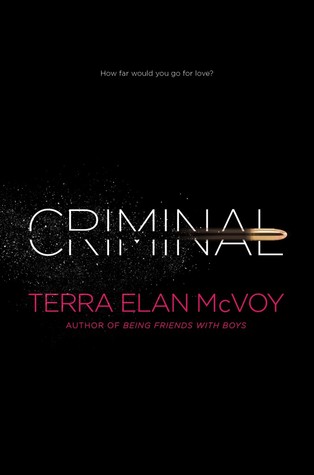
Criminal by Terra Elan McVoy


Eighteen-year-old Nikki is in love with her twenty-year-old boyfriend, Dee. She had no idea when he took her on a ride over the weekend that he would point a gun, pull a trigger, and leave a man dead.  She loves him so much she would do anything for him.  When the police call Dee in for questioning in conjunction with the murder of a retired police officer over the weekend, Nikki doesn’t question Dee’s directions to lie, to provide an alibi, and to attest to his innocence.  But what Nikki can’t do is tolerate Dee’s order not to speak with him.   When the police seem to be closing in on the killer, will she tell the truth or take responsibility for what she didn’t do?  Recommended independent reading for older high school students who enjoy suspense and characters in trouble with the law.--Jessica Fenster-Sparber

McVoy, Terra Elan.  Criminal.  New York: Simon Pulse, 2013.  Print.

Thursday, March 6, 2014

Predator: Life and Death in the African Bush by Mark C. Ross and David Reesor


“Who would win in a fight? A lion or a tiger?” I can’t tell you how many times students have asked me some variant of that question - cheetah and lion, hyena and leopard, anything and a crocodile - the pairings are endless and the discussion endlessly fascinating.  Predator is a natural companion to these conversations - its full color photographs with informative captions invite further investigation.  But Predator is not all style and no substance.  Written by a wildlife biologist, the book is split into five main sections, each covering one large African predator.  The prose covers each animal’s biology, behavior, development, and habitat and is engaging and informative without being overly scientific.  Still, Predator is a text for confident readers.  Backmatter includes a bibliography and index.  Predator is a compelling book for browsing and is well-suited for inquiry, though some pictures are not for the faint of heart. --Regan Schwartz

Ross, Mark and David Reesor. Predator: Life and Death in the African Bush. New York: Abrams, 2007. Print.

Thursday, February 13, 2014

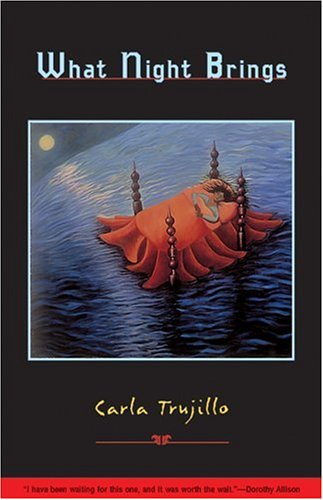
What Night Brings by Carla Trujillo


Marci Cruz, 11, is determined, sincere, and funny without meaning to be.  She speaks Spanglish sometimes and makes up her own terms for sex stuff.  Like many kids, she notices how the community treats people who are different and people who ask questions that no one wants to answer.   

Marci and her younger sister, Corin, get frequent beatings from their father.  Their mother is aware, but is blind to his faults.  Marci prays to god to get her father out of her life forever.  She doesn’t go as far as wanting her dad to be dead because she doesn’t want god to think badly of her.  She needs god's help to change her into a boy, which she believes will allow her to live out her attraction to girls.
Although the well-described beatings continue and helpful adults seem to be missing, all is not hopeless. The two girls, Marci and Corin, work together on inventive ways to help their mother come to her senses about their dad.   Marci also manages to get to the library, make a garden, and have a crush.--Joy Ferguson

Joy Ferguson has worked with detained youth as both an outreach librarian and a facility staff member.  She currently serves students as a school librarian  at PS 261 Phillip Livingston School.

Tuesday, February 11, 2014

Ender’s Game (Graphic novel adaptation)


After having repelled an alien invasion, the International Fleet creates Battle School, a program to train children who show great tactical prowess into becoming military leaders.  The fleet hopes that one trainee can rise above all others and lead the future space armada on a preemptive mission to destroy the invading alien race before they try to invade Earth again. Enter Andrew “Ender” Wiggin who was the third child birthed by the Wiggin family upon request from the government.  Ender is selected to attend Battle School at the age of six. Here he will climb the ranks and become one of the youngest battle commanders in battle school history.  But that is only the beginning. With humanity’s hope resting on Ender’s young shoulders, battle school has to make sure Ender is ready for anything.  They toss the rules and place Ender in every impossible-to-win situation they can. Is Ender the tactical prodigy the fleet has been looking for? Can the fleet finish the training before the aliens invade again? If the human race is to survive, they will have to.

The graphic novel is a stripped down version of the book.  Some of the subplots are missing and character development is limited. The art is very sleek and colorful.  It all adds a nice touch that complements the sci-fi aspects of the book, especially the battle-room combat scenes. I recommend reading the graphic novel along with the book.  Comic book readers should enjoy Ender’s Game. --Claudio Leon

Yost, Christopher, Pasqual Ferry, and Orson S. Card. Ender's Game. New York: Marvel, 2013. Print.

Wednesday, February 5, 2014

Aphrodite: Goddess of Love by George O'Connor


Hey, my name is George O’Connor, and I’m making a blog tour of the greatest book blogs in the universe to promote my newest book Aphrodite: Goddess of Love, the sixth volume of my ongoing series Olympians, which retells classic Greek myth in graphic novel form. The good folks at What's Good in the Library have forwarded me five interview questions from Belmont library patron Daniel, 15.  As any writer will tell you, there is nothing more intimidating than a big blank page, except for maybe an armored grizzly bear with a grumpy disposition. That’s pretty intimidating, yo.

Daniel: What gave you the idea or made you interested in re-telling the stories of the Olympians?

George: This is a two part question, or rather a two part answer. I was first introduced to Greek mythology when I was in the fourth grade. It made a huge impression on my young mind, as I was suddenly allowed to draw musclemen fighting monsters in school, which is pretty much what I wanted to do anyway and at least now I wouldn’t get yelled at for doing it. From that point on I was obsessed with drawing the gods and monsters of mythology, and did so for years and years. That’s what made me want to retell the stories of the Olympians. As for what gave me the idea to actually retell the stories of the Olympians, my editor Neal Porter  referred to a mutual acquaintance of ours as slobbering like Cerberus the three-headed dog of Hades. I said, something equally geeky back to him about a Cyclops or something and he fixed me with a steely gaze and pulled a book off of his shelf and said “,what if you do a graphic novel retelling the Greek myths, about this big?” In retrospect, it was the sort of thing I should have come up with by myself, but I needed that kernel of inspiration. I went home, wrote Zeus and came back with it and plans for eleven more.


Daniel: Which of the Olympians is your favorite and why?

George: Another two part answer. Hermes is my favorite god, and has been since I was a little kid. I’ve always liked fast characters, like the Flash or Quicksilver from the Avengers, and I always liked the trickster characters who are the smartest guys in the room but always play it for laughs. Hermes was both of those in one. My favorite goddess is Hera, which surprises a lot of people who think of her as a bad guy, but I think that’s such a narrow viewing of her character. Yeah, she persecutes a lot of Zeus’s girlfriends and illegitimate children, but that’s because Zeus is the worst husband in the universe. In my studies I uncovered how she was such a remarkably important divinity to the ancient Greeks that it bums me out how much of that gets lost in modern retellings.

Daniel: Do you believe that all gods and goddesses are equal, or are some of more importance than others?

George: There’s a definite hierarchy at play in the Olympian order. The idea of a big three encompassing Zeus, Hades and Poseidon has been popularized by Rick Riordan’s Percy Jackson books, but I think you need to add the other three children of Kronos, Hera, Demeter and Hestia to that upper echelon as well (even though Demeter and Hestia tend to be the ‘forgotten’ Olympians). The second generation, like Ares, Apollo, Hermes, and the rest tend to comprise the second tier of Olympians, though sometimes some second generation gods like Athena seem to be jostling for a position at the top. I would also place Aphrodite, the only Olympian not directly related to Zeus, who essentially married into this family of super-powered lunatics, as a top tier diety. With her control of the powers of love, in her own way, she is the most powerful god on Olympus.

Daniel: Did you always love to write books or was it something you grew to like?

George: I always have loved, and continue to love, to write, but I will say writing is much harder for me than drawing.  Writing has given me a lot more headaches and misery, but  I also get more satisfaction out of a piece of writing that turned out well than anything else I can do.


Daniel: What other books are you planning in publishing? A book on more Olympians? Or on different subjects, like urban, fantasy and biographies?

George: Hopefully, if all goes well, there will be six more books on Olympians. I just turned in the seventh book, Ares: God of War, and that will be followed up by Apollo. I have some picture books, another love of mine coming out from Candlewick Press. My first one, If I Had a Raptor, drops in May. Finally, since writing is so rewarding (yet difficult! So difficult!) I want to write a young reader novel—something that stands more or less entirely on the merit of my words. I’m working on a couple of comedic adventure ideas along those lines, but it’s too early to announce anything else about them.

Thank you, George, thank you Daniel!  --Jessica Fenster-Sparber

Tuesday, February 4, 2014

Suckerpunch by David Hernandez


“At the funeral for Oliver’s father, I daydreamed about killing my own.”  So begins Marcus’ narrative of his summer before senior year.  Marcus’ father has abandoned his family and his best friend’s father just committed suicide, setting the stage for Marcus and Oliver’s illicit drug use and desire to escape.  Set in contemporary Cerritos, California, this novel features an attention-grabbing start and gathers steam as Marcus, his brother, and Oliver plan to find and confront Marcus’ dad.  Hernandez’s  use of  fresher imagery and dialogue remain consistent, but the story’s momentum peters out in the last third. This book may appeal to teen male readers ready for conversations about author’s craft.  Suckerpunch pairs interestingly with Last Night I Sang to the Monster on the themes of brotherhood and teen substance abuse, or Fitz on the theme of confronting absent fathers.--Jessica Fenster-Sparber

Hernandez, David.  Suckerpunch.  New York: HarperTeen, 2008.

Friday, January 31, 2014

Bicycles by Nikki Giovanni


I have been inundated with requests for books of love poems.  I am happy to have this slim, enigmatic volume on hand to offer students after they have moved through the more accessible poetry of lyricists such as Alicia Keyes and Tupac Shakur.  Bicycles gets at love and longing from many different angles and in many different ways.  Friendship, family, romantic love, and hero-worship are all here, in one to two page poems in forms ranging from free verse to simple four line stanzas to paragraphs of prose poetry.  There is something for everyone inside, but it may take patience and a bit of guidance to find, especially for less sophisticated readers.  “A Substitute for You,” “Friends and Lovers,” and “Trash Pans” have all proven popular.--Regan Schwartz

Giovanni, Nikki. Bicycles. New York: Harper Perennial, 2009. Print.

Thursday, January 30, 2014

Hip-Hop Biographies: Drake


Saddleback’s Hip-Hop Biographies series has drawn tremendous student interest since the moment I took the books out of the box. In Drake’s biography, the reader gets to know a little bit about Drake’s childhood in Toronto, where he was raised by his white, Jewish mother. He didn’t have much of a relationship with his father, an African American musician, until he was a teenager, but when they finally started spending time together, they bonded over music. Some readers might be surprised to learn that Drake was an actor on the popular television program Degrassi High before he made it as a singer, and this book clearly explains his trajectory from one role to the next. Also of interest is his relationship with mentor Lil Wayne and a breakdown of some rivalries Drake has had with other musicians.


The font is large and accessible, and students have enjoyed flipping through the pages and looking at the colorful pictures in these slim volumes. Other popular titles in the series are Chris Brown, Rihanna, Nicki Minaj and Lil Wayne. This series is recommended for independent reading or as a starting point for inquiry work. Additionally, each book contains a table of contents, a glossary and a page of photo credits. --Anja Kennedy


Hip-Hop Biographies: Drake. Costa Mesa, CA: Saddleback Educational Publishing, 2013. Print.

Monday, January 27, 2014

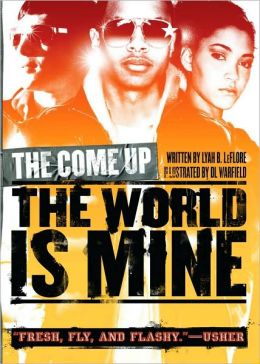
The Come Up: The World Is Mine by Lyah B. LeFlore Illustrated by DL Warfield


Blue is a junior at Silver Spring High School and he believes he is destined to become a hip-hop mogul.  His father, however, expects him to become a lawyer and his best friend, Collin, is in the same boat. Both are friends with Whiteboy, an artist who grew up on the tough streets of Anacostia.  The heart of the plot involves theft of music and the adolescents’ conflict between following in a parent’s footsteps versus forging a new path and identity.  The myriad alternating voices and short chapters provide multiple perspectives and further the building suspense in the second half make this novel a possible bridge for students ready to move beyond Ni-Ni Simone and Kimani Tru series.  English teachers will be disappointed with the editing, but developing readers may appreciate the copious illustrations, white space, and the hip-hop vibe.  While the novel is not as fast-paced as some reluctant readers may require, the ending is suspenseful enough to create a demand for the sequel, Can’t Hold Me Down.  --Jessica Fenster-Sparber

LeFlore, Lyah B.  The Come Up: The World is Mine.  New York: Simon and Schuster, 2009.  Print.

Friday, January 24, 2014

Bang by Norah McClintock


Quentin knows his best friend JD is bad news.  After all, JD just got back from a boot camp program he was sentenced to after beating up a kid who was talking about his sister, Leah.  But old habits die hard and Quentin has a thing for Leah, so he finds himself running around town and getting into minor trouble with JD until one day the trouble turns major.  A threat, a theft, a gunshot and now a man is dead and Quentin is the prime suspect.  This fast-paced HiLo offering is a compelling read touching on themes of betrayal and accountability.  While it wraps up far too neatly, and the pace of the story offers little room for substantial character growth, reluctant readers looking for action will be well-served. --Regan Schwartz

McClintock, Norah. Bang. Victoria, BC, Canada: Orca Book Publishers, 2007. Print.

Thursday, January 23, 2014

Unchained by L.B. Tillit


TJ is already a bully and the neighborhood tough guy when he gets recruited by a gang at the age of thirteen. With drug-addicted and negligent parents at home, TJ has been taking care of himself for a long time; thus, the prospect of having a new “family” is enticing. But before he’s able to get too involved, tragedy strikes at home when his father dies. Against his wishes, he’s whisked away and sent to live in a foster home on the other side of town. Readers may need to pause here and suspend their disbelief because Miss Dixie’s home is one that probably isn’t too familiar to most, a foster home where everyone is kind to one another and all meals take place together around a table. In two years’ time, TJ turns his life around. Then, suddenly, his mother meets the requirements to get him back and he is forced to face the gang again.


While students may be able to relate to the feelings of helplessness that TJ experiences, the book loses momentum in the middle. Students will pick it up because of its strong cover, and it might be a hit with readers of Bluford High. --Anja Kennedy


Tillit, L. B. Unchained. Costa Mesa, CA: Saddleback Educational Publishing, 2012. Print.

Wednesday, January 22, 2014

Avengers Vs. X-Men


It’s battle mayhem, when Psyclops and Captain America can’t settle their differences about how to handle the second coming of the Phoenix Force.  In the past this cosmic being wreaked havoc on Earth by inhabiting Psyclops’ deceased wife, Jean Grey.  Believing that their daughter is the Phoenix’s next host, Psyclops has been training Hope for this moment.  That is until the Avengers get word of it and decide to take Hope away from her father and lock her up until they can find a way to completely eradicate the Phoenix Force.  With the entire mutant race and safety of the planet at stake, can both sides find common ground?
Readers who enjoyed Hulk Vs Wolverine or the Runaways will also enjoy Avengers Vs .X-Men.  This volume is not recommended as a starting point for readers new to the Marvel Universe.  In order to fully enjoy the the story, it requires for the reader to have knowledge about past Marvel Universe events and characters.--Claudio Leon

Aaron, Jason, Brian M. Bendis, Ed Brubaker, Matt Fraction, Jonathan Hickman, John Romita, Olivier Coipel, Adam Kubert, Scott Hanna, Mark Morales, John Dell, and Chris Eliopoulos. A Vs X, Avengers Vs X-Men. New York: Marvel, 2013. Print.

Friday, January 17, 2014

The Brooklyn Nets


Two new books about Brooklyn’s own Nets have arrived in Belmont’s library and both are slim volumes with a heavy bent on the Nets’ history.  Wyner focuses more on the team’s current incarnation and will probably appeal more to reluctant readers with its engaging narrative style.  There are some differences in points of view between the two volumes’ authors, so these might make for a useful pairing as teachers lead students into Common Core ELA Informational text standards.  Neither text contains a bibliography, but Frager’s backmatter includes a timeline, index, and glossary.  Both begin with a table of contents and contain a generous helping of pictures throughout their 48 pages.--Jessica Fenster-Sparber
Frager, Ray.  Brooklyn Nets.  Edina: ABDO Publishing, 2012.  Print.

Wyner, Zach.  On The Hardwood: Brooklyn Nets.  La Jolla: MVP Books, 2014.  Print.

Wednesday, January 15, 2014

Journey into Mohawk Country by George O’Connor


The journals of a young Dutch barber/surgeon traveling through what is now New York State in the 1630s to inquire with local indigenous communities about why trading at Fort Orange was dwindling may not make thrilling reading for anyone but a colonial history buff.  That was before George O’Connor got his pencils and inks on them.  O’Connor has managed to transform these informative, if inaccessible, primary documents into a dynamic graphic novel.  O’Conner’s comic illustrations bring Harmen Meyndertsz van den Bogaert’s nearly four-hundred-year-old words to life, making them far more understandable and adding a bit of comic relief to the travelogue.   Teachers of Social Studies may find it a useful teaching aid in teaching about the fur economy of colonial North America and early relationships between Native inhabitants and European newcomers. --Regan Schwartz

O’Connor, George. Journey into Mohawk Country. New York: First Second, 2006. Print.

Friday, January 10, 2014

The Boy is Mine! by Charmaine White


Written by eighteen-year-old Charmaine White, The Boy is Mine! is chock full of high school relationship drama from an insider’s perspective.  Starring Neisha Thompson, a popular cheerleader who isn’t sure what or who she wants, this fast-paced read centers on a set of intersecting love triangles wreaking havoc in the personal lives of Wilson High’s most popular students.  While English teachers may cringe at the editing in publisher Wahida Clark’s new young adult line, teens looking for juicy drama will be well-served and those interested in writing may find inspiration in the book’s teen author.  Non-graphic sexual situations and occasional drug use recommend this book for high school and up.  --Regan Schwartz

White, Charmaine. The Boy is Mine!. East Orange, NJ: Wahida Clark Presents Publishing Young Adult, 2011. Print.