Tuesday, October 23, 2012
Teenie by Christopher Grant
Smart, self-conscious, petite Martine Lashley is about to have a very tough year. A freshman at the immense Brooklyn Tech High School, she is under a lot of pressure, both academically and socially. Determined to earn a scholarship into a study abroad program in Spain, her grades start to slide as she deals with ostracizing cliques, her best friend’s dangerous lack of judgement, and the increasingly forceful attentions of the star of the basketball team. Not knowing where to turn for help, she tries to handle everything on her own, but that’s a lot for a girl nicknamed Teenie to carry.
Christopher Grant’s first book is full of complex characters and realistic situations brought to life by its vibrant descriptions of familiar Brooklyn settings. While it is written at a middle school reading level, the content is high school appropriate, as the book deals with sexual assault and violence. --Regan Schwartz
Grant, Christopher. Teenie. New York: Ember, 2010. Print
Labels:
book club,
fiction,
high school,
novel
Thursday, October 18, 2012
Beowulf (Graphic Novel Adaptation) by Gareth Hinds
As a mythical hero who accomplished unparalleled deeds, Beowulf should need no introduction. This graphical adaptation tells the story of his battles against Grendel, Grendel’s mother, and his final battle against a monstrous fire breathing dragon. It is a beautifully drawn graphic novel which strays from traditional text bubbles. Instead, text is delivered through stand alone boxes. Some pages possess a few text boxes while others are left empty with nothing but imagery. This adaptation could be used to introduce readers to graphic novels as there are never more than three text boxes per page. Often the pages left with no text are the actual battles between Beowulf and his adversaries. Having no text during these intense moments allow the reader to be sucked in and appreciate the artwork. The final chapter changes from full color to black and white perhaps as a symbol of Beowulf’s last battle. Whether in color or black and white, the novel never loses it’s ability to convey to the reader the gruesomeness, sweat, and effort of each of Beowulf’s battles. If you’ve never read Beowulf this is the perfect introduction. --Claudio Leon
Hinds, Gareth. Beowulf. Candlewick Press, 2007. Print.
Labels:
classic,
classic literature,
fiction,
graphic novel
Tuesday, October 16, 2012
Extreme Pumpkins: Diabolical Do-It-Yourself Designs to Amuse Your Friends and Scare Your Neighbors by Tom Nardone
Tired of the boring old jack-o-lantern with a cheesy grin? Well, this is what you’ve been waiting for. In Extreme Pumpkins (and Extreme Pumpkins II), Nardone, shows off his creativity with the pumpkin -- making unusual, and sometimes gory, displays with just a few extra props and materials. In addition to looking at the photographs of his imaginative jack-o-lanterns, readers can learn about how to re-create his designs, as well as how to dispose of pumpkin carcasses and random trivia relating to the designs. For instance, in the “Roadkill-Eating Pumpkin” chapter, readers might find the sidebar on actual roadkill statistics quite sobering: an estimated 41 million squirrels are killed annually, and 26 million cats! In “Crime Scene Pumpkin,” we learn about the variety of uses for fake blood on Halloween. My personal favorite of all the creations, “Property-Defender Pumpkin” might take a little extra work, and a few extra pumpkins, but it’s sure to be memorable amidst all the regular pumpkins out there this month.
Students have often looked through these books to get inspiration for the pumpkins they carve in their facilities and for future pumpkin-carving at home. ELA teachers may find these books useful in the upcoming nonfiction unit; science teachers may appreciate the how-to steps. --Anja Kennedy
Nardone, Tom. Extreme Pumpkins: Diabolical Do-It-Yourself Designs to Amuse Your Friends and Scare Your Neighbors. New York: Penguin, 2007. Print.
Monday, October 15, 2012
African-American Classics: Graphic Classics Vol 22 edited by Tom Pomplun
Often, graphic novel adaptations of classic literary works struggle to stand on their own, appearing as watered down versions of greats. Thankfully, that is not at all the case in this top-notch collection. Modern African-American comic writers and artists have adapted a slew of classic stories and poems by America’s earliest African-American authors, including W.E.B. Dubois, Zora Neale Hurston, and Paul Lawrence Dunbar, and turned them into engaging and dynamic comics in their own right. From a haunting adaptation of Jean Toomer’s “Becky” by Mat Johnson and Randy DuBurke, to a spare and dreamy “On Being Crazy” illustrated by Kyle Barker, this solid anthology offers something for everyone. Its use as a tool in analyzing how different texts address similar themes or in comparing versions of the same story told in diverse media, may be of specific interest to teachers of English Language Arts. --Regan Schwartz
Pomplun, Tom. African-American Classics: Graphic Classics Vol 22. Mount Horeb: Eureeka Productions, 2011. Print.
Labels:
African-American,
classic literature,
graphic novel
Friday, October 12, 2012
Scary Stories to Tell in the Dark collected by Alvin Schwartz
Yes, they’re corny, and no, they’re not that scary. But, they are short and slightly spooky, and perfect for students who just want to read a little story at a time. Better yet, they’re a good fit for students who like to tell scary stories and need more material. This book, along with More Scary Stories to Tell in the Dark and Scary Stories 3, also has a lot of potential for ELA teachers currently working on short stories with their classes. With the accompanying CDs (sold separately, but available in some of our libraries) that include stories from all three volumes of Schwartz’s scary story collections, teachers will certainly be able to find at least a few to entertain, all while demonstrating the traditional elements of short stories. Note that the illustrations by Brett Helquist are far lighter than the original publications’ drawings by Stephen Gammell; the original books would certainly be scarier, and probably more appealing to teens.--Anja Kennedy
Schwartz, Alvin. Scary Stories to Tell in the Dark. New York: Harper Collins, 2010.
Labels:
audiobooks,
scary,
short stories
Wednesday, October 10, 2012
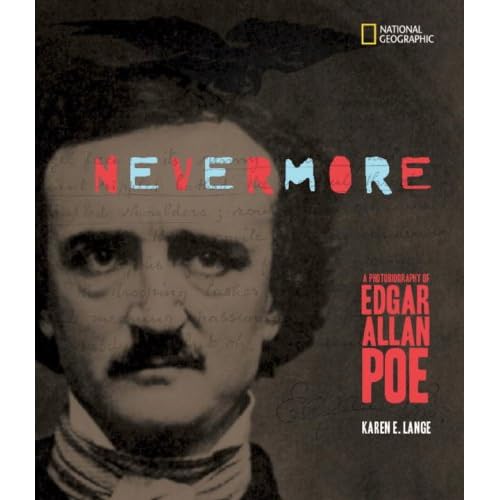
Nevermore: A Photobiography of Edgar Allan Poe by Karen Lange
This
approachable and engaging photobiography is a great match for anyone
with even the slightest bit of curiosity regarding Edgar Allan Poe. All
too often, Poe’s life is glossed over during short
story and poetry units of study. Packing a number of extant photos of
Poe and his contemporaries, as well as the arc of his tumultuous 40
years of life into a slim 57 pages, this volume is a perfect
introduction or second text on the subject of the life and times of
Edgar Allan Poe. Lange neatly covers real-life tragedies that lent
themselves to literary masterpieces like “The Raven” and “The Tell-tale
Heart” and inspired contemporary literature like Snicket’s Series of
Unfortunate Events. She similarly covers Poe’s tragic loves and places
his writing in literary history, crediting him with the invention of detective fiction.
Backmatter includes a chronology, a list of quote sources, books, articles, and websites for further reading, an index, and illustration credits. An excellent non-fiction text to supplement or include in ELA curricular studies, this volume straddles the divide between a simple text and a more challenging text in regard to layout, structure, and language features.--Jessica Fenster-Sparber
Lange, Karen. Nevermore: A Photobiography of Edgar Allan Poe. Washington D.C.: National Geographic, 2009. Print.
Labels:
biography,
Bronx,
classic literature,
common core,
non-fiction,
nonfiction,
photobiography,
poetry
Tuesday, October 9, 2012
One Piece by Eiichiro Oda
If you like pirates, over-the-top characters, and long journeys, you’re going to love One Piece. As this manga series starts we meet Luffy, a teenage boy who ate a devil fruit from a Gum-Gum Tree. Unbeknownst to Luffy, the fruit grants him special powers at the cost of the ability to swim. How then will Luffy be able to realize his dream of becoming the greatest pirate in history? Since this manga series is on the lengthy side with about 66 volumes, it will surely keep readers entertained for a long time. One Piece may provide fodder for teachers working on topics that include debate skills as they prepare arguments on the subject of “Pirates vs. Ninjas.” In all seriousness, readers of manga series like Bleach, Naruto, Dragon Ball Z and Death Note will enjoy this prolific writer. --Claudio Leon
Oda, Eiichiro, and Lance Caselman. One Piece. San Francisco, CA: Viz, LLC, 2004. Print.
Labels:
fiction series,
manga,
manga series
Tuesday, October 2, 2012
The Accuser by Anne Schraff
When the neighborhood bully gets murdered, all clues seem to point towards Donyell’s brother, Ricky. Donyell doesn’t want to believe it, but Ricky was out late that night, he came home in bloody clothes, his face looked like it had taken a few punches, and most incriminating of all, he tells Donyell to lie for him and he leaves town for a few days. In a mere 30 pages, Donyell tries to solve this murder mystery by speaking with all the potential suspects, only to discover that he was mistakenly jumping to a lot of conclusions.
This book is part of the Quickreads series, a collection of high interest, low reading level books from Saddleback, and written by one of the authors of the tremendously popular Bluford High series. While it might not have a lot of appeal for students who like to sink their teeth into a longer story, it could be a good match for students looking for something they can get through in one class period or one evening. Our Reading Specialist at Bronx Hope likes to use books in this series while working with her students; this title is one she says students like the most. --Anja Kennedy
Schraff, Anne. The Accuser. Costa Mesa, CA: Saddleback, 2010. Print.
Labels:
hi-lo,
mystery,
reluctant readers
Monday, October 1, 2012
The Secret Story of Sonia Rodriguez by Alan Lawrence Sitomer
Sonia Rodriguez is determined to be the first in her family to graduate from high school. However, Fortune does not seem to be favoring her aspirations. As the oldest daughter in a traditional Mexican-American family, she must balance the academic demands of her teachers (at least one of which is an out-of-touch bigot) with the nearly all-consuming demands of her family. When she balks at these responsibilities and focuses on her school work she is chastised and misjudged as conceited and lazy and sent to her abuelita’s in Mexico for the summer. She soon realizes that she may have been doing a great deal of misjudging herself. Sonia returns home with a new sense of her history and vision for her future, but the old obstacles remain as stubborn as ever and bad situations escalate quickly. Will Sonia’s determination be enough to see her through?
Inspired by the lives and stories of the author’s own students, and vetted with them each step of the way, The Secret Story of Sonia Rodriguez is a modern Cinderella story, told in the fresh and feisty voice of its protagonist. Beyond being an engaging coming-of-age story, it is also an interesting examination of stereotyping and prejudice in modern American society and full of rich character development. Readers will find plenty to discuss, analyze, and debate. With a Lexile of 800, it is aimed at students reading comfortably at a fifth or sixth grade level. --Regan Schwartz
Sitomer, Alan. The Secret Story of Sonia Rodriguez. New York: Jump at the Sun Books, 2008. Print.
Labels:
book club,
coming of age novel,
fiction,
novel
Friday, September 28, 2012
Cesar Chavez: A Photographic Essay by Ilan Stavans
It
is possible that there is another more perfect photograph in a library
book for sharing with students when Yom Kippur, a holiday they may have
never heard of, occurs smack-dab in the middle of Latino/a History
Month, but on page 62 of Ilan Stavan’s Cesar Chavez: A Photographic Essay,
there is a wonderful image for sparking students’ curiosity and
wonderings. Here is a picture of Cesar Chavez holding a shofar. Why is Cesar Chavez holding a shofar?
Serendipitous events aside, this book is essential for readers who have yet to wonder or have just begun to ask the question Who was Cesar Chavez? With a minimum of text, this volume is an invitation to consider the life of the six-year old boy, his eighth-grade graduation photo, the farmworkers and farm life he concerned himself with, and the battles he fought to establish the humanity and dignity of farm workers. Highly recommended as a supplement to Steinbeck’s Grape of Wrath, Zola’s Germinal, or units of study on child labor, human rights, activism, civil rights, labor movements, and revolution. This book will also be of interest to instructors searching for accessible photobiographies with social relevance which include a higher degree of text-complexity than usually accompanies so much white space. --Jessica Fenster-Sparber
Stavans, Ilan. Cesar Chavez: A Photographic Essay. El Paso: Cinco Puntos Press, 2010. Print.
Thursday, September 27, 2012
Usagi Yojimbo Book 4: The Dragon Bellow Conspiracy by Stan Sakai
Welcome to Edo Japan! Usagi Yojimbo is the story of a rabbit named Miyamoto Usagi, a rounin (a samurai that doesn’t have a lord to serve) who wanders the land taking jobs as a yojimbo (bodyguard). Throughout his journey Usagi meets many fascinating characters; some who become allies willing to aid him in his journey and others who turn into sworn enemies. These characters help keep the story fresh as the focus is not constantly on Usagi. One of the series’ charms is the characters being anthropomorphic animals, which makes the otherwise bloody story more approachable. The series is one of the longest I’ve seen, having well over 23 volumes. Although it is not necessary, I would recommend starting from book one since the story sometimes makes references to previous books. The art is a cross between Japanese manga and western comics all drawn in black and white. Teachers looking to introduce students to Japanese culture, history during the Edo era (1603 - 1868), and the Samurai code (Bushido) should look into this series. Students that have enjoyed Buddha, Maus and Barefoot Gen would probably enjoy Usagi Yojimbo as well. --Claudio Leon
Tuesday, September 25, 2012
How They Croaked: the Awful Ends of the Awfully Famous by Georgia Bragg, illustrated by Kevin O’Malley
What else do you need to know, really? In this collection of historical biographies, all the facts point in one direction -- toward cause of death. Bragg expertly tells the story of nineteen well-known figures in history, from Mozart to King Tut to Edgar Allan Poe, in a mere four or five pages each. Granted, these biographies are not exhaustive, but they do describe who the person was, what they are famous for, and how they died.
Because of the historical nature of these awfully famous people, some of the deaths are quite gruesome, many having come about from less-advanced medical practice and widespread diseases. Mozart, for example, was only 35 when he died of strep throat in 1791; antibiotics were invented one hundred and forty years later. The details of his death are gory, but somehow Bragg’s sly sense of humor makes it all easy to digest.
With the addition of O’Malley’s whimsical illustrations and some fun trivia at the end of each chapter, this book is a sure winner among readers of history. Teachers and librarians will also appreciate the table of contents, bibliography, further reading suggestions and index. --Anja Kennedy
Bragg, Georgia. How They Croaked: the Awful Ends of the Awfully Famous. New York: Walker & Company, 2011. Print.
Labels:
biography,
history,
non-fiction,
nonfiction
Monday, September 24, 2012
Would You Rather: Doubly Disgusting by Justin Heimberg and David Gomberg
Would you rather get lost in your favorite novel, or debate with a group of your peers? If you fall into the latter category, then this is the book for you. It starts quietly, a question posed to a nearby friend, “Would you rather...” marking the discovery of this hilariously disgusting tome by another curious student. Suddenly everyone is thinking long and hard about the options, weighing the pros and cons, and discussing the long-term ramifications of choices such as, “Would you rather clean yourself like a cat, or use a litter box like a cat?” This small book is full of options designed to nauseate and repel, so it is obviously very popular. One part joke book, one part introduction to debate, Would You Rather is an engaging and stress-free read for students that will get them talking about what they are reading, as well as a wonderful tool to introduce the idea of argument and debate to a class. --Regan Schwartz
Heimberg, Justin and David Gomberg. Would You Rather: Doubly Disgusting. New York: Seven Footer Press, 2009. Print.
Friday, September 21, 2012
Drake by C. F. Earl
The wait is over. New
this year to the Superstars of Hip-Hop series from Mason Crest, Drake
the biracial Canadian rapper on the rise since 2009 now has a spot on school library shelves. While this
title would benefit from higher quality images and a reconsideration of
the “hip-hop lingo” text boxes that define words as basic as “rap” (telegraphing to teens that this book does not recognize their prior
knowledge), the current dearth of available library materials on this
popular topic makes this volume worth considering. Earl focuses on
Drake’s ascent to stardom after establishing the music star's success as actor
Aubrey Graham. Earl pays particular attention to Drake’s use of the
internet and mixtapes to create a fan base without the backing of a
major label, and offers a sequential explanation of the artist's eventual
connection with Lil’ Wayne which may have been previously obscure. For
urban teens not yet ready to tackle more challenging text, Drake offers
an opportunity to access a simple expository text on a subject that
will be of high interest to some. The back matter includes a sparse
timeline, web links, an index and picture credits.--Jessica Fenster-Sparber
Earl, C. F. Drake. Pennsylvania: Mason Crest, 2013. Print.
* note this review copy was provided by a publisher at the request of the reviewer.
Earl, C. F. Drake. Pennsylvania: Mason Crest, 2013. Print.
* note this review copy was provided by a publisher at the request of the reviewer.
Labels:
biography,
hip-hop,
non-fiction,
nonfiction
Wednesday, September 19, 2012
Locomotion by Jacqueline Woodson
This
slim, poignant novel in verse introduces the reader to Lonnie Collins
Motion, four years after a tragic accident took his parents and
separated him from his beloved younger sister. Bounced from home to
home, Lonnie has finally found some stability in his foster mom, Ms.
Edna, and his teacher, Ms. Marcus. Told in Lonnie’s voice, through his
poetry, Locomotion
is an engaging and accessible glimpse into the mind of a bright and
loving, but traumatized, young man. Readers interested in exploring
novels in verse will find in Locomotion
a great place to start with its judicious use of white space,
uncomplicated forms, and realistic middle grade vocabulary. Throughout
the book, Woodson uses the conceit of classroom writing, allowing her to
naturally introduce and explain a variety of poetic forms, making Locomotion a fantastic introduction to a unit on poetry. --Regan Schwartz
Woodson, Jacqueline. Locomotion. New York: Puffin Books, 2003.
Friday, September 14, 2012
Bad Dog: 278 outspoken, indecent, and overdressed dogs by R. D. Rosen, Harry Prichett & Rob Battles
Looking for a laugh? Bad Dogs is popular with students who just want to browse and enjoy a few giggles while at it. This is a collection of photographs of dogs, all of them in compromising situations, ridiculous costumes, or both. The authors have included silly captions for each photo, written in the first person from the dog’s perspective. Also included are the pets’ names, ages and hobbies. A call for submissions in the back of the book implies that this is a collection of regular dogs, albeit with maybe not so regular owners. And while the title may suggest the featured dogs are bad, it seems obvious to this reader that these animals have the patience of saints. Also check out the book’s companion, an equally popular Bad Cats: 244 not-so-pretty kitties and cats gone bad. --Anja Kennedy
Rosen, R. D., Harry Prichett, and Rob Battles. Bad Dog: 278 outspoken, indecent, and overdressed dogs. New York: Workman Publishing, 2005.
Labels:
dogs,
humor,
photography,
stress-free read
Thursday, September 13, 2012
Hulk Vs Wolverine by Damon Lindelof, art by Leinil Francis Yu & Dave McCaig
Two of Marvel’s biggest names come together to create a story fueled by love, betrayal and vengeance. Told from the viewpoints of Bruce Banner, Betty Ross, Jennifer Walters and one relentless hunter, Wolverine, this story is full of twists, turns and surprises. Bruce Banner, better known as the Incredible Hulk, has been sentenced to death but he (not surprisingly) survives the death sentence and goes into hiding. In comes Wolverine who is ordered by Nick Fury to find and eliminate the Hulk. The entire story plays out as a high octane action film with an underlying love story between Betty Ross and Bruce Banner. Can Wolverine really bring an end to one of Marvel’s most powerful heroes? And why would Nick Fury select Wolverine for this task out of all the other heroes? Those aware of Jennifer’s true identity will be surprised at the turn of events. This is a must read for any comic book fan. --Claudio Leon
Labels:
comics,
graphic novel,
superhero
Wednesday, September 12, 2012
Black Boy White School by Brian F. Walker
If who you are is a product of where you’re from, how do you stay true to yourself nearly a thousand miles from the only home you’ve ever known? That’s exactly what Anthony “Ant” Jones tries to figure out when he’s sent to elite Belton Academy after witnessing a horrifying murder in his rough Cleveland neighborhood. Over the course of the school year, Ant struggles to navigate the tricky private-school politics of race, class, and academic achievement as he works to find his place in the overwhelmingly white and wealthy crowd. And yet, when he returns home for vacation, he finds himself a stranger on his own block. Can Ant succeed at Belton without losing his identity and alienating everyone who loves him?
Based on the author’s personal experience at prep school in Massachusetts, Black Boy White School is a thoughtful and engaging novel, full of believable characters and realistic situations. The text is straightforward and well-suited to readers of popular teen fiction, such as the Drama High series, and the works of Allison Van Diepen. Readers interested in race and politics will find a lot to think about in Brian F. Walker’s first book. --Regan Schwartz
Labels:
book club,
fiction,
high school
Monday, September 10, 2012
Perfect Chemistry by Simone Elkeles
There is more than geography separating the south and north sides of the Chicago suburb of Fairfield, IL. On the north side, the houses are immense, the clothing gorgeous, the GPAs impeccable, and the pressure nearly suffocating. There is a whole different kind of pressure on the south side, where poverty and gang warfare end lives far too early and protecting your loved ones often means giving up your future. These two sides come together and often clash at Fairfield High School, where a tough chemistry teacher has partnered popular cheerleader Brittany Ellis with dangerous gang member Alex Fuentes. Amused by this situation, Alex happily takes a bet that he can lure Brittany into his bed before the semester ends. But as they cautiously grow closer, they both realize that under the stereotypes and the facades, they have more in common than they ever thought possible. Will it be enough to save them from the futures everyone else has mapped out for them?
Told in both main characters voices, this fast-paced novel, full of realistic relationships and dangerous situations is a hit. This title will appeal to readers looking for teen romance and gritty “real life” novels. Although the epilogue pushes the boundaries of believability, sometimes a bit of a fairytale ending is just what a reader needs. -- Regan Schwartz
Thursday, September 6, 2012
Buddha by Osama Tezuka
This compelling manga series takes readers on a journey of enlightenment across 8 volumes. It begins before Siddartha, the Buddha, is born. Book one starts by explaining the different social castes in Kapilavastu, India. Siddartha who is born a prince sacrifices his riches and family in order to search for the meaning of life. This journey is what makes the series such an amazing read. A Throughout the series we learn about a multitude of characters, that change their lives as they interact with Siddartha. In turn they also force the future Buddha to rethink the purpose of his journey. This manga series offers an accessible entry point to classic works on the buddha, such as Hermann Hesse’s Siddartha. The first volume in the series can be helpful to introduce students to the concepts of social classes and segregation and to world religions, perhaps in Global Studies. Students looking for drama or that have read titles like The Alchemist would likely enjoy the series. -- Claudio Leon
Labels:
comics,
graphic novel,
graphic series,
history,
manga,
series,
Social Studies
Subscribe to:
Posts (Atom)