
Monday, September 29, 2014

Wednesday, September 24, 2014
The Most Dangerous Game by Richard Connell

Sanger
Rainsford is a celebrated hunter from New York City. He travels the
world in search of big game. When he falls off a yacht in the middle of
the Caribbean, he swims for the closest shore and discovers a single
palatial home built on an unfamiliar island surrounded by craggy rocks.
He is given sanctuary by the home’s singular owner, General Zaroff, who
recognizes him immediately and invites him to rest and dine with him.
Over a glass of port, the two men discuss their shared hobby of hunting
and the question of “what is the most dangerous game?” This well-loved
short story is useful for teaching setting, character, conflict and
foreshadowing, and this edition may interest teachers because it is an
unabridged short story bound into a single volume. Interesting language
abounds and readers who persevere through the start of the story are
likely to be hooked by page 16. Offering a great deal of white space, a
four-page analysis of the story, and another four pages of back matter
dedicated to the author’s biography, including images, this series is
packaged for English teachers. The design and layout of the text can be
viewed here. Lesson plan ideas for teaching this classic text from ELA Common Core Lesson Plans can be viewed here. Currently available at our Belmont site.--Jessica Fenster-Sparber
Connell, Richard. The Most Dangerous Game. Mankato: Creative Education, 2011.
Tuesday, September 23, 2014
The Pact: Three Young Men Make a Promise and Fulfill a Dream

The journey to become a doctor is not an easy path for anyone, let alone for a young person growing up in a crime-ridden neighborhood surrounded by negative influences. Yet three best friends facing those exact challenges succeeded in obtaining medical degrees. How?
Drs. Sampson Davis, George Jenkins and Rameck Hunt met as students in Newark, New Jersey. Told in alternating voices in each chapter, each of the three shares his story with the reader from childhood to the present (as of 2002, the time of publication). While each man has a different story to tell (one was arrested and spent time in juvenile detention, another managed to stay out of fights and avoid conflict throughout his childhood), the common thread is that they worked incredibly hard throughout high school, college and medical school to get to where they are now. Each reached points where he felt he might give up -- whether it was problems in his family, academic failure, financial hardships or just plain stress, and his friends were there to support him and encourage him to get back on track. This message is an important one for our students. Young people are frequently lectured on the negative effects of peer pressure and how destructive it can be to “hang out with the wrong crowd.” This memoir sheds light on the flip side of that pressure, and the opportunities that come from surrounding oneself with positive thinkers and ambitious, hard-working friends. --Anja Kennedy
Davis, Sampson, George Jenkins, and Rameck Hunt. The Pact: Three Young Men Make a Promise and Fulfill a Dream. New York: Penguin. 2002. Print.
Thursday, September 18, 2014
Jon Scieszka Presents Guys Write for Guys Read

Bizarre sports initiation rituals, dating, fathers, brothers - the list of topics expounded on in this nonfiction collection goes on and on. Written by men, for young men, the all-star lineup of authors and illustrators includes Walter Dean Myers, Chris Crutcher, Jack Prelutsky, Ned Vizzini, Marc Aronson, Dave Pilkey, and Jack Gantos, and Matt Groening, to name a few. Each of the ninety short biographical stories weigh in at two pages or less, making them a good fit for classroom use. With the wide range of topics and styles offered, Guys Write for Guys Read is a versatile tool for teachers and librarians. Particular stories recommended by my English teaching colleague include Walter Dean Myers’ “Daydreams,” Will Weaver’s “Training the Bear,” and David Shannon’s “No, David!” Each selection includes biographical information about the author and a short selected bibliography. --Regan Schwartz
Scieszka, Jon, ed. Guys Write for Guys Read. New York: Viking, 2008. Print.
Monday, September 15, 2014
Sudden Fiction Latino: Short Short stories from the United States and Latin America
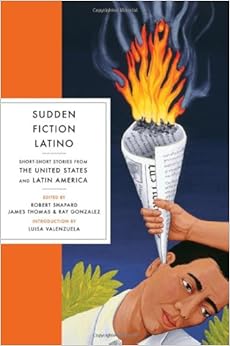
For Passages Academy it seems that Latino History Month and our ELA short story curricular unit are destined to occur at the same time each Fall. Thus, teachers seeking extremely short fiction, totalling about four pages or less, and stories with a connection to Latino/a history, may be interested in this volume. Although many of the stories will not appeal to reluctant adolescent readers, short pieces by literary greats like Rudolfo Anaya (“The Native Lawyer”) and Gabriel Garica Marquez (“Light is Like Water”), may serve as a worthy introduction to these canonical authors. “Day Ah Dallas Mare Toes,” by Luna Calderon, and “Counterfeit,” by Edmundo Paz Soldan, on the other hand, have a charm all their own and might just provoke meaningful discussion on themes of truth, deceit, family, and death and the role of names in literary texts and life. This link from the publisher allows readers to view the entire table of contents, some of which are hyperlinked to permit previews of the text. --Jessica Fenster-Sparber
Shapard, James Thomas and Ray Gonzalez (Eds.) Sudden Latino Fiction: Short-short stories form the United States and Latin America. New York: W. W. Norton & Company, 2010.
Thursday, September 11, 2014
Above Hallowed Ground: A photographic record of September 11, 2001 by photographers of the New York Police Department

For
young people who were not born yet or may have been newly born, and for
older readers who want to remember or enrich their memory, Above Hallowed Ground
is a serviceable pictorial which begins with crisp NYPD photographs of
September 11th, 2001 and ends with the site of Ground Zero, cleared in
April, 2002. This coffee-table sized volume is punctuated by images of
details and memorials and well-captioned throughout. An introduction
paints the event in the most dramatic of terms and leaves the full-color
images to tell the rest of the story. A useful text to visit during a
national day of remembrance. For additional topical texts reviewed in
this blog, readers may want to view The 9/11 Report and One Nation --Jessica Fenster-Sparber
Tuesday, September 9, 2014
Interview Spotlight: Principal Terrell
Welcome
back! I hope you had a wonderful summer. I’m excited to start the new
year and this new year has brought a new principal at Passages. Ms.
Terrell joined us last week and graciously took a few moments out of her
extraordinarily busy schedule to give us a short interview so that we
could introduce her to you. Without further ado, please meet Ms. Avis
Terrell.
JFS: Can you tell us a little bit about what you were doing before taking the helm at Passages?*
AT:
Before Passages, I was the principal of an all boys school, Urban
Assembly Academy of History and Citizenship for Young men (UAAHC),
located inside the Taft Campus.
JFS: What is your favorite kind of text to read? Where is your favorite place to read?
AT:
My favorite kind of text is fiction, books that create complex, real
characters. My favorite place to read is in the bathroom (lol).
Sometimes it is the only place that I can get some peace.
JFS: What was your favorite book as a teenager?
AT: My favorite book as a teenager…..there were so many! A Catcher in the Rye, Invisible Man by Ralph Ellison and anything by Toni Morrison but my all time favorite is Song of Solomon.
JFS: What do you like to do for fun when you're not reading?
AT: When I’m not reading, I like to watch sports (except golf) and spend time with my children.
*Please note that the questions were shamelessly borrowed from my colleague, Regan Schwartz.
Thursday, June 26, 2014
Summer Break
Dear Readers,
Happy summer! We will continue to provide school library services this summer, but we'll be taking a break from posting until the start of the new school year. We wish you a wonderful summer full of good reads.
See you in September,
Anja, Regan, Claudio and Jessica
Happy summer! We will continue to provide school library services this summer, but we'll be taking a break from posting until the start of the new school year. We wish you a wonderful summer full of good reads.
See you in September,
Anja, Regan, Claudio and Jessica
Wednesday, June 25, 2014
Pinned by Sharon Flake

Autumn
is the only girl on her high school wrestling team, and she’s good. A
younger boy, Roland, would like to get to know her better, but Autumn
only has eyes for Adonis. In fact, Autumn is in love with Adonis, a
fellow student who manages her wrestling team when he’s not teaching her
math class, volunteering to tutor and mentor other students, taking
visiting dignitaries on tours of his school, and speaking at school
assemblies. Adonis, however, disdains “regular” people who are not
differently-abled (as he is in his wheelchair), and he cannot stand the
way Autumn flails in academics, nor her relentless pursual of him.
Will Autumn graduate on time, succeed in the face of mean wrestling
opponents, and win Adonis’ heart? This novel in two voices (chapters
alternate between Adonis and Autumn’s different perspectives and voices)
explore differences in abilities and becomes heavy-handed, at times,
but will still appeal to fans of Flake and developing middle school
readers looking for a bit of a love story. --Jessica Fenster-Sparber
Flake, Sharon. Pinned. New York: Scholastic Press, 2012. Print.
Tuesday, June 24, 2014
Fourth Down and Inches: Concussions and Football's Make-or-Break Moment by Carla Killough McClafferty

From the early days of brute force football to the contemporary high-flying dynasties, Fourth Down and Inches
provides readers with a concise history of the American pastime and
brings awareness to the dangers of the sport. The book begins with a
detailed history of the origins of college football, mentioning some of
the oldest team feuds and how they originated, along with the rising
popularity of the sport. Each chapter discusses injuries and
fatalities that happened in the field and the gradual progress made
towards identifying and treating concussions. As the book moves through
the years, the focus shifts to the prevention of fatalities and
minimization of injuries at both the college and professional level.
Although the book provides many medical terms and details the high tech
equipment used to keep players healthy, it never overwhelms or confuses.
Fourth Down and Inches
is filled with old and new pictures of teams, athletes and past games.
The diagrams are colorfully detailed and help explain some of the
equipment the athletes use and the medical analysis done to help make
sure football becomes a safer sport. For those looking to learn more
about football and its wonderfully dangerous history, Fourth Down and Inches is a great read.--Claudio Leon
McClafferty, Carla Killough. First Down and Inches: Concussions and Football’s Make-or-Break Moment. Minnesota: Carolrhonda Books, 2013. Print.
Monday, June 23, 2014
Graffiti School: A Student Guide With Teacher’s Manual by Chris Ganter

Acknowledging
in his introduction that the graffiti scene is split into two groups:
illegal sprayers and legal sprayers, and noting that the legal sprayers
need experience and ideas to create the detailed pieces worthy of a
legal wall, author Chris Ganter has written the missing “how-to” book for the less experienced writer. With the care of a teacher, Ganter
covers graffiti’s relationship to society, its history, the hip-hop
context, terminology, and related media before jumping into directions
for designing graffiti. These chapters are separated out into a)
designing and b) dealing with spray paint. The last chapter of the book
is devoted to teachers, suggesting approaches to planning a graffiti
unit and including a sample lesson plan, exercises, and corresponding
“solutions.” Back matter contains a smattering of sample alphabets (for
more of these, see Walde’s Graffiti Alphabets),
a European-oriented timeline of graffiti’s evolution beginning in 1970,
a glossary, a bibliography for further reading, photo credits and an
index. Strongly recommended for independent use, as well as art
educators. Highly popular with Passages students at Belmont.--Jessica Fenster-Sparber
Ganter, Chris. Graffiti School: A Student Guide with Teacher’s Manual. New York: Thames & Hudson, 2013. Print.
Friday, June 20, 2014
Core Reference List

Which titles are the most popular and essential reference print items in your library? In ours, they seem to be:
1) Hip Hop Rhyming Dictionary by Kevin M. Mitchell
2) Pocket Oxford American Dictionary (Paperback) by Oxford University Press
3) Scholastic Pocket Thesaurus by John K. Bollard
4) The Occupational Outlook Handbook
7) DK’s Spanish-English Visual Bilingual Dictionary (other languages in this series are popular as well)
8) The Ultimate Scholarship Book by Gen and Kelly Tanabe
--Passages Academy Library Team
Thursday, June 19, 2014
Core Biography List

Which are the most popular and essential biographies, memoirs, and autobiographies in your collection? Here are Passages Academy Libraries':
1) Yummy by Greg Neri, Illustrated by Randy DuBurke (n.b. This hybrid volume contains an acknowledged element of fiction)
2) A Child Called It by Dave Pelzer
3) The Autobiography of Malcolm X: As Told to Alex Haley by Malcolm X, Alex Haley and Attallah Shabazz
4) Life in Prison by Stanley Tookie Williams (n.b. Currently only available in a hardbound version)
5) Saddleback's Hip-Hop Biography series titles Drake, Nikki Minaj, Beyonce
6) LeBron James: King of Shots by Anne E. Hill
7) The Diary of a Young Girl by Anne Frank and Anne Frank: Her Life in Words and Pictures
8) A Question of Freedom by Dwayne Betts
9) Fist Stick Knife Gun by Geoffrey Canada, illustrated by Jamar Nicholas
10) Burned Alive by Souad
11) DK Biography: Barack Obama by Stephen Krensky
---Passages Academy Library Team
Wednesday, June 18, 2014
Before I Die by Candy Chang

What
do you want to do before you die?
Candy Chang contextualizes this
question in New Orleans after the storm, the wake of tremendous personal
loss, and the Stoics’ suggestion that to contemplate death is to
restore perspective and make life meaningful. Chang introduces her book
with this context, and then goes on to describe her project to paint an
abandoned house in her neighborhood with chalkboard paint and stencil it
with a grid of the sentence, “Before I die I want to ________________.”
Anyone walking by could pick up a piece of chalk, reflect on their
lives, and share their personal aspirations in public. This book shares highlights via text and photographs of Chang’s New Orleans installation, and then goes on to show images and quotes as the community art installation found new life in new environs. Artists and
community members in Jerusalem, Germany, South Africa, Thailand, and
more created similar projects to similar effect. The book also includes
“remixes,” stats, and directions for making this kind of wall project.
This book can inspire students to talk about public art, to think about
the questions worth asking, and to reflect on what they hope to
accomplish, as well as evoke responses to the aspirations from around
the world contained within the covers. The design of the book uses
pulled quotes against solid color rectangles alongside colorful images
of text, rendering it accessible for emerging readers as well as their
more sophisticated peers. Recommended for independent reading, inquiry,
and art educators. --Jessica Fenster-Sparber
Chang, Candy. Before I Die. New York: St. Martin’s Griffin, 2013. Print.
Thursday, June 12, 2014
Snitch by Allison Van Diepen

Julia DiVino has a plan for her future and it does not involve the gang life. Julia has managed, with her best friend Q for support, to stay clear of the constant gang-related violence and drama at her Brooklyn high school, despite the fact that some of her friends are in rival gangs. When gorgeous Detroit-transplant, Eric Valiente shows up, he and Julia fall hard and fast for each other. But soon he reveals his gang-involved past and joins up again, breaking Julia’s heart in the process. Then, at a club one night, Julia warns Eric that he’s about to get jumped. With that one act, her life will never be the same - no one’s will. Because everyone is not who they seem and she’s not the only snitch.
Snitch is a fast-paced, drama-filled novel that has wide appeal - it is one of the most popular books in our libraries. Its accessible language and straightforward structure make it a solid independent reading choice for reluctant readers ready to move on from the Bluford High series or similar books. --Regan Schwartz
Those looking to facilitate a book club discussion of Snitch is may want to take a look at the teacher guide available here.
Van Diepen, Allison. Snitch. New York: Simon Pulse. 2007.
Tuesday, June 10, 2014
Upstate by Kalisha Buckhanon

Seventeen-year-old Antonio pleads guilty to his abusive father’s murder; whether he did it or not is unclear, but he’ll still have to serve ten years for it. Natasha, Antonio’s girlfriend, swears she’ll wait for him. But ten years is a long time, and while Natasha is getting ready to go to college and explore the world, Antonio is stuck in a four-by-ten room. Upstate allows the reader to see how two intertwined lives can go in complete different directions over the course of ten years. The entire narrative of the book is wonderfully done in correspondence between Natasha and Antonio. The letters between the two at first come almost daily and eventually devolve to a handful a year. Did Antonio really kill his father? Where will Natasha be when Antonio is finally released? Upstate is a great independent read for fans of Paul Volponi’s Riker’s High and Walter Dean Myers’ Lockdown. --Claudio Leon
Teachers and book club facilitators may want to check out Macmillian's teacher guide to upstate here.
Buckhanon, Kalisha. Upstate. New York: St. Martin’s Press, 2005. Print.
Monday, June 9, 2014
Book of Majors by College Board

For students who have had a productive career exploration experience and an idea of where their interests lie, College Board’s Book of Majors is a handy reference item. For users who know the major they would like to pursue in college, the Book of Majors
offers a useful list of every major offered at American universities.
Underneath each major (e.g. Music Management, Nanotechnology,
Cabinetmaking, African-American Studies), readers can find a definitive
list of U.S. colleges offering it. For those who have not yet selected
an area of focus, as well as those who have, this sizeable volume
includes other useful tools: a part 1 featuring a two-page spread on
each major describing what it covers, who might like it, recommended
high school preparation, a surprising fact related to the major, typical
courses in the major, concentrations, a description of the course of
study, related majors, questions to ask prospective colleges, career
options and trends relating to the major, an insider’s quote, and where
to go for more information (snail mail and on the web.) For those who
want to know what all of their options are but are short on time, as
well as for career exploration guides, the book also offers a thirty
seven page listing of majors with one sentence describing each. This is
where some will most efficiently discover that it is possible to major
in Gunsmithing, Gay/Lesbian Studies, and Geotechnical / geoenvironmental
engineering. Highly recommended for reference collections where access
to the Internet is limited or prohibited.--Jessica Fenster-Sparber
College Board. Book of Majors 2013. New York: The College Board, 2013. Print.
Friday, June 6, 2014
March: Book 1 by John Lewis and Andrew Aydin illustrated by Nate Powell

John Lewis grew up trying to save the souls of the chickens on his family’s farm in Pike County, Alabama. He ended up on Capitol Hill. March: Book 1 tells the story of his journey from boy preacher to renowned civil rights activist in vignettes as he entertains two young boys and their mother in his office on the morning of President Obama’s inauguration. The book is solidly rooted in Mr. Lewis’ lived experience - from his first trip up north in 1951, to his first meeting with Dr. King, to his introduction to nonviolence and the fight to desegregate Nashville’s lunch counters. Illustrated in arresting black and white, March: Book 1 is an engaging and edifying read. The conversational tone make it accessible, even to those with little experience reading graphic novels, though the content and vocabulary recommend it to fluent readers. --Regan Schwartz
A teacher's guide is available from the publisher here.
Lewis, John and Andrew Aydin. March: Book 1. Marietta, GA: Top Shelf Productions. 2013.
Thursday, June 5, 2014
Spotlight Interview: Coe Booth


Coe
Booth, beloved author of Tyrell, Bronxwood and Kendra,
took some time out of her busy schedule to answer a few questions from one of
our students. Thanks Coe!
D: When
did you realize you wanted to be a writer?
Coe: I really don't remember a
time when I wasn't writing stories. Ever since I learned how to write
words and sentences, I was stringing them together to make stories. On my
second grade report card, the teacher complained to my mom that I wasn't paying
attention in class, that I was just writing all day! So this has been a
constant thing in my life, and it surprises me to know that not everybody has
characters and stories in their head all the time. That must be very boring!
D: How do you come up with the stories you write?
Coe: That's a hard question because there's no one place where stories come from. They usually start with myself, with experiences I've had or emotions I've felt. From there it's a combination of situations I've seen my friends go through, things I've witnessed in my neighborhood, and lots and lots of imagination. As a writer, you really need to be an observer. You have to watch people on the street, eavesdrop on other people's conversations in public places, etc. You also have to be in touch with your own feelings, the pleasant ones and the sad, difficult ones. That's why I really recommend keeping a journal. Not only does it help you understand yourself better, but it comes in handy when you're trying to recall what you were feeling at certain points in your life. And that becomes very useful when you're writing stories.
D: Who helped you accomplish your goals? How?
Coe: It would take way too long to answer this question! Besides my
parents, I think my friends had the most to do with helping me accomplish my
goals. Even when I was young, I always chose good friends. I grew
up in the Bronx, so of course there were lots of kids who were making bad
decisions. I never turned my back on them, but they weren't my close
friends. I surrounded myself with people who were about something, who
had goals. And they weren't just dreamers; they worked really hard to
make their dreams come true. If it weren't for my friends, I probably
wouldn't have any books published. When I was working as a crisis
intervention specialist, a job that took up most of my time, my friends got
together and reminded me of the goal I had since I was a kid, to be a writer.
Then they pushed me to quit that job so I'd have more time to write,
advice I (thankfully) followed. Friends are so important; choose them
wisely!
Subscribe to:
Posts (Atom)

 Posts

