Monday, November 29, 2010

Microcosmos by Brandon Broll


Did you know that a butterfly’s wings magnified 585X their size reveal that they are made of feather-like scales? Or that shark skin magnified 135X its size reveals it is made of steely tooth-like scales actually called dermal teeth?! Microcosmos is divided into six chapters: Microorganisms, Botanics, Human Body, Zoology, Minerals, and Technology. Each two-page spread contains a full-page color photo of the chapter’s subjects magnified 20X to over 22,000,000X times its size, the subject’s title, a brief description, and how largely it was magnified. I love asking students to guess what the photos are really of before revealing the answer. They dive into this book, pulled in by the strange and bizarre worlds we are unable to see with the naked eye. This book would be perfect for any science classroom, and is a great discussion starter.

Broll, Brandon. Microcosmos: Discovering the World Through Microscopic Images From 20X to Over 20 Million X Magnification. Buffalo, NY: Firefly Books, 2007.

Monday, November 22, 2010

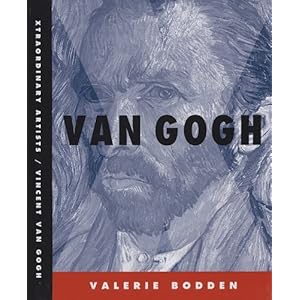
Vincent van Gogh by Valerie Bodden


He experienced life as an outcast, he shot himself, he died in relative obscurity, and one of his paintings recently sold for almost $82 million dollars. Hard not to be interested in this guy. Perhaps this is why Lauren Adelman, outreach educator at the Museum of Modern Art, chose to start her session in Bridges’ library last week with Vincent van Gogh’s Starry Night, a highlight of MoMA’s permanent collection. Whatever the reason, students were quickly captivated by the art-looking she facilitated and were subsequently eager to pore over this volume on van Gogh from the Xtraordinary Artists series. A short 48 pages with 25 full-color reproductions and studies of van Gogh’s art, this book is approachable and full of information to start students on an inquiry project. The author has thoughtfully included several excerpts from van Gogh’s numerous letters so that the reader can encounter the painter in his own (albeit translated) words. Endnotes contain a one-page timeline, a one-page glossary, an index and a bibliography.

Click here to read Tupac’s Starry Night. Connection made by Passages’ student Avian M.


Bodden, Valerie. Vincent van Gogh. Mankato: Creative Education, 2009.

Sunday, November 21, 2010

Get your tickets now! Biblioball 2010: Spellbound


You won't want to miss this! On Saturday, December 4th, The Desk Set is having a huge dance party at the Bell House in Brooklyn to raise money for Literacy for Incarcerated Teens. For those of you who don't know, LIT funds all kinds of literacy initiatives for incarcerated and detained youth, including library collections and author programs. Please come and support this amazing organization!

Watch an invitation to the event that Time Out New York made a critic's pick here: http://vimeo.com/16865892


A special discount applies for Passages' teachers -- get in touch with Anne, Anja or Jessica for the secret code.

We'd love to see you all there.

Friday, November 19, 2010

Tyrell by Coe Booth


Tyrell is feeling the pressure. He and his mom and his little brother just got kicked out of the projects and they’re living in a shelter. His dad is in prison and his mom wants him to start selling drugs to support the family. He’s torn between his long-time girlfriend (whose life seems perfect and nothing like Tyrell’s) and the new girl he met at the shelter (whose life is more similar to his own). With all of these challenges in his life, school is not a priority and he stops going. Booklist, in its starred review of the book, said Tyrell is “heartbreakingly realistic,” and I agree. Tyrell’s life reflects the stressful experiences of many of our students’ own lives. The plot is immediately familiar, as is the characters’ language and dialog. This book flies off the shelves; it gets checked out more times than any other novel in the library, and it is the most difficult one to get returned. One student borrows the book, but it often then gets read by each student in the group home before it comes back to school. This book is highly recommended for independent reading— trust me, it’s not a tough sell. Also exciting for students and teachers, the sequel, Bronxwood, is coming out soon! We are eagerly anticipating Ms. Booth’s visit with our high school students at Summit in December.

Booth, Coe. Tyrell. New York: PUSH Scholastic, 2006.

Wednesday, November 17, 2010

Visiting Day by Jacqueline Woodson


This is not a book we currently have in our libraries, but fans of Jacqueline Woodson, beautiful picture books, and those serving incarcerated youth will want to know about it. You don’t have to do too much digging to figure out that while incarceration effects everyone, there is a highly significant link between incarcerated parents and incarcerated teens, at least in New York City. Sharon Content founded Children of Promise for this particular reason, and Torrey Maldonado wrote Secret Saturdays for younger (middle school) readers who may have a family member (or neighbor or friend) who is “upstate.” But Jacqueline Woodson, never one to shy away from the ways pre-teens and teens are affected by incarceration, joined forces with illustrator James E. Ransome to deliver a heartbreakingly beautiful picture book on the subject for younger children. Visiting Day follows a young female narrator as she and her Grandma get ready to visit Daddy and then make the trip. The young protagonist’s experience is portrayed as familiar and full of love. Author and illustrator notes at the end may cause your eyes to well up. This book will be of interest to students who are incarcerated and parents themselves. It is both warm and a wake up call.

Woodson, Jacqueline. Visiting Day. New York: Scholastic, 2002.

Monday, November 15, 2010

Ten Mile River by Paul Griffin


Ray’s book smarts and Jose’s street smarts make them a bit of an odd couple. But their shared experiences in foster care and juvenile detention have forged a strong friendship between the two, one in which both are able to demonstrate survival skills. This amazing first novel from author Paul Griffin chronicles 14-year-old Ray and 15-year-old Jose’s experience living on the streets and on their own. An attention grabbing opening scene, in which the boys are paid by a local auto body shop owner to smash windshields, and the authentic dialogue immediately draw Passages’ students into this coming-of-age tale. The boys’ brief stint at “Spofford” provides an immediate text-to-self connection for our readers. The novel continues to explore themes of friendship, loyalty, love, morality, and family, offering endless discussion opportunities for literature circles. Passages Academy students at Crossroads are enthusiastically reading Ten Mile River in preparation for an upcoming visit from Paul Griffin before Thanksgiving. --Anne Lotito Schuh

Griffin, Paul. Ten Mile River. New York: Penguin, 2008.

Friday, November 12, 2010

Opposing Viewpoints: Military Draft edited by Viqi Wagner


Looking for a book that encourages critical and independent thinking? A book filled with short essays by scholars, professionals and “ordinary” people, who have opinions on big issues from every angle? The Opposing Viewpoints series has all of this and more. In Military Draft, four chapters with questions around the topic of the draft are explored in essays that argue and attempt to persuade from one point of view. These essays are highly opinionated, often controversial, and full of material for discussion and debate. Also useful and appreciated are the bibliographies throughout the book that list additional and suggested reading on the subject at hand. When I ask students to tell me what they think non-fiction means, they often answer “truth” or “facts.” This book (and all the others in the series) is a well-edited example of how truth can mean so many different things to different people -- and it encourages students to think about where the information comes from. While this is not a book that students choose for independent reading, it is certainly recommended for teaching persuasive writing, non-fiction writing, and information literacy skills.

Wagner, Viqi, ed. Military Draft. Detroit: Greenhaven Press, 2008. Opposing Viewpoints.

Thursday, November 11, 2010

Guest Blog Post: Life on the Outside: The Prison Odyssey of Elaine Bartlett by Jennifer Gonnerman


“For Elaine, the nights were the hardest, when she was locked in her cell…she spent the last hours of every day crying into her pillow, trying to muffle her sobs so the other women wouldn’t hear her. Eventually, after an hour or two, she would wear herself out…Every day began the same way, with a guard outside her cell shouting , ‘On the count!’ ”

If I were still at Passages I would definitely teach this book. Maybe not every kid would read the whole book but definitely I know (have some in mind) who if I brought it to their room they would devour it. In class I would photocopy particular chapters or long passages and teach the book piecemeal. The writing is worth studying because it’s honest, detailed, fair and decent to its subject. It's about how incarceration affects the whole family -- parents, children -- so if it doesn't speak to a student’s personal experience, it will probably connect to an adult he or she knows who faced prison and release. A large takeaway would be the scarlet letter of incarceration -- how one arrest can marginalize you, dehumanize you for your life.

The book hits a lot of the requirements for HS English standards -- journalism, memoir, historical accounts, govt. policy document, which is why I recommend it to teachers planning to cover these topics.

It’s a New York Story - - Rikers, the Lower East Side, Bellevue, The Rockefeller Laws, the G train, part two is titled “Thirty-five Miles from Harlem - - about Elaine Bartlett, her four children, her 16 years for a first offense, and her attempt to build a life. --Kevin Jay Heldman

Kevin Heldman taught Journalism at Passages Academy’s Horizon site from 2007-2009 and is a veteran of the U.S. military. You can read his students’ published writing here and here. Mr. Heldman has received numerous awards and his work has been published all over the place. You can read his writing at http://www.journalismworksproject.org and check out his amazing bio there. If you like to read insightful, excellent, writing, you might also want to visit Mr. Heldman’s new blog at http://kevinjayheldman.wordpress.com/.

Wednesday, November 10, 2010

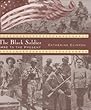
The Black Soldier: 1492 to the Present by Catherine Clinton


When 14-year-old free black James Forten was captured by the British during the Revolutionary War and offered freedom in return for his service, he replied, “I’m a prisoner for my country and I’ll never be a traitor to her.” In The Black Soldier, Catherine Clinton chronicles the experience of black soldiers in America, from the earliest days of exploration to the first Gulf War. Not only are the men and women formally enlisted in the nation’s armed forces discussed, but also featured are the enslaved who fought for their own freedom against their masters and military forces. Chronologically ordered, each chapter is organized around a particular conflict. The writing is accessible and chapters are often only five pages of text, making them easily adaptable to a single class lesson. Also included are engaging black and white photographs from the period. This book would make an excellent supplement to almost any US History lesson because it spans such a broad time period. Not only will students gain knowledge of larger historical events, but also concrete information on how these events effected the men and women involved in them directly. The Black Soldier is highly recommended to celebrate Veterans Day.--Anne Lotito Schuh

Clinton, Catherine. The Black Soldier: 1492 to the Present. Boston: Houghton Mifflin Company, 2000.

Tuesday, November 9, 2010

Guest Blog Post: Be More Chill by Ned Vizzini


What if there was a pill you could buy that made you cool? This is the very question author Ned Vizzini asked himself as he set out to write the wonderfully engaging Be More Chill. In Vizzini’s novel chronicling the life of teenage outcast Jeremy Heere, the protagonist purchases a technologically advanced pill-sized super computer called a SQUIP, which offers young Jeremy direction and much needed guidance navigating the cruel hallways of high school. The SQUIP’s faulty technology places Jeremy in a number of outrageous, humbling, and ultimately meaningful situations.

Be More Chill
is somewhat lengthy, weighing in at just under three hundred pages. Therefore an effective way to assist Passages’ students in successfully completing this novel is to incorporate the unabridged audio version into the daily lessons. Be More Chill also proved to be useful in teaching the many elements of literature, story arch, character development and the value of implied endings (which some of the students at Boys Town challenged Mr. Vizzini on, when he visited on October 27th, 2010).
--L.A. Gabay

L.A. Gabay teaches Creative Writing at Passages Academy’s Boys Town site. L.A. Gabay is a doctoral candidate in the Urban Education Program at the CUNY Graduate Center in New York. His published works can be found in Teaching City Kids: Understanding and Appreciating Them and The Praeger Handbook of Education and Psychology.

Monday, November 8, 2010

Teen Astrology: The Ultimate Guide to Making Your Life Your Own by M. J. Abadie


What’s your sign? The heft of this 300 page paperback coupled with the almost-tattered appearance of this volume in our library might lead you to believe that students can’t stop reading the details of the more complex aspects contained in the pages. That would be a mistake. This book, one of the most popular in our library at Bridges, is most often used to check the basic descriptions of each sign on pages 26-37 and the “How to Find Your Sun Sign” information box on page 4. Whether searching for more information on oneself, one’s associates, or one’s love interests, students regularly approach this volume with personal motivation and often follow up with requests for more “books like this.” Abadie breaks the text up into four parts, prefaced by an explanation as to why teens deserve their own astrology book. Part one addresses the basics, Part two delves into the planetary parings of sun/moon relationships and romantic relationships. Part three covers aspects of the inner planets and the outer planets. Part four addresses teens and their relationship with their parents. Math teachers might find fodder for students to design their own word problems around identifying their chart elements. Counselors might find starting points for conversations about self-knowledge and personality traits. Mainly, though, this book draws readers like moths to a light because we are all inherently curious about mysterious forces that claim to tell us who we are and what’s going to happen next.

Abadie, M.J. Teen Astrology: The Ultimate Guide to Making Your Life Your Own
. Rochester: Bindu Books, 2001.

Saturday, November 6, 2010

The Life of Mammals hosted by David Attenborough


Who doesn’t enjoy watching real, vivid, and up-close footage of animals in the wild? David Attenborough, veteran wild-life expert, hosts and narrates each segment on this DVD collection of four discs, roughly 500 total minutes of mammals. Each disc is further broken down into chapters of mammal-types, making it ideal for showing short bits to a class at a time. By far, most popular with students I have watched it with is the Meat Eaters chapter, where lions and tigers and other big beasts hunt their prey with breakneck speed and ferocity, but students are also riveted to the screen while watching the less obvious chapters on Chisellers (squirrels, marmots, beavers, etc.), Opportunists (hyenas, prairie doges, etc.), Return to the Water (whales, dolphins, seals, etc.) and the others. Like teens everywhere, presumably, our students are fascinated by animals, especially wild ones roaming in places where they have never been. This collection is a perfect tool for beginning research and inquiry projects because students naturally ask many questions while watching it. These questions, which are authentic and organic, make their research all the more valuable. ELA teachers may also use this collection for writing prompts, both creative and non-fiction.

Thursday, November 4, 2010

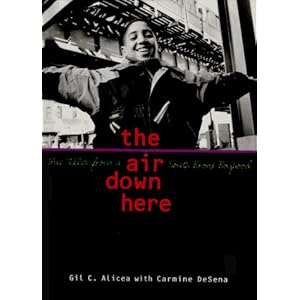
The Air Down Here: True Tales from a South Bronx Boyhood by Gil C. Alicea with Carmine DeSena


“The air in my neighborhood is harder. It’s more thicker, harder to breathe in, harder to see through.” So begins one of the only known texts published by a fourteen year old living in the South Bronx. I love the South Bronx. Not everyone feels the way I do, but you will probably fall in love with Gil C. Alicea after reading The Air Down Here: True Tales from a South Bronx Boyhood, co-written with Carmine DeSena. I first encountered this book while designing lessons for a class of high school seniors entitled Autobiography. While I often found myself wanting more from the hundred or so brief vignettes that fill the short 133 pages, the seniors I worked with usually appreciated the authors’ brevity, vernacular and humor. A single vignette frequently provided sufficient provocation for hours of writing and sharing and ultimately this text became a central one to the project of writing individual biographies. The short form and the accessible language make this book a potentially perfect fit for middle- and high-school aged New York City readers who are a little wary of committing to a 200 page book, yet searching for a true story they can relate to. Alicea hits topics as familiar as family, girls, school, cops and basketball and as serious as his mother’s terminal illness and poverty.

Alicea, Gil C. with Carmine DeSena. The Air Down Here: True Tales from a South Bronx Boyhood. San Francisco: Chronicle Books, 1995.

Monday, November 1, 2010

Lost & Found by Anne Schraff (Bluford High Series)


Darcy has a lot on her mind: a mother exhausted by the demands of her job, a beloved grandmother slipping away as the result of a stroke, an absentee father suddenly reappearing after five years, a sister caught up with the wrong crowd, a crush on a shy-guy classmate, and her own sense of loneliness. Schraff packs the novel’s brief 133 pages chock full of tension and challenges. But the high drama along with the urban setting and realistic situations are what keep our students turning the pages of Lost and Found and all of the Bluford series books. This high interest series is written between a third and fifth grade reading level, but features teenage characters dealing with real life issues such as family, friendship, school, depression, violence, loss, and romance. Students that are looking for a rapid-paced, realistic, accessible read that they can complete relatively quickly will become fast fans of the series. All titles would be ideal for independent reading time or a fiction study.--Anne Lotito Schuh

Schraff, Anne. Lost and Found. New York: Scholastic, 2002.

Friday, October 29, 2010

Where's Waldo by Martin Handford


He might be a blast from the past, but Waldo is as popular as ever in the Summit library. Just in case you’ve never opened a Where’s Waldo book, or if it’s just been a long time since you last looked inside, every double-page spread is a colorful, crowded, puzzling landscape-- and Waldo, the man in a red and white striped sweater, glasses, and a scarf, is always somewhere to be found. But it’s not easy to find him, and even after the reader has found Waldo, he or she can still try to find the rest of the recurring characters. Each spread also provides an opportunity to discover new ideas. Many students love these books, but I find them especially useful when trying to reach our self-identified non-readers. Those students who claim to hate reading and hate books are often perfectly content to sit in a beanbag chair and search for Waldo and his group of friends. Often these same students will turn to their neighbors and work together to solve the puzzles and shout out (very excitedly) when they find who or what they’re looking for. These are “stress-free” books. They’re also great for students who are fans of I Spy books and optical illusions.

Monday, October 25, 2010

Lockdown by Walter Dean Myers


Lockdown. I can’t think of a title more appealing to many of the students I meet at Bridges. One copy is currently missing from our school library after I went out of my way to book talk it on the occasion of the recent announcement that it was a National Book Award finalist. (Stay tuned on November 17th when the winner is announced!) It doesn’t hurt that the cover is enticing too. Readers may have to make it to the second chapter to get hooked, but the entire novel is filled with Myers’ signature telling details, humor, and mission to transport the reader to familiar and unfamiliar territory through the eyes of a young man from Harlem.

In this iteration we meet Reese who finds himself doing time in an upstate juvenile detention facility. Unusually, Reese has been selected as the pilot participant of an experimental new work-release program, and is confronted with the very real challenges that stop him from what might seem to outsiders and policy makers to be an easy path to success.

For those who are familiar with Myers’ oeuvre, Lockdown reads like a cross betweenMonster and The Mouse Rap. Like Monster, Lockdown provides keen insight into the mentality of the denizens of the obscured world that is a secure juvenile detention center. The novel, which I can only guess has been at least several years in the making, comes at a time when more public attention is turned to New York’s state-run juvenile detention facilities than ever before. Lockdown is a timely walk in a resident’s shoes, and should appeal not only to the young people who can relate to Reese, but to the reading public who are curious and remain largely in the dark regarding what life is like for the residents of these facilities.

Adults who give this book to incarcerated young folks should expect readers to express frustration at the lack of a happy ending. Walter Dean Myers continues his remarkable service to citizens of all ages as a public intellectual.


Myers, Walter Dean. Lockdown. New York: HarperCollins, 2010.

Friday, October 22, 2010

One of Those Hideous Books Where the Mother Dies by Sonya Sones


Students seeking an easy read novel in verse with a rags-to-riches plotline may find what they are looking for in Sones’ One of Those Hideous Books Where the Mother Dies. Set in contemporary Beverly Hills, the sixteen year old narrator tells her story of loss, transplantation, meeting her estranged movie-star father, and adjustment and betrayal through poems and emails. Funny and over-the-top, One of Those Hideous Books is a quick read with no chapter breaks. Recommended for independent reading and available for book groups via the Great Stories Club grants Passages received.

Sones, Sonya. One of Those Hideous Books Where the Mother Dies. New York: Simon & Schuster, 2008.

Wednesday, October 20, 2010

Fear This Book by Jeff Szpirglas


Ever wonder where your fears come from, why you can't control your reaction to them, or even why you sometimes like to be scared? Fear This Book begins with an explanation of our physical response to fear and then moves onto explore the origins of superstitions, scary stories, and common phobias. Each topic is given a two-page full-color spread with engaging illustrations, whether it is fear of the dark, snakes, monsters, spiders, or even school. Szpirglas' conversational writing style offers the reader origins, explanations, and interesting trivia related to each topic. With Halloween approaching, students may appreciate reading a brief passage about their own fears. Fans of trivia books like Ripley's Believe It or Not, The Guinness Book of World Records, and Do Not Open will appreciate the information included. Other spooky resources in your library include Are You Afraid Yet?: The Science Behind Scary Stuff, the Goosebumps series by R. L. Stine, works by Stephen King, and Darren Shan's Cirque du Freak and Demonata series.

Szpirglas, Jeff (author) and Ramon Perez (illustrator). Fear This Book: Your Guide to Fright, Horror, & Things That Go Bump in the Night. Toronto: Maple Tree Press, 2006.

Monday, October 18, 2010

Amazing Leonardo da Vinci Inventions You Can Build Yourself by Maxine Anderson


Have you ever wondered how to make your own invisible ink? Or how to make a camera out of a cardboard box? Leonardo da Vinci might be famous for being a great artist, but he was also a tireless inventor. Inspired by the notebooks he filled with ideas and sketches for his inventions, author Maxine Anderson has developed simple experiments for students to recreate da Vinci’s big ideas using common household objects. Each project, and there are close to twenty of them, is introduced through its connection to Leonardo da Vinci and its historical context – some of the more interesting ones include a “perspectograph,” hydrometer, helicopter and parachute. Part biography, part history, and part hands-on experiments, this book is loaded with activities for a variety of content areas. For next week’s Italian Heritage celebration, I will be working with the middle school math teacher (hey, Mr. LoPorto!) and his students to create some of the more mathematically based projects in the book.

Anderson, Maxine. Amazing Leonardo da Vinci Inventions You Can Build Yourself. White River Junction, VT: Nomad Press, 2006.

Friday, October 15, 2010

Exciting posts on NYPL's blog!

We were just mulling over the week and realized we'd be remiss if we didn't share with you that we were recently honored with an interview by Marie Hansen, librarian with the New York Public Library (also one of our community partners) on their blog Stuff for the Teenage! You can read it here: http://www.nypl.org/blog/2010/10/06/incarcerated-teens-passages-academy

Also check out Lindsy Serrano's post, an Incarcerated Teens booklist, for some titles you may have missed. Lindsy has been visiting Passages' students in the Bronx for booktalks, library cards, and giveaways since 2007. http://www.nypl.org/blog/2010/10/08/incarcerated-teens-booklist