Thursday, May 28, 2015

The Great American Cereal Book: How Breakfast Got Its Crunch by Marty Gitlin and Topher Ellis


What is your favorite kind of cereal?  The Great American Cereal Book documents this quintessentially American invention from its very first ready-to-eat cold and boxed appearance in 1863 (Granula) through the present, with a focus on varieties produced by Kellogg’s, Post, General Mills, and their ilk.  Most cereal entries contain the name of the cereal, its producer, the start and end date of production, notable spokescharacters, and interesting facts.  The more familiar (Cheerios, Rice Krispies, Frosted Flakes) are all here along with the obscure (Freakies, Quisps, Klondike Pete’s Crunchy Nuggets, Barbie Fairytopia.)  Occasional features are sprinkled throughout on topics like Marbits (freeze-dried marshmallows found in cereals like Lucky Charms), the origins of Rice Krispie Treats, and The Trix Rabbit Story.  Whether browsing the images of the boxes or reading the features, this volume offers a rich source of advertising examples and stories for analysis and will appeal to students and their teachers immersed in introductions to media studies.  Backmatter includes acknowledgements, credits, and an index, and information about the authors and photographers. --Jessica Fenster-Sparber


Gitlin, Marty and Topher Ellis.  The Great American Cereal Book:  How Breakfast Got Its Crunch.  New York: Abrams Image, 2011.

Click here and here
for examples of a lesson plan inviting students to create their own cereals and advertisements and to analyze the nutritional value of different cereals. 

Wednesday, May 27, 2015

Interview Spotlight: Principal Baxter-Sweet

Passages Academy began 2015 under the guidance of a new principal and as we begin to wrap up this academic year, she graciously carved a bit of time out of her incredibly busy schedule for an interview.  We are very excited to introduce to you our new leader, Ms. Yvette Baxter-Sweet.


RS: Can you tell us a little bit about what you were doing before taking the helm at Passages?

YBS: Prior to accepting the Principalship at Passages I was an Assistant Principal at East River Academy located on Rikers Island.  Prior to that I was an instructional/literacy coach for 5 years.  Last but not least I was a classroom teacher for 8 years in grades ranging from Kindergarten to 5th grade.


RS: What is your favorite kind of text to read?  Where is your favorite place to read?

YBS: I love reading mysteries, fantasy and realistic fiction text.  I love to read anywhere when I have the time to read for enjoyment.


RS: What was your favorite book as a teenager?

YBS: There were a few that I liked and remember: A Tree Grows in Brooklyn, Down These Mean Streets and I Know Why the Caged Bird Sings.


RS: What do you like to do for fun when you're not reading?

YBS: I love to travel around the world as well as the country.

Friday, May 22, 2015

Guest Post: Why I Think This World Should End by Prince Ea

In honor of Earth Day and National Poetry Month, my students and I watched rapper/activist Prince Ea perform his spoken-word poem “Why I Think This World Should End” about the damage humans have done to the environment. Noting the mass destruction of trees to make money, pollution caused by carbon emissions, and the government’s inability to prevent any of it, Prince Ea apologizes to future generations for leaving them a dismal place to live.  Though Prince Ea’s message reveals the brutal reality of the Earth’s decaying state, it also provides hope by reminding viewers that individuals can take action.  My students were moved by the performance, and also alarmed by the new information they received.  One student, T, asked, “If they cut down all the trees, how are we going to survive?” J added, “How are we going to breathe?” Though my students were disturbed by the facts in the video, it prompted them to brainstorm ways they can help save the environment, including recycling, planting trees, car-pooling, taking public transportation, and minimizing their energy use.

I recommend this six-minute video to teachers, especially English teachers, who want to celebrate Earth day with their students. Because this video combines poetry with information about the environment, it serves well as an Earth Day/National Poetry Month text for the month of April.  --Mackenzie Magee


Thursday, May 21, 2015

Start It Up: The Complete Teen Business Guide to Turning Your Passions Into Pay by Kenrya Rankin


A reader interested in starting his or her own business need look no further than Start It Up. The book is a step by step guide on how to start one’s own business during one’s teenage years. This text’s ability to explain business jargon using simple terms makes this title easily accessible to high school students. Without overwhelming, Start It Up provides a good amount of information to get teens started on their business venture. Each chapter deals with a specific step of building, managing, sustaining and growing a business. The chapters conclude with a list of resources for further information and support on the topics discussed. The examples of teens who have started their own businesses can be helpful in demonstrating that a business doesn’t have to be overly complex and that anyone can do it as long as he or she is willing to invest the time and effort. Young entrepreneurs will have their hands full while they start up their own business; the resources in this book will help them plan and stay on track.--Claudio Leon

Rankin, Kenrya. Start It Up: The Complete Teen Business Guide to Turning Your Passions into Pay. San Francisco, 2011. Print.

Wednesday, May 20, 2015

Ms. Marvel: No Normal by G. Willow Wilson


Sixteen year old Kamala is having an identity crisis.  Born and raised in Jersey City in a Pakistani family, she’s beginning to feel like she doesn't fit in with either.  No one really understands her Avengers obsession or her love of fanfiction, and her parents say they trust her but won’t even consider letting her go to a party...at the waterfront...with boys.  In a late-night act of defiance, she sneaks out to the party and almost immediately regrets her decision.  She doesn't feel “normal” at all and the meatheads and clique-girls are only meaner and more xenophobic once it looks like Kamala has ditched her culture.  As she storms off and heads home a weird mist envelopes the city.  Out of the mist Iron Man, Captain America and Captain Marvel appear to Kamala.  When Captain Marvel asks Kamala, “Who do you want to be?” she answers, “I want to be you.”  But being Captain Marvel is not the cure-all Kamala had hoped for.  She has powers she can barely control, parents who are outraged at her disobedience, friends (and frenemies) in trouble, and a city that needs a superhero.  Ms. Marvel is here and Jersey will never be the same. --Regan Schwartz

Wilson, G. Willow, and Adrian Alphona. Ms. Marvel Volume 1: No Normal. New York: Marvel Entertainment, 2014. Print.

Sunday, May 17, 2015

Pluto by Naoki Urasawa


In the future, robots and humans have fought many wars together and now live, relatively peaceably, side-by-side.  International robot laws are in place and these legal restrictions prohibit robots from killing humans.  In spite of a recent civil rights movement for robots, they are still discriminated against by humans, and the protagonist of this murder mystery is a robot member of an international police agency who passes for human named Gesicht.  As the series begins, Gesicht is investigating the recent chilling destruction of a beloved robot and global hero and a string of murders, trying to determine a motive.

This eight volume manga series brings Astro Boy and the grandfather of manga to a fresh audience with fresh perspective.  It begins with a re-imagining of the premise of the recent war in Afghanistan.  In doing so, it raises questions for readers of the nature of sentient life, the implications of artificial intelligence, the features of a post-conflict diverse society, and explores notions of human rights and civil rights in the future.  Fans of manga who loved Death Note and are looking for a new series will devour this one. ---Jessica Fenster-Sparber

Urasawa, Naoki and Osamu Tezuka.  Pluto.  San Francisco: Viz Media, 2008.  Print.

Friday, May 15, 2015

Fullmetal Alchemist by Hiromu Arakawa


After losing their bodies in an alchemy experiment gone wrong, Edward and Alphonse Elric set out on a journey for the only item that can bring their bodies back: the Philosopher’s Stone. The two brothers must overcome many challenges and are forced to choose between what they want most or save those they love. The Elrics will meet many memorable characters along their way in this typically stylized manga series which spans across twenty-seven volumes. As with many popular shonen, themes such as friendship, perseverance, grit and self-sacrifice are woven into this series. The black and white drawings are sharp and full of details which bring to life the multitude of action scenes found in nearly every chapter. Readers of Naruto, Bleach and One Piece are sure to enjoy following Edward and Alphonse along their epic journey.--Claudio Leon

Arakawa, Hiromu. Fullmetal Alchemist. San Francisco: Viz, 2005. Print.

Thursday, May 14, 2015

How to Fake A Moon Landing by Darryl Cunningham


So how does homeopathy work? Wait, does homeopathy work? What is the difference between straight and reform chiropractic?  Is fracking ingenious or dangerous or both?  Inquiring minds want to know.
In this age of sweeping conspiracy theories, climate change denial, and anti-vaccination hysteria we are awash is mis-and-disinformation.  It can be difficult to separate fact from convincing fiction and teaching students to do just that is a key component of developing information literacy.  This is where How to Fake a Moon Landing shines.  In accessible, comic book format, Darryl Cunningham presents seven prevalent controversies as well as an overview of science denial.  Beyond simply offering examples and information to counter the claims of conspiracy theorists and deniers, Cunningham consistently models asking good questions and synthesizing information from multiple sources.  With an extensive list of sources and a cartoon format that belies the density of the information found within, How to Fake a Moon Landing is perhaps best suited to instructional use.  Though avid readers of graphic nonfiction and science buffs will find plenty to ponder.--Regan Schwartz


A teacher’s guide is available from the publisher here.

Cunningham, Darryl, and Andrew Revkin. How To Fake A Moon Landing. New York: Abrams ComicArts, 2013. Print.

Wednesday, May 13, 2015

Interivew Spotlight: Daniel Vargas

Hi there.  We've been busier than usual with poetry programming and free comic book day-- pictures coming soon!  We've been meaning to introduce you to Daniel Vargas who is kindly filling in for our teammate Anja Kennedy at our Bronx Hope site.  Daniel gamely answered a few questions for us so we could introduce you.  Without further ado: Daniel Vargas in his own words.


JFS:  Can you tell us a little bit about what you were doing before arriving at Passages?

DV:  Prior to arriving at passages, I was enjoying being free from a fixed work schedule for the first time in my life. I was reading a lot of fiction, spending time outdoors and exploring the real estate field.


JFS:  What is your favorite kind of text to read?


DV:  From a very early age, I have been partial to fiction. Fiction delves into virtually all aspects of the human experience which enables fiction readers to be proficient in non-fiction as well. Besides the pleasure derived from an intriguing, well-written story, the reader is witness to the age-old struggle between good and evil from the safety of his favorite reading space.

JFS:  Where is your favorite place to read?


DV:  It depends. I favor the dining room table --with my back the wall, to read the newspaper, correspondence and non-fiction in general. But when it comes to fiction, I’m partial to the couch in the family room. I have, on occasion, read a paperback 18 feet above ground, on a tree stand, waiting for deer to go by.

JFS:  What was your favorite book as a teenager?


DV:  It’s difficult for me to identify a favorite book. Normally, several titles come to mind that define a genre or a time. Suffice it to say that I read a lot of comics and Greek mythology as a teenager. Also, I remember nights when my whole family listened to readalouds of Mark Twain’s Tom Sawyer. I was impacted by El coronel no tiene quien le escriba, by Gabriel García Marquez, for I was exposed to a course word for the first time, in a superbly written story. Later on, I was deeply touched by Jorge Icaza’s Huasipungo because of its raw images and strong stand against injustice.


JFS:  What do you like to do for fun when you're not reading?

DV:  I love the outdoors. I enjoy camping, fishing and hunting. In the summer, my wife and I fight for space in our small backyard vegetable patch.


Thursday, April 23, 2015

SLSIDY UnConference is Tomorrow


Tomorrow, April 24th, Passages Academy Libraries will host the fourth annual School Libraries Serving Incarcerated and Detained Youth UnConference.  We look forward to an exciting, attendee-driven day!

Friday, April 17, 2015

How To Rap: The Art and Science of the Hip Hop Emcee by Paul Edwards


Where to write?  Use paper or go digital… or keep it all in your head?  Make your own beats or collaborate with a producer?  How to plan your flow in connection with the beat and write it out so you can remember?  These are just some of the essential questions a novice rapper may contemplate and Paul Edwards has solicited advice from over 100 artists-- some of them as well-known as Q-Tip, will.i.am, and Shock G, some lesser known, and organized their perspectives and insights into four parts: content, flow, writing and delivery.  Within these four parts, topics are addressed by subject matter like content forms (chapter two in part one, including braggadocio, story, abstract and humorous) and rhyme (chapter five in part two, addressing perfect rhyme, assonance, alliteration and consonance, compound rhymes, and coming up with rhymes).  The table of contents is specific and makes subtopics easy to locate.  There is plenty here to keep an interested reader busy and nothing to intimidate besides length--over 300 pages.  While the artists themselves are not always the most articulate, Edwards presents them in their own vernacular.  Teachers might not be happy to read four-letter words in regular use, but younger readers will appreciate the uncensored language.  Backmatter includes an annotated list of interviewees and a helpful index. Recommended for teen patrons who already write or say they would like to write rhymes.  Circulates frequently with Mitchell’s Hip Hop Rhyming Dictionary. --Jessica Fenster-Sparber


Edwards, Paul.  How to Rap: The Art and Science of the Hip Hop Emcee. Chicago: Chicago Review Press, 2009

Bill Batterman expounds on how to use this book to teach public speaking and debate skills on his blog, The 3nr, here.  The post includes an excellent short list of links to lyrics he deems useful to the would-be high school debater.

Wednesday, April 15, 2015

Turn Me Loose: The Unghosting of Medgar Evers poems by Frank X. Walker


Turn Me Loose: The Unghosting of Medgar Evers poems by Frank X. Walker


This slim volume of accessible poems packs a profusion of potent punches.  For readers interested in learning more about Evers, as well as students of American history, racism, and creative writing, these fifty poems offer a rich experience in several voices.  Educators focused on social justice will appreciate Walker’s clear intent articulated in his introduction:


I believe acknowledging and working to fully understand history can create opportunities to better understand racism.  I offer these imagined poems in hope that art can help complete the important work we continue to struggle with-- the access to economic and social justice that Medgar Evers and so many others died for, and ultimately the healing and reconciliation still needed in America.


Poems like “Ambiguity Over the Confederate Flag” (p.4) and “After Dinner in Money, Mississippi” (p. 29) may be useful to teachers introducing aspects of the craft of poetry.  “Unwritten Rules for Young Black Boys Wanting to Live in Mississippi Long Enough to Become Men” (p.  23) offers a form sure to inspire imitative drafts for the current generation of teens living in the wake of Trayvon Martin and recent events in Ferguson, MO.  Recommended for independent reading for eleventh and twelfth graders due to mature content. --Jessica Fenster-Sparber


Walker, Frank X.  Turn Me Loose: The Unghosting of Medgar Evers.  Athens: The University of Georgia Press, 2013.


Click here  for an interview with Walker in which he discusses his use of form and craft in Turn Me Loose.  The full text is available via the Project Muse database, currently accessible through the New York Public Library.

Monday, April 13, 2015

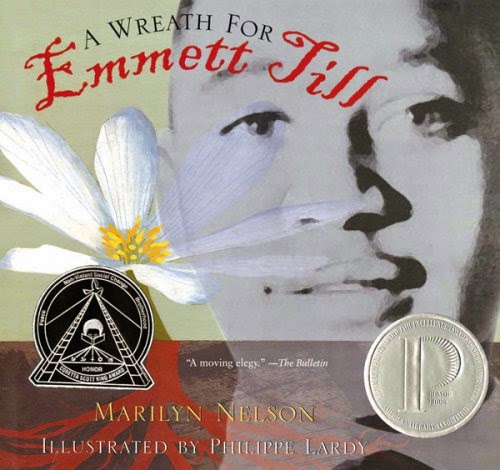
A Wreath for Emmett Till by Marilyn Nelson, illustrated by Philippe Lardy


This haunting and thought-provoking collection of sonnets is both an elegy for Emmett Till and a call to action.  Nelson urges the reader to remember and to bear witness to our country’s shame and horror and offers A Wreath for Emmett Till as a potential starting point.  In the book’s introduction, Nelson describes the heroic crown structure she used and her purpose in selecting such a strict poetic form.  Each of the fifteen interconnected poems is illustrated in vivid color by Lardy’s dynamic and symbol-laden paintings.  This book is not easy to read for many reasons including the difficulty of the subject matter and the complicated form full of literary and historical references.   Helpful backmatter includes a brief history of Emmett Till’s murder and the subsequent trial, notes on the allusions in each sonnet, and an artist’s note.  A Wreath for Emmett Till is a powerful resource for educators looking to tackle the murder of Emmett Till, the birth of the Civil Rights movement and the current state of race relations in the United States.--Regan Schwartz


A teacher’s guide from the publisher is available here.  A guide from Teaching Tolerance is available here.

Nelson, Marilyn, and Philippe Lardy. A Wreath For Emmett Till. Boston: Houghton Mifflin, 2005. Print
.

Wednesday, April 1, 2015

Happy National Poetry Month!

Passages Academy Library team with poet Reggie Harris at Poets House on 3/13.  Photo by Joe Fritsch

We were fortunate to spend a day with poet. librarian and teacher Reggie Harris (formally known as Poetry in The Branches Coordinator & Information Technology Director)
at Poets House, collecting ideas, poems and inspiration.  We're looking forward to all of the language yet to blossom in our libraries in the weeks ahead.  Thank you Reggie, and thank you Poets House!  We'll be back after spring break on April 13th-- see you then.

Monday, March 30, 2015

Sneak Preview: Ghetto Brother: Warrior to Peacemaker by Julian Voloj, Illustrated by Claudia Ahlering


In the last five years there has not been an obvious response to reader demand for another book “just like Yummy,” and that is set to change in May with the publication of Ghetto Brother.  The story of Benjamin Melendez’s founding of, and later departure from, the South Bronx-based gang builds a bit slowly while author Julian Voloj takes the time to lay the foundation for what is yet to come. The true history of the gang’s founding and its role in brokering a peace is all the more surprising in light of later revelations due to the care taken in the first part of the story.  Voloj does Melendez’s tale justice by prioritizing the narrative storytelling over factual minutia, and the black and white artwork by Claudia Aherling utilizes fine detail and watercolor to eschew a cartoonish-ness that might otherwise make this street-language-filled edition appeal to younger readers.  Themes of maturity, identity, and responsibility recommend this book to older teens. 

 Ghetto Brother depicts a fascinating slice of New York City/ South Bronx history that pairs well with Panther Baby and touches on Columbus’s arrival in the western hemisphere and the Spanish Inquisition.  Back matter includes eight pages of photographs and the author’s recounting of the “story behind the story,” where Voloj explains that the book is primarily based on interviews with former activists.  He goes on to list additional resources consulted and includes photos of Melendez himself during the years of his gang involvement as well as Melendez now, forty plus years later.--Jessica Fenster-Sparber


This review is of an advance reader’s copy provided by the publisher to the reviewer.  This title is scheduled for release in May.

Click here to see Melendez talking about GB's former storefront right in front of former Passages' site Summit(?!).  (around 2:26)
 
Julian Voloj and Benjamin Melendez will be signing books at MoCCA Fest 2015 on April 11th (both from 1:30-3pm, and Julian Voloj alone from 5 to 6pm) and 12th (Julian Voloj alone from 12-1pm, and both Julian Voloj and Benjamin Melendez from 3:30-5pm).   

Friday, March 27, 2015

Sports Illustrated Basketball’s Greatest


“In the clutch, who would you rather have with the ball, Magic Johnson or Larry Bird?”  Sports Illustrated’s Basketball’s Greatest is another pictorial with dramatic and artistic photographs of the most famous men in basketball, filling the void left by books like DK’s Basketball’s Best Shots when they go out of print.  Yes, only men.  To their credit, this edition includes the editors’ notes on how they created the rankings and lists the writers and editors whose opinions counted on page ten.  Back matter includes full lists of all nominees for each category.  Less sophisticated readers will appreciate the treasury of photographs, most in full-color, in this oversized coffee table book.  More sophisticated readers will enjoy the articles authored by some of the most famous and most prolific Sports Illustrated writers.  All basketball lovers will find much to discuss, similar to Sports Illustrated’s Kids’ edition on this same topic.  The two make an interesting comparison:  what do publishers do differently when they are trying to sell a book for a younger audience and why?  Perfect for media units and scaffolding the common core’s emphasis on analyzing nonfiction text for audience. --Jessica Fenster-Sparber

Skyen, Bill. (Editor).  Sports Illustrated Basketball’s Greatest.  New York: Time Home Entertainment, 2014.

Thursday, March 26, 2015

Marian Anderson: A Voice Uplifted by Victoria Garrett Jones


Why was vocal artist Marian Anderson awarded the United Nations Peace Prize?  Why did she receive the Presidential Medal of Freedom?  Victoria Garrett Jones leads the curious reader through Anderson’s life beginning with her birth in 1897, and filling the reader in on social and historical context through page-length features on topics like “Spirituals”, “Black Jews” (Anderson’s grandfather identified as such), Anderson’s packing habits (she sometimes traveled with more than twenty-five pieces of luggage at a time!) and key figures in her life and times.  The neat layout, ample white space, and well-selected accompanying images make this volume a strong selection for less-sophisticated older readers.  Helpful front matter includes a timeline of Anderson’s life and backmatter includes a glossary, a bibliography, and an index.  Readers with an interest in American history, black history, civil rights, and music will find much to appreciate.  Patrons requesting a true rags-to-riches story need look no further. --Jessica Fenster-Sparber

Jones, Victoria Garrett.  Marian Anderson: A Voice Uplifted.  New York: Sterling, 2008.

Click here for a calendar-based activity which invites students to write a public letter regarding their feelings on a present-day social injustice.   Within the lesson, students may read Eleanor Roosevelt’s letter of resignation to the Daughters of the American Revolution upon learning that they would not permit Marian Anderson to perform in Constitution Hall  (an image of Roosevelt’s letter is printed in Jones’ book on page 74.)

Wednesday, March 25, 2015

Things I Have to Tell You edited by Betsy Franco

“my friend and i/ got caught in a storm/ with tears for rain/ and shouts for thunder”
-Melissa Leigh Davis, p41

This slim collection of poetry written by teen girls covers a wide swath of topics, from self-image to gender inequality to complicated relationships and transitioning to adulthood, in its 63 pages.  The writing is at times poignant, acerbic, witty, and deeply touching.  It is always heartfelt.  Each page is illustrated with bold, candid black and white photographs which, while unrelated to the text, complement it well.  Things I Have to Tell You collects voices from girls from many walks of life and many different places and in this diversity offers a chance for girls to see themselves powerfully reflected on the page.  Recommended for fluent readers looking for honest and relatable poetry and to young writers looking for inspiration.  Best suited to teen girls with established poetic leanings.  Front and back matter include a table of contents, author’s preface, photographer’s preface and acknowledgements, author's acknowledgements, and an about the editor and photographer section.  Educators wishing to use this volume in the classroom, perhaps as a supplemental text for women’s history or poetry month lessons, may want to know that there is occasional strong language. --Regan Schwartz

Thursday, March 19, 2015

No Fear Shakespeare: Graphic Novels: Romeo & Juliet


Getting ready to teach Shakespeare? Then I’m sure you’ve heard of No Fear Shakespeare, but have you seen the comic book?  The graphic novel version of No Fear Romeo & Juliet manages to keep many of the jokes and double entendres found in the original play.  Unlike the full-text versions of the No Fear series, the manga adaptation does not contain both the original text and a plain English translation.  Instead, it only has the latter which is suitable for high school students. The graphic novel really excels where it should-- the illustrations.  The black and white panels support the text as they depict characters’ emotions as easy to read; shading helps separate night and day, as well as give characters depth and help the reader understand the mood/tone of each scene. Not every graphic novel reader will gravitate to this adaptation on their own. Students who have read and enjoyed Persepolis and Maus will certainly feel right at home due to the similar art styles, and the demand of students’ background knowledge about the time period. Teachers may want to consider using this adaptation as a scaffolding tool when teaching Romeo and Juliet. I highly recommend pairing this version with both more complex and simpler versions of the play to enrich a reading.--Claudio Leon

Shakespeare, William. No Fear Shakespeare: Graphic Novels: Romeo & Juliet. New York: Spark Publishing, 2008. Print.

Tuesday, March 17, 2015

Slam Dunk! The Top 10 Lists of Everything in Basketball by Sports Illustrated Kids


Greatest basketball player of all time...well, let’s just say that SIK’s pick won’t surprise you and this book is full of rankings that will inspire controversy among readers passionate about basketball.  The large format size emphasizes the full-color photos, sure to appeal to social readers and browsers, as well as serious fans and players.  Foregoing an introduction in favor of jumping right into “Top 10 Greatest Players,” this volume encompasses thirty-two lists, some spread out over several pages, and including topics such as “coolest jerseys,” “teams,” “trades,” and “WNBA players,”... What’s that?  You can’t believe that women don’t show up until page thirty-four and none are among the “greatest players?”  Me neither.  This book will be popular anyway.  Fodder for discussion on multiple fronts.--Jessica Fenster-Sparber

Sports Illustrated Kids.  Slam Dunk!  Top 10 Lists of Everything In Basketball.  New York: Time Hope Entertainment, 2014.