Showing posts with label rap. Show all posts

Friday, April 17, 2015

How To Rap: The Art and Science of the Hip Hop Emcee by Paul Edwards


Where to write?  Use paper or go digital… or keep it all in your head?  Make your own beats or collaborate with a producer?  How to plan your flow in connection with the beat and write it out so you can remember?  These are just some of the essential questions a novice rapper may contemplate and Paul Edwards has solicited advice from over 100 artists-- some of them as well-known as Q-Tip, will.i.am, and Shock G, some lesser known, and organized their perspectives and insights into four parts: content, flow, writing and delivery.  Within these four parts, topics are addressed by subject matter like content forms (chapter two in part one, including braggadocio, story, abstract and humorous) and rhyme (chapter five in part two, addressing perfect rhyme, assonance, alliteration and consonance, compound rhymes, and coming up with rhymes).  The table of contents is specific and makes subtopics easy to locate.  There is plenty here to keep an interested reader busy and nothing to intimidate besides length--over 300 pages.  While the artists themselves are not always the most articulate, Edwards presents them in their own vernacular.  Teachers might not be happy to read four-letter words in regular use, but younger readers will appreciate the uncensored language.  Backmatter includes an annotated list of interviewees and a helpful index. Recommended for teen patrons who already write or say they would like to write rhymes.  Circulates frequently with Mitchell’s Hip Hop Rhyming Dictionary. --Jessica Fenster-Sparber


Edwards, Paul.  How to Rap: The Art and Science of the Hip Hop Emcee. Chicago: Chicago Review Press, 2009

Bill Batterman expounds on how to use this book to teach public speaking and debate skills on his blog, The 3nr, here.  The post includes an excellent short list of links to lyrics he deems useful to the would-be high school debater.

Friday, April 5, 2013

Hip-Hop Rhyming Dictionary by Kevin M. Mitchell


If you like to write rap lyrics and could only pick one book to be stranded on a desert island (or locked in a small institutional room) with every night for a week, you would likely want to consider Mitchell’s reference work as you make your careful selection.  This pocket-sized paperback was designed for writers on the go, weighing in at a lightweight 180 pages.  One of my favorite lines from the intro reads “Words found offensive are … left out because there are only so many trees we can slay to make this book...”  The slim profile is part of the appeal for the reluctant readers and would-be prolific writer of rhymes.  In addition to the simple-to-use format we couldn’t get enough of in Scholastic’s now out-of-print rhyming dictionary, Mitchell includes accessible and engaging front matter.  These first fifteen pages feature an intro, an explanation of how the book works, five tips for writing, a brief history of rap, and a short bibliography of recommended reading.  Teachers of literacy, ELA and creative writing will find this essential and many a Passages student has articulated a desire not to return a borrowed copy to the library.  Multiple copies strongly recommended. --Jessica Fenster-Sparber

Mitchell, Kevin M.  Hip-Hop Rhyming Dictionary.  Los Angeles: Firebrand Music, 2003.

Thursday, December 3, 2009

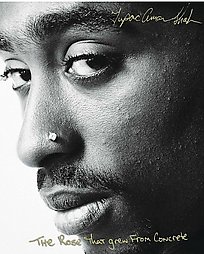
The Rose That Grew From Concrete by Tupac Shakur


Themes of love, pain and poverty are prevalent in this collection of poetry by famed rap artist Tupac Shakur. His handwritten and illustrated poems (complete with misspellings and edits), appear alongside the printed words, making it less intimidating than polished, "scholarly" poetry. This book gets requested by students who love Tupac and poetry – but it also serves as an introduction to poetry for students who claim they aren’t fans. With lines like, “we R 2 young 2 stress and suffer” (from Nightmares), teens can relate to the casual writing style. Most even look like they were written on lined notebook paper, adding to the accessibility of the entire book. This would be a fantastic lead into a poetry unit, or an engaging resource to demonstrate the editing and revising process.

Shakur, Tupac. The Rose That Grew From Concrete. New York: Simon & Schuster, 1999.