Showing posts with label civil rights. Show all posts

Wednesday, May 8, 2024

Who Was the Greatest? Muhammad Ali by Gabe Soria, illustrated by Chris Brunner with colors by Rico Renzi

For comics fans who can’t get enough of Muhammad Ali, I highly recommend this short, punchy biography.  It’s a mix of comics narrated by Ali’s friend,  photographer, and biographer Howard Bingham.  Pages alternate between gorgeously coloured panels and non-fiction paragraphs about Joe Frazier, the Philipines, and professional boxing.  The actual fight is nearly wordless and thus perfect for discussions of sequences, storytelling, layout and perspective.  This book will be of interest to students of all ages and accessible to our younger readers, as well as a good fit for older ones looking for a short read.--Jessica Fenster-Sparber


Thursday, March 30, 2023

Rosa Parks & Claudette Colvin: Civil Rights Heroes by Tracey Baptiste, illustrated by Shauna Grant

You probably know who Rosa Parks was, and it’s likely you’ve also heard of Claudette Colvin.  But did  you know the two women knew each other?  And do you know what teenager Colvin was up to during the time of the 1955-56 Montgomery Bus Boycott?  


In this double biography of the two civil rights figures author Baptiste and illustrator Grant give readers the missing pieces needed to better understand the events of the Montgomery Bus Boycott,  and the brave actions of Parks and Claudette,  all done in comic book format.

Adolescent readers who enjoy comics as well as reading about history and civil rights heroes will enjoy this book as will Social Studies teachers.  --Jessica Fenster-Sparber


Baptiste, Tracey.  History Comics: Rosa Parks and Claudette Colvin.  New York: First Second, 2023.  Print.

Thursday, June 15, 2017

Fred Korematsu Speaks Up by Laura Atkins and Stan Yogi; illustrated by Yutaka Houlette


Imagine that one day your country decides to incarcerate you and your entire family. The crime? Your ethnicity. If your answer is fight back, you would be in the good company of Fred Korematsu, a Japanese-American who took his fight all the way to the Supreme Court after the United States sent thousands of Japanese-Americans to internment camps during WWII. After Korematsu was arrested and convicted for not reporting to prison camp, many of those imprisoned did not support his fighting back for fear that their situation would worsen.  Korematsu lost that first case, and rebuilt his life after the war, marrying and becoming a father, never telling his children about the case or his time in an internment camp until his teenage daughter read about it at school.  When it was revealed that the lawyers for the US government lied to the Supreme Court, the case was reopened and Korematsu won.  Each chapter of Korematsu’s story opens with a full-page illustration, a free-verse narrative poem, and a two-page spread providing historical context, scrapbook-styled primary documents, a helpful timeline, and important vocabulary words. While this is not a book most students will select for independent reading, its compact packaging of information and visual appeal are ideal for those teaching American history. --Anne Lotito-Schuh

Atkins, Laura, and Stan Yogi. Fred Korematsu Speaks Up. Berkeley, CA: Heyday, 2017. Print. Fighting for Justice.

Friday, April 28, 2017

Of Poetry & Protest: From Emmett Till to Trayvon Martin, Edited by Philip Cushway and Michael Warr


A volume of poetry, portraiture, and history, Of Poetry & Protest is “unapologetically political,” specifically addressing police violence, Black Lives Matter, the Civil Rights Movement, the Black Panthers, and how poetry and protest converse with one another. Forty-three living poets are featured, each with a full page portrait, one of their poems, and perhaps most interestingly, a first person narrative describing each writer’s journey to becoming a poet. Throughout the pages are scattered cultural ephemera including fine art, album artwork, posters, flyers, and photographs. This volume lends itself to a unit on current affairs as well as history, author studies, and obviously poetry.  Recommended for strong readers.--Anne Lotito-Schuh

Cushway, Philip and Michael Warr, Eds. Of Poetry & Protest: From Emmett Till to Trayvon Martin. New York: W. W. Norton & Company, 2016. Print.

Wednesday, April 15, 2015

Turn Me Loose: The Unghosting of Medgar Evers poems by Frank X. Walker


Turn Me Loose: The Unghosting of Medgar Evers poems by Frank X. Walker


This slim volume of accessible poems packs a profusion of potent punches.  For readers interested in learning more about Evers, as well as students of American history, racism, and creative writing, these fifty poems offer a rich experience in several voices.  Educators focused on social justice will appreciate Walker’s clear intent articulated in his introduction:


I believe acknowledging and working to fully understand history can create opportunities to better understand racism.  I offer these imagined poems in hope that art can help complete the important work we continue to struggle with-- the access to economic and social justice that Medgar Evers and so many others died for, and ultimately the healing and reconciliation still needed in America.


Poems like “Ambiguity Over the Confederate Flag” (p.4) and “After Dinner in Money, Mississippi” (p. 29) may be useful to teachers introducing aspects of the craft of poetry.  “Unwritten Rules for Young Black Boys Wanting to Live in Mississippi Long Enough to Become Men” (p.  23) offers a form sure to inspire imitative drafts for the current generation of teens living in the wake of Trayvon Martin and recent events in Ferguson, MO.  Recommended for independent reading for eleventh and twelfth graders due to mature content. --Jessica Fenster-Sparber


Walker, Frank X.  Turn Me Loose: The Unghosting of Medgar Evers.  Athens: The University of Georgia Press, 2013.


Click here  for an interview with Walker in which he discusses his use of form and craft in Turn Me Loose.  The full text is available via the Project Muse database, currently accessible through the New York Public Library.

Monday, April 13, 2015

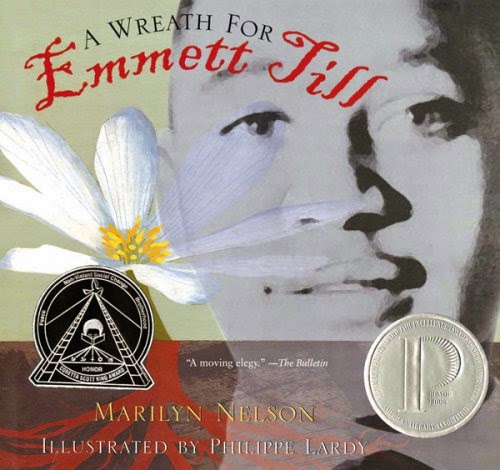
A Wreath for Emmett Till by Marilyn Nelson, illustrated by Philippe Lardy


This haunting and thought-provoking collection of sonnets is both an elegy for Emmett Till and a call to action.  Nelson urges the reader to remember and to bear witness to our country’s shame and horror and offers A Wreath for Emmett Till as a potential starting point.  In the book’s introduction, Nelson describes the heroic crown structure she used and her purpose in selecting such a strict poetic form.  Each of the fifteen interconnected poems is illustrated in vivid color by Lardy’s dynamic and symbol-laden paintings.  This book is not easy to read for many reasons including the difficulty of the subject matter and the complicated form full of literary and historical references.   Helpful backmatter includes a brief history of Emmett Till’s murder and the subsequent trial, notes on the allusions in each sonnet, and an artist’s note.  A Wreath for Emmett Till is a powerful resource for educators looking to tackle the murder of Emmett Till, the birth of the Civil Rights movement and the current state of race relations in the United States.--Regan Schwartz


A teacher’s guide from the publisher is available here.  A guide from Teaching Tolerance is available here.

Nelson, Marilyn, and Philippe Lardy. A Wreath For Emmett Till. Boston: Houghton Mifflin, 2005. Print
.

Thursday, March 26, 2015

Marian Anderson: A Voice Uplifted by Victoria Garrett Jones


Why was vocal artist Marian Anderson awarded the United Nations Peace Prize?  Why did she receive the Presidential Medal of Freedom?  Victoria Garrett Jones leads the curious reader through Anderson’s life beginning with her birth in 1897, and filling the reader in on social and historical context through page-length features on topics like “Spirituals”, “Black Jews” (Anderson’s grandfather identified as such), Anderson’s packing habits (she sometimes traveled with more than twenty-five pieces of luggage at a time!) and key figures in her life and times.  The neat layout, ample white space, and well-selected accompanying images make this volume a strong selection for less-sophisticated older readers.  Helpful front matter includes a timeline of Anderson’s life and backmatter includes a glossary, a bibliography, and an index.  Readers with an interest in American history, black history, civil rights, and music will find much to appreciate.  Patrons requesting a true rags-to-riches story need look no further. --Jessica Fenster-Sparber

Jones, Victoria Garrett.  Marian Anderson: A Voice Uplifted.  New York: Sterling, 2008.

Click here for a calendar-based activity which invites students to write a public letter regarding their feelings on a present-day social injustice.   Within the lesson, students may read Eleanor Roosevelt’s letter of resignation to the Daughters of the American Revolution upon learning that they would not permit Marian Anderson to perform in Constitution Hall  (an image of Roosevelt’s letter is printed in Jones’ book on page 74.)

Monday, February 23, 2015

Panther Baby by Jamal Joseph


Jamal Joseph, at 16, was the youngest member of the Panther 21 to be arrested in New York City in 1969 and his memoir, Panther Baby, opens with a gripping scene of Panther weapons training.  Just the thing to draw in readers who may be a bit younger and stand to benefit the most from his look back on his life experiences thus far, including his political participation in the Black Panther Party and the Black Liberation Army, through his six year bid at Leavenworth and into the present. Joseph displays a rare lighthearted humor, inviting the reader to laugh with him at some of the choices he made as a young man and with hard-won deep insight into some of those choices.  Highly recommended for independent readers interested in history, American history, “real life stories,” and Black history.  Teachers may be interested to know that the author uses adult language to authentically capture voices throughout his tale.--Jessica Fenster-Sparber

Click here to register to download a free teaching activity on the Panthers' Ten Point Program from the Zinn Education project.

Joseph, Jamal.  Panther Baby.  New York: Algonquin Books, 2012.

Friday, June 6, 2014

March: Book 1 by John Lewis and Andrew Aydin illustrated by Nate Powell


John Lewis grew up trying to save the souls of the chickens on his family’s farm in Pike County, Alabama. He ended up on Capitol Hill.  March: Book 1 tells the story of his journey from boy preacher to renowned civil rights activist in vignettes as he entertains two young boys and their mother in his office on the morning of President Obama’s inauguration.  The book is solidly rooted in Mr. Lewis’ lived experience - from his first trip up north in 1951, to his first meeting with Dr. King, to his introduction to nonviolence and the fight to desegregate Nashville’s lunch counters.  Illustrated in arresting black and white, March: Book 1 is an engaging and edifying read.  The conversational tone make it accessible, even to those with little experience reading graphic novels, though the content and vocabulary recommend it to fluent readers. --Regan Schwartz

A teacher's guide is available from the publisher here.

Lewis, John and Andrew Aydin.  March: Book 1. Marietta, GA: Top Shelf Productions. 2013.

Wednesday, June 4, 2014

Still I Rise By Roland Laird with Taneshia Nash Laird, Illustrated by Elihu “Adofo” Bey


From colonial day slavery to the Obama campaign, Still I Rise is the intertwined history of the United States and the African American struggle towards freedom and equality in graphic novel format.  The book is narrated by two caricatures which lend some humor to what otherwise would be a very dry and long history lesson.  One strategic decision that separates this text from others on the same subject is the authors' inclusion of the huge events like the abolishment of slavery without dwelling on them.  Instead, the novel brings attention to lesser known events that contributed to the fight for African American equality. The book focuses on back deals and individuals who were working behind the scenes, kind of the unsung heroes of African American history in the United States.  Unfortunately, once the book gets into the Civil Rights Movement it speeds up, trying to squeeze forty plus years of history into fifty pages which may leave the reader with a desire to know more about those years.  Then again, that seems to be the perfect place where teachers can jump in and help students fill in the gaps.  

Still I Rise has a large quantity of text for a graphic novel and its panels and text bubbles are not so easy to follow.  This makes it a bit less accessible for students without any experience reading graphic novels. Students looking to learn more about the history of slavery in the United States, or who enjoyed The Cartoon History of the United States would likely enjoy this book.--Claudio Leon

Laird, Roland, and Laird, Taneshia Nash. Still I Rise. New York: Sterling Publishing Co., 1997. Print

Wednesday, June 5, 2013

Claudette Colvin: Twice Toward Justice by Phillip Hoose


Just when you thought you knew that Rosa Parks sparked what later came to be known as the Civil Rights Movement in December, 1955, Phillip Hoose cracks open the previously almost silent vault of Claudette Colvin.  Divided into two parts to encompass Colvin’s two major efforts to fight injustice as a teen, Hoose gives us Colvin’s voice, along with his own narrated tale, engaging and brief sidebars, and historical photographs.  Adolescent readers may be intrigued to learn of Colvin’s arrest and placement in an adult jail, her meetings with Rosa Parks before Parks made history, and her subsequent experiences as a pregnant teen. Readers will never see Parks in the same way again.  Backmatter in the paperback edition includes an epilogue, afterword, interview, bibliography, notes, acknowledgements, photo credits and an index, all of which help the reader see this work of non-fiction as a well-documented inquiry project.  A riveting, inspiring non-fiction read, this book will be of interest to social studies and ELA teachers alike, as well as their students. --Jessica Fenster-Sparber


Social Studies teachers may be interested in these lesson plans developed by The State of Rhode Island and librarians may want to familiarize themselves with this pathfinder from Eduscape’s website.


Hoose, Philip.  Claudette Colvin:  Twice Toward Justice.  New York: Macmillan, 2009. Print.

Monday, September 27, 2010

Promises to Keep: How Jackie Robinson Changed America by Sharon Robinson

Who better to write a biography on the iconic Jackie Robinson than his own daughter? Sharon Robinson, the baseball player's only daughter, fills this engaging book with a mix of historical facts and family anecdotes. Robinson uses timelines to outline the history of slavery and integration in baseball, and she discusses her father’s athletic achievements in the context of civil rights and the political climate of the day. Primary source materials are highlighted throughout the text, including letters written by Jackie Robinson, death notes sent to the Robinson family, newspaper pages and plenty of pictures, both from the media and from family albums. All of these documents are shown in photographs – readers will get chills looking at the note written in all caps, “WE HAVE ALREADY GOT RID OF SEVERAL LIKE YOU ONE WAS FOUND IN RIVER JUST RECENTLY” (p. 34). This book could easily be used as a resource to teach primary and secondary source documents, or in units on civil rights, biographies and oral histories.

Robinson, Sharon. Promises to Keep: How Jackie Robinson Changed America. New York: Scholastic, 2004.