Showing posts with label short stories. Show all posts

Thursday, September 28, 2017

Guest Post: The Sounds of My Village by Ishmael Beah

Ishmael Beah by Sarah Stacke.  Image from www.themoth.org

Best known for his experiences as a child soldier in the memoir A Long Way Gone, Ishmael Beah’s pre-war childhood in a rural village of Sierra Leone deserves as much attention. This story is an audio recording of Beah’s performance for The Moth, a group which organizes live storytelling events worldwide. In recounting his upbringing, Beah pays homage to his community and its traditions.


When he was nine, Beah’s grandmother told him that “each person’s mind is their own personal library, and as life breathes its moments before you, those moments become memories, and those memories become narratives [...] that you put on a shelf in your own personal library.”  Inspired by her words to create his own rich narrative, Beah inscribes the rhythms of his village in his mind: the morning cry of the birds, the evening communal meal, and the elders’ nightly stories. With tenderness and humor, Beah narrates how his life, once anchored by the warmth of tradition, is torn apart by the unending impact of war. He draws attention to how each victim’s death is the loss of a storyteller and intimates that war does not just destroy the individual but wipes out the collective memory of a culture. War creates a past without storytellers, a tradition without practitioners, and survivors without access to the narratives they need to understand their place in civilization. This story provides an engaging introduction to Beah’s memoir and implants the idea that a young adult’s life is rich enough to compose a personal library.


While this story, suitable for students ages 9 and up, is easily accessible to English speakers, Beah’s dialect may require additional support and scaffolding to aid students in their understanding.


You can access “The Sounds of My Village” here on The Moth’s website. --Esther Kau

Esther Kau currently teaches middle school English in New Jersey. Her current roster of books include Garth Greenwall’s What Belongs to You, her daughter’s favorite, Ben Clanton’s Narwhal: Unicorn of the Sea, and her son’s favorite, Steve Light’s Cars Go.

Monday, March 7, 2016

Fable Comics edited by Chris Duffy


For teachers who cover fables: ELA, Greek and Latin, and general elementary teachers, as well as ESL and Reading specialists who provide academic remedial support to students whose teachers are covering fables, this title will be of interest.  The inimitable Chris Duffy has collected 28 fables, two-thirds attributed to Aesop and the balance being from a variety of cultures including American, European, Asian, and African.  As with all anthologies, the mix means that some hit their mark while others miss.  For teachers providing remedial support, the longer fables may be the most useful, among them Kochalka’s “The Fox and the Grapes,” Sikoryak’s “Lion + Mouse,” and Hernandez’s “The Boy Who Cried Wolf” offer stronger entry points.  The variety Duffy has assembled means that fans of the Flight and Explorer anthologies, and graphic novel fans in general will find favorite artists like George O’Connor and Maris Wicks mixed in with previously-unfamiliar illustrators like Corrine Mucha and Keny Widjaja.--Jessica Fenster-Sparber

Duffy, Chris (Editor).  Fable Comics.  New York: First Second, 2015.  Print.

Click here for a lesson plan from the anthology's own Corrine Mucha via First Second's website.

Monday, December 7, 2015

What My Father Gave Me Edited by Melanie Little


This collection of short stories is a powerful read on the theme of father-daughter relationships. Each of the seven stories features a different family dynamic used to demonstrate how said relationships evolve over the course of time and how complex they can be. From an abusive father to the perfect stepdad, each story is carefully told to show the reader how these relationships affect the daughter’s future relationships and for some their future lives. Although short (8 to 16 pages,) writers manage to convey their thoughts and feelings in a way that encourages the reader connect with the characters. Some of the stories are followed by an interview with the story’s author where she answers questions about her life and what inspired them her to write. My favorite story was by Jessica Raya. She writes about the string of stepfathers in and out of her mother’s life. In and out until the least likely one to stick around does. He sees her grow into a young woman and helps their family as a whole overcome their past challenges. This title would be a good resource for students and teachers seeking short narrative nonfiction as well as looking for alternative texts within the short stories unit.--Claudio Leon


Little, Melanie (Ed.) What My Father Gave Me. Buffalo: Annick Press, 2010. Print.

Monday, December 1, 2014

Why Are We Still Getting HIV? Teens Respond to the AIDS Epidemic Edited by Laura Longhine


35.3 million people are living with HIV around the world, according to UNAIDS, cited on HIVaware.org.uk.  35.3 million.  Asking anyone to contemplate the size of that number is a challenge, and Youth Communication’s Why Are We Still Getting HIV? offers numerous angles from which teachers, parents, and other youth workers (including peer educators) can approach the topic through interviews and personal narratives.  This collection includes both anonymous and credited teen authors’ perspectives on HIV, ranging from what it’s like to go for a first HIV test (“What If…” by Anonymous), to having a peer or adult share their positive status (“Saying Goodbye to Uncle Nick,” by Josbeth Lebron, “A Sad Silence,*” by Desiree Guery), to receiving notification of one’s own HIV positive status (“Date with Destiny” by Anonymous,) as well as dealing with a loved one dying from AIDS (My Uncle Died of AIDS” by Anonymous), and living a long life while HIV positive (“All Too Real: Teens Living with HIV*” by NYC Writers and “Twenty Years Living Positive” interview with Dave Nisbett.)  Back matter includes separate notes to teens and staff trainers as well as a discussion guide for teachers and staff on how to use the book effectively.  While the writing varies in style and tone, it is generally very accessible to teens who are reading proficiently and a worthwhile resource in spite of the fact that there have been some significant updates to the American conversation taking place around AIDS since many of these stories were written. --Jessica Fenster-Sparber


*These two stories are available for free in full-text and with lesson plans provided by YC Teen.


Longhine, Laura (Ed.)  Why Are We Still Getting HIV? Teens Respond to the AIDS Epidemic.  New York: Youth Communication, 2010.  Print.

Tuesday, October 28, 2014

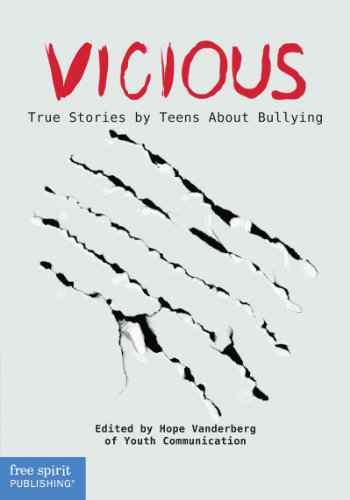
Vicious: True Stories by Teens About Bullying


Vicious: True Stories by Teens About Bullying Edited by Hope Vanderberg

Bullying seems to be a universal experience to the students I’ve gotten to know where I work.  Whether they’ve been bullied, been a bully, or been a bystander, the topic is never unfamiliar.  This collection of writings from teenagers and young adults will let any reader who has experienced bullying know that he or she is not alone.  One of the collection’s strengths is its authenticity; these are the true voices and experiences of contemporary survivors.  The stories are accessible to developing teen readers and their brevity may appeal to both student readers and their teachers.  Recommended for independent reading for teens and educators looking for short stories addressing bullying.  Diverse sub-themes include sexual harassment (“Can I Holla Atcha” by Allajah Young”), LGBTQ (“Gay on the Block” by Jeremiyah Spears and “A Place to Belong” by Lavell Pride), the immigrant experience (“I Showed My Enemies-- and Hurt My Friends, Too” by Elie Elius), and multiple perspectives from foster homes, treatment centers, and residential facilities (like “Standing My Ground” by Xavier Reyes).--Jessica Fenster-Sparber

Vanderberg, Hope (editor).  Vicious: True Stories by Teens About Bullying.  Minneapolis: Free Spirit Publishing, 2012.

Youth Communication provides assorted stories from this collection (and more) on the topic of bullying here.  Titles displaying an apple icon include lesson plan and discussion ideas for teachers.

Monday, September 29, 2014

Who Am I Without Him? Short Stories About Girls and the Boys in Their Lives by Sharon G. Flake

Engaging short stories written in African American voices for teens are always in demand and not always easy to find.  Enter Sharon G. Flake, author of The Skin I’m In and Money Hungry, with this collection geared toward girls, originally suggested to me by my colleague Chrystal Stewart.  While this book makes for an enjoyable read from start to finish, three stories recommend themselves to ELA faculty.  “Don’t Be Disrespecting Me,”  one of the collection’s few stories written with third-person narration, would serve as an accessible lesson on characterization and offers a good match with a Venn diagram or other compare and contrast  graphic organizers. This tale meaningfully contrasts two teen males, Erin and Noodles, who are friends striving to make it through high school in the face of poverty and who approach their frustrations differently.  Another stand-out is the last story, written in epistolary form and entitled “A Letter to My Daughter.”  Articulated in the voice of an absent father returned from prison after a decade or so, the narrator speaks to his daughter from a distance about her experiences becoming a young woman.  Full of admonitions, this story pairs interestingly with Lupe Mendez’s “What Should Run in the Mind of Caballeros” and Jamaica Kincaid’s “Girl” for students learning to think critically about voice, form, and purpose.  Chrystal additionally favors the collection’s first story, “So I Ain’t No Good Girl.” This book works well as an independent read for middle school and younger high school girls, but the true beauty of a collection like this one is that students are likely to become motivated to read it on their own after reading one or two of its stories with an engaging teacher. --Jessica Fenster-Sparber

Flake, Sharon G.  Who Am I Without Him?  New York: Jump at the Sun, 2007.


Click here for the author's discussion guide to the book found on her website.

Wednesday, September 24, 2014

The Most Dangerous Game by Richard Connell


Sanger Rainsford is a celebrated hunter from New York City.  He travels the world in search of big game.  When he falls off a yacht in the middle of the Caribbean, he swims for the closest shore and discovers a single palatial home built on an unfamiliar island surrounded by craggy rocks.  He is given sanctuary by the home’s singular owner, General Zaroff, who recognizes him immediately and invites him to rest and dine with him.  Over a glass of port, the two men discuss their shared hobby of hunting and the question of “what is the most dangerous game?”  This well-loved short story is useful for teaching setting, character, conflict and foreshadowing, and this edition may interest teachers because it is an unabridged short story bound into a single volume.  Interesting language abounds and readers who persevere through the start of the story are likely to be hooked by page 16.  Offering a great deal of white space, a four-page analysis of the story, and another four pages of back matter dedicated to the author’s biography, including images, this series is packaged for English teachers. The design and layout of the text can be viewed here.  Lesson plan ideas for teaching this classic text from ELA Common Core Lesson Plans can be viewed here.  Currently available at our Belmont site.--Jessica Fenster-Sparber

Connell, Richard.  The Most Dangerous Game.  Mankato: Creative Education, 2011.

Thursday, September 18, 2014

Jon Scieszka Presents Guys Write for Guys Read


Bizarre sports initiation rituals, dating, fathers, brothers - the list of topics expounded on in this nonfiction collection goes on and on.  Written by men, for young men, the all-star lineup of authors and illustrators includes Walter Dean Myers, Chris Crutcher, Jack Prelutsky, Ned Vizzini, Marc Aronson, Dave Pilkey, and Jack Gantos, and Matt Groening, to name a few.  Each of the ninety short biographical stories weigh in at two pages or less, making them a good fit for classroom use.  With the wide range of topics and styles offered, Guys Write for Guys Read is a versatile tool for teachers and librarians.  Particular stories recommended by my English teaching colleague include Walter Dean Myers’ “Daydreams,” Will Weaver’s “Training the Bear,” and David Shannon’s “No, David!”  Each selection includes biographical information about the author and a short selected bibliography. --Regan Schwartz

Scieszka, Jon, ed. Guys Write for Guys Read. New York: Viking, 2008. Print.

Monday, September 15, 2014

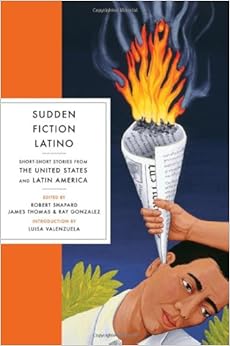
Sudden Fiction Latino: Short Short stories from the United States and Latin America


For Passages Academy it seems that Latino History Month and our ELA short story curricular unit are destined to occur at the same time each Fall. Thus, teachers seeking extremely short fiction, totalling about four pages or less, and stories with a connection to Latino/a history, may be interested in this volume.  Although many of the stories will not appeal to reluctant adolescent readers, short pieces by literary greats like Rudolfo Anaya (“The Native Lawyer”) and Gabriel Garica Marquez (“Light is Like Water”), may serve as a worthy introduction to these canonical authors.   “Day Ah Dallas Mare Toes,” by Luna Calderon, and “Counterfeit,” by Edmundo Paz Soldan, on the other hand, have a charm all their own and might just provoke meaningful discussion on themes of truth, deceit, family, and death and the role of names in literary texts and life.  This link from the publisher allows readers to view the entire table of contents, some of which are hyperlinked to permit previews of the text.  --Jessica Fenster-Sparber


Shapard, James Thomas and Ray Gonzalez (Eds.)  Sudden Latino Fiction:  Short-short stories form the United States and Latin America.  New York:  W. W. Norton & Company, 2010.

Wednesday, October 23, 2013

Historias De Miedo: 1 by Alvin Schwartz

If you’re looking for scary stories in Spanish you’re in luck!  Historias de Miedo (Scary Stories) is filled with a wide range of short horror stories written in Spanish. No story is longer than three pages, making the book a quick read for those looking to read it cover to cover or those just looking for a quick scare fix.  The book seems a good fit for middle schoolers, because it is unlikely that any of the stories will keep students up at night; a few tales were more funny than scary.   The book is divided by chapters, each one containing a category of stories such as: ghosts, stories that will make you jump, scary stories about everyday dangers and even a funny scary stories section.  Tales are accompanied by black and white pictures that complement the story.  My favorite was a comic strip like tale told through four panels about the sea waves coming in and out of the beach called, “El Slideri-di,” which translates to “the sliding slide” or something along those lines.


At the end of the book is an annotated bibliography with details about the background of the stories and their original source. Students looking for not so serious horror stories should enjoy this book. -- Claudio Leon


Schwartz, Alvin. Historias de Miedo: 1. Editorial Everest, 1981. Print.

Monday, October 7, 2013

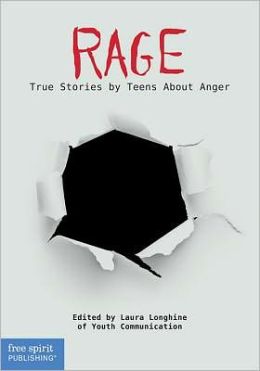
Rage: True Stories by Teens About Anger edited by Laura Longhine


Very few opening lines have more potential to grab a detainee’s attention than one that places the reader in media res while the narrator is making a guilty plea to a judge. Fred W.’s “Loose Cannon” does just that, taking the reader from the courtroom to a secure detention facility (Goshen),  and on to an outpatient drug treatment program.  Natasha Santos’ “Bum-rushed by the Past” follows with a similarly strong opening: “This is the story of a girl born in the projects, neglected by her parents, and tormented by memories of families she is no longer a part of.  It’s about how I spent six years in foster care and got adopted.”  While the collection’s diversity of perspectives may make it difficult for reluctant and developing readers to consume cover to cover, the topical themes will motivate more sophisticated readers to explore the panoply of voices in these seventeen stories.  Notably, all of the seventeen were written by teens and they are complemented by an end interview with Toni Heineman, therapist, who discusses healthy and unhealthy ways to express anger.  ELA teachers looking for personal essays as well as bridges between short stories and memoirs will want to check this out.  Social workers will want to have a copy of Rage on hand to direct students to piecemeal.  ---Jessica Fenster-Sparber

Longhine, Laura.  Rage:  True Stories by Teens About Anger.  Minneapolis:  Free Spirit Publishing, 2012.

Monday, September 23, 2013

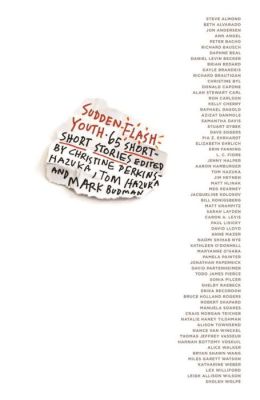
Sudden Flash Youth: 65 Short Short Stories Edited by Christine Perkins Hazuka, Tom Hazuka, and Mark Budman


In need of a short story? An extremely short story?  Check out Sudden Flash Youth.  65 short short stories—none of them longer than four pages— is a worthwhile place to start looking for the shortest fiction that is closer to the “highly sophisticated” end of the text complexity spectrum.  Readers with a preference for an urban voice can go straight to “A Whole Other,” which deftly reveals the differences between what we think and what we say and do.  Those who enjoy the Twist anthologies can  check out “Little Brother ™,” by Bruce Holland Rogers.  Readers in search of  literary experiments may enjoy Voskuil’s eerie “Currents.”  Coming of age themes abound, notably relevant for LGBTQ youth in Konigsberg’s “After” and Soares’ “Haircut.”   Other noteworthy shorts include Hazuka’s “Homeward Bound,” and Dagolds’ fable “The Two Rats and the BB Gun.” Strongly recommended for English Language Arts teachers seeking a fresh crop of very short stories to share with their students. –Jessica Fenster-Sparber

Perkins-Hazuka, Christine, Tom Hazuka and Mark Budman.  Sudden Flash Youth:  65 Short Short Stories.  New York: Persea Books, 2011.  Print.


Click here to view the table of contents and read “Currents.”  Click here to view the publisher’s lesson plan for “Currents.”

Wednesday, September 18, 2013

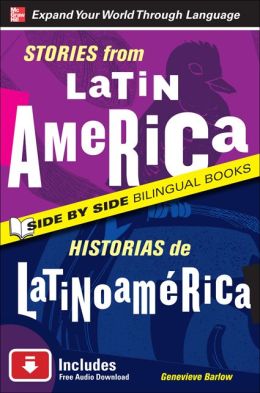
Stories from Latin America by Genevieve Barlow


This slim bilingual volume of sixteen folktales and legends spans thousands of years and ten countries.  From Columbia’s “Poor Fool!” - the story of haughty Don Ramiro’s amusing comeuppance - to Venezuela’s “The Empty Boat” - the tale of a man’s moral transformation - each story is written simply and elegantly, in language accessible to second language learners and developing readers.  The Spanish and English versions are presented side by side for easy back and forth comprehension checks and back matter includes thorough translated vocabulary lists.  Stories from Latin America also includes a map of Latin America and directions to accessing free MP3 audio recordings of four selected stories in Spanish. --Regan Schwartz

Barlow, Genevieve. Stories from Latin America. New York: McGraw-Hill, 2010. Print.


Thursday, May 2, 2013

Flight Volume Six edited by Kazu Kibuishi


What do a Ninja that can't get a job, a gunslinging female detective and an astronaut have in common? Flight! This eight volume set of graphic novel short stories features a multitude of great artwork. Each story has its own unique art style which seems to match the story perfectly and make it come alive.  Like every short story compilation, it has it's hits and misses.  But, in volume six, the hits far outnumber the misses.  The stories cover a wide range of genres but the one thing that brings them all together is the concept of flight.  Although in some stories it is difficult to understand how the theme of flight is represented, this offers a great opportunity for students to figure out the connection, and for teachers to explain the concept of theme.  One favorite in this volume was "The Excitingly Mundane Life of Kenneth Shuri," a story about a ninja freshly graduated from ninja school that can't find a job.  The employment office is no help, his wife complains about him not finding a job and his son wants to be figure skater. In a twist of fate it all works out in the end and the story is filled with hilarious moments.  Among other good ones are "Dead at Noon," a story about a cowboy with amnesia, and "Magnus the Misfit,” a Viking that, unlike the rest of his clan, is not very ferocious.  A definite must read for any comic book fan or short story lover.  Each story is only a few pages, and they range from having no text to plenty of it. --Claudio Leon

Kibuishi, Kazu, ed. Flight Vol 6. New York: Random House Inc, 2009. Print

Friday, October 12, 2012

Scary Stories to Tell in the Dark collected by Alvin Schwartz

Yes, they’re corny, and no, they’re not that scary. But, they are short and slightly spooky, and perfect for students who just want to read a little story at a time. Better yet, they’re a good fit for students who like to tell scary stories and need more material. This book, along with More Scary Stories to Tell in the Dark and Scary Stories 3, also has a lot of potential for ELA teachers currently working on short stories with their classes. With the accompanying CDs (sold separately, but available in some of our libraries) that include stories from all three volumes of Schwartz’s scary story collections, teachers will certainly be able to find at least a few to entertain, all while demonstrating the traditional elements of short stories. Note that the illustrations by Brett Helquist are far lighter than the original publications’ drawings by Stephen Gammell; the original books would certainly be scarier, and probably more appealing to teens.--Anja Kennedy

Schwartz, Alvin. Scary Stories to Tell in the Dark. New York: Harper Collins, 2010.

Friday, October 7, 2011

Guest Post: You Don't Even Know Me by Sharon G. Flake


The boy code of silence is broken, and a perfect blend of powerful poems and short stories written by boys is created in Sharon G. Flake’s You Don’t Even Know Me. In this book, Flake gets us to contemplate on what it really means to know someone. The boys in this book share their stories of foster care, thoughts of suicide, obesity, unplanned pregnancy, love, revenge and the need to be understood with us in hopes of being accepted into our world. This book is a great invitation for all our boys to read and rise and write and inspire. I highly recommend You Don’t Even Know Me as a good read, especially for our reluctant readers. Sharon G. Flake did it again and this time the voices of boys is heard loud and clear. --Denice Martin-Thompson

Denice Martin-Thompson is a Reading Specialist at Passages Academy’s Summit site in the Bronx. She’s the creator of RAW- Ready, Able & Willing to Read and Write, an intervention service for Pre-K--Adults and she is also a published poet. Struggling to Survive The Story of a First Year Teacher Told Through Poetry is available here. Her passion for the arts comes alive in her writing; she believes in the liberating power of poetry and hopes to self publish her other titles one day. You can read more about Ms. Martin-Thompson by visiting her website here.

Tuesday, December 8, 2009

Knucklehead by Jon Scieszka

Absolutely hilarious and totally relatable. Jon Scieszka invites the reader into his childhood antics growing up as the second oldest in a family of six boys. Family photos often deliver the punch line as Scieszka tells stories about Halloween costumes, school photos, and hand-me-downs. While each of the stories are brief and written in language that is accessible for students with a low reading level, the work maintains a reverence for childhood as a special time from the perspective of someone who has already left it. In this way, it invites even the most disenfranchised students to reflect upon the innocence, silliness, and adventure of childhood without talking down to them. Teachers can easily select one tale to share as a class and invite students to tell their own story.

Scieszka, Jon. Knucklehead: Tall tales & mostly true stories about growing up Scieszka. New York: Viking, 2008.