Showing posts with label HIV/AIDS. Show all posts

Thursday, December 4, 2014

Quicksand: HIV/AIDS In our lives by Anonymous


For a student who needs immediate answers, or a teacher looking for a slim volume to read through with students during a non-fiction ELA unit, Quicksand’s length and hybrid format offer an interesting option.  Opening with a first-person narrative, this quick read is eighty-five pages of large font with plenty of white space. Quicksand commences with a chapter entitled “Why I Wrote this Book: The Still Hidden World of HIV/AIDS in America” and uses subtitles like “What is AIDS?” and “How can you tell if someone has HIV?” to toggle between the anonymous author’s experience learning about her brother-in-law’s diagnosis and anticipating the reader’s questions.  The author keeps the text simple enough for a less-experienced, yet  proficient reader to comprehend the content, but the unique format will be best navigated with a knowledgeable guide for less-experienced readers, recommending this text to ELA teachers, social workers, and reading and ESL specialists.  Backmatter includes websites for more information about HIV/AIDS (essential for updated information since this book appears to have been written in 2008), a glossary for terms like “window period” and “viral load,” a narrated bibliography of works consulted, acknowledgements, and an index. --Jessica Fenster-Sparber

Anonymous.  Quicksand:  HIV/AIDS in our lives.  Fairfield: Candlewick Press, 2009.  Print.

Monday, December 1, 2014

Why Are We Still Getting HIV? Teens Respond to the AIDS Epidemic Edited by Laura Longhine


35.3 million people are living with HIV around the world, according to UNAIDS, cited on HIVaware.org.uk.  35.3 million.  Asking anyone to contemplate the size of that number is a challenge, and Youth Communication’s Why Are We Still Getting HIV? offers numerous angles from which teachers, parents, and other youth workers (including peer educators) can approach the topic through interviews and personal narratives.  This collection includes both anonymous and credited teen authors’ perspectives on HIV, ranging from what it’s like to go for a first HIV test (“What If…” by Anonymous), to having a peer or adult share their positive status (“Saying Goodbye to Uncle Nick,” by Josbeth Lebron, “A Sad Silence,*” by Desiree Guery), to receiving notification of one’s own HIV positive status (“Date with Destiny” by Anonymous,) as well as dealing with a loved one dying from AIDS (My Uncle Died of AIDS” by Anonymous), and living a long life while HIV positive (“All Too Real: Teens Living with HIV*” by NYC Writers and “Twenty Years Living Positive” interview with Dave Nisbett.)  Back matter includes separate notes to teens and staff trainers as well as a discussion guide for teachers and staff on how to use the book effectively.  While the writing varies in style and tone, it is generally very accessible to teens who are reading proficiently and a worthwhile resource in spite of the fact that there have been some significant updates to the American conversation taking place around AIDS since many of these stories were written. --Jessica Fenster-Sparber


*These two stories are available for free in full-text and with lesson plans provided by YC Teen.


Longhine, Laura (Ed.)  Why Are We Still Getting HIV? Teens Respond to the AIDS Epidemic.  New York: Youth Communication, 2010.  Print.

Monday, January 17, 2011

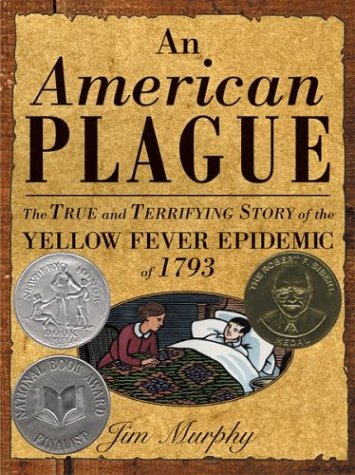
An American Plague by Jim Murphy


If a deadly and contagious sickness struck your city, and the wealthier classes began to evacuate, would you stay, and help your fellow citizens? Or would you leave with your family and head for safety? Appropriately subtitled The True and Terrifying Story of the Yellow Fever Epidemic of 1793, the story begins one hot summer in Philadelphia when all were faced with this question. This non-fiction title does not have a cover that draws the viewer in, nor does it have an opening line that grabs you by your neck and forces you to keep reading. But if you can start on Chapter 2, with its grisly death scene, or pitch students a story about a plague that attacked the United States before it extended beyond its current eastern coast, the reader will be richly rewarded with a harrowing story of death and perseverance, racism and heroism, politics and a glimpse at life in the U.S. just after its revolution. George Washington and the Free African Society are major players in this 139 page title which is followed by sources and an index. Pair it with Anderson’s Fever 1793 (click here for scholastic's lesson plans to teach it), or assign it as supplemental reading to students studying 16th century American History. An interesting point of contrast with contemporary literary responses to the AIDS crisis, this just might interest future public health advocates and policy makers in their course of study.

Murphy, Jim. An American Plague: The True and Terrifying Story of the Yellow Fever Epidemic of 1793. New York: Clarion Books, 2003.

Thursday, November 4, 2010

The Air Down Here: True Tales from a South Bronx Boyhood by Gil C. Alicea with Carmine DeSena


“The air in my neighborhood is harder. It’s more thicker, harder to breathe in, harder to see through.” So begins one of the only known texts published by a fourteen year old living in the South Bronx. I love the South Bronx. Not everyone feels the way I do, but you will probably fall in love with Gil C. Alicea after reading The Air Down Here: True Tales from a South Bronx Boyhood, co-written with Carmine DeSena. I first encountered this book while designing lessons for a class of high school seniors entitled Autobiography. While I often found myself wanting more from the hundred or so brief vignettes that fill the short 133 pages, the seniors I worked with usually appreciated the authors’ brevity, vernacular and humor. A single vignette frequently provided sufficient provocation for hours of writing and sharing and ultimately this text became a central one to the project of writing individual biographies. The short form and the accessible language make this book a potentially perfect fit for middle- and high-school aged New York City readers who are a little wary of committing to a 200 page book, yet searching for a true story they can relate to. Alicea hits topics as familiar as family, girls, school, cops and basketball and as serious as his mother’s terminal illness and poverty.

Alicea, Gil C. with Carmine DeSena. The Air Down Here: True Tales from a South Bronx Boyhood. San Francisco: Chronicle Books, 1995.