Showing posts with label narrative history. Show all posts

Friday, February 7, 2025

My Name is Marcus by Geoffrey Philp, illustrated by Shaquille Cross and Marcel Hemmings


For many years my Belmont colleague has asked  for a text for students about Marcus Garvey, and until now, there has been little to recommend beyond biographical entries in reference works.  This previous dearth of texts about Garvey, whose significance cannot be overstated, now makes this graphic novel for middle school readers remarkable.  


Although the book lacks a  bibliography or table of contents,  teachers who have been hungering for a book about Garvey will be delighted by this slick and richly colored slim volume.  Crosse and Hemmings’ serviceable digital illustrations get the job done,  and youth reading it in detention may appreciate the depiction of Garvey’s time in an American prison and the abuse he endured there.  They may also appreciate learning about President Biden’s recent posthumous pardon of Garvey, and teachers may use this newsworthy development as an introduction to Marcus Garvey’s role in American history and world history.  Backmatter includes a list of 75  facts about Garvey and 20 quotes without any further context provided. --Jessica Fenster-Sparber


Philp, Geoffrey.  My Name is Marcus.  Kingston: Blue Banyan Books, 2024.  Print.


Monday, March 9, 2015

Nazi Hunters: How a Team of Spies and Survivors Captured the World’s Most Notorious Nazi. By Neal Bascomb


Nazi Hunters is a compelling example of narrative non-fiction that reads like a true spy novel. The pages are filled with primary sources gathered during the suspenseful hunt for Adolf Eichmann, the orchestrator of the Nazi’s Final Solution. Nazi Hunters begins with the retelling of Eichmann’s rise to power in the Nazi Party, the end of World War II, and his escape to Argentina. Sixteen years later he was found and a team of special Israeli spies was sent out to secretly capture him and smuggle Eichmann back to Israel where he could stand trial. Through the spies’ retelling of the story, we learn about the preparation and dangers of the mission. From disguises to hidden cameras, the Israeli spies employed every trick up their sleeves to confirm the man they would capture was indeed the man they sought for his involvement in the death of millions.

Nazi Hunters is a great read for high school students interested in the Holocaust, spy novels or the events surrounding World War II.  The text is supplemented by photographs, maps, and documents used during the reconnaissance, capture and escort phases of the mission. --Claudio Leon

Bascomb, Neal. Nazi Hunters: How a Team of Spies and Survivors Captured the World’s Most Notorious Nazi. New York: Arthur A. Levine Books. 2013. Print.

For a few discussion questions from the folks at Unleashing Readers, click here.

Thursday, October 30, 2014

Bootleg: Murder, Moonshine, and the Lawless Years of Prohibition by Karen Blumenthal


While almost all of our students know what the word “bootleg” means in contemporary slang, few, if any, know of prohibition, the eighteenth amendment, or that Al Capone was born in Brooklyn.  This engaging narrative history begins in 1875 with the birth of Morris Sheppard, later known as The Grandfather of Prohibition, and takes the reader through American history, highlighting key figures in the story like Carrie Nation (Chapter 3), the notorious bar smasher, Al Capone (Chapter 8), infamous gangster, and ending with MADD and Red Ribbon Week.  Throughout, Blumenthal refrains from any final judgement on the “wets” and the “drys,” focusing on the dual messages that “each of us is responsible for our own behavior” and that “the experience of prohibition continues to color our laws, our debates and our personal lives.”  Rich backmatter includes a glossary, discussion questions from the author, an interview with the author, additional resources, source notes, acknowledgements and an index.  Recommended for independent reading, as a teaching text for non-fiction ELA units, an enrichment text for American history, and even a book club. .--Jessica Fenster-Sparber

Blumenthal, Karen.  Bootleg:  Murder, Moonshine, and the Lawless Years of Prohibition.  New York: Roaring Brook Press, 2011.

Monday, January 17, 2011

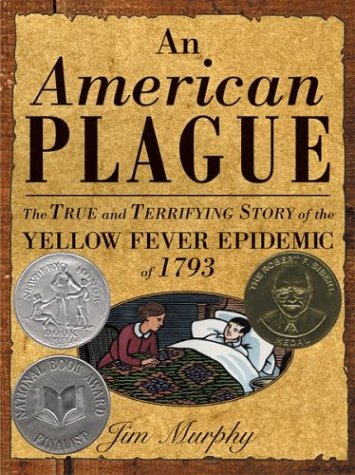
An American Plague by Jim Murphy


If a deadly and contagious sickness struck your city, and the wealthier classes began to evacuate, would you stay, and help your fellow citizens? Or would you leave with your family and head for safety? Appropriately subtitled The True and Terrifying Story of the Yellow Fever Epidemic of 1793, the story begins one hot summer in Philadelphia when all were faced with this question. This non-fiction title does not have a cover that draws the viewer in, nor does it have an opening line that grabs you by your neck and forces you to keep reading. But if you can start on Chapter 2, with its grisly death scene, or pitch students a story about a plague that attacked the United States before it extended beyond its current eastern coast, the reader will be richly rewarded with a harrowing story of death and perseverance, racism and heroism, politics and a glimpse at life in the U.S. just after its revolution. George Washington and the Free African Society are major players in this 139 page title which is followed by sources and an index. Pair it with Anderson’s Fever 1793 (click here for scholastic's lesson plans to teach it), or assign it as supplemental reading to students studying 16th century American History. An interesting point of contrast with contemporary literary responses to the AIDS crisis, this just might interest future public health advocates and policy makers in their course of study.

Murphy, Jim. An American Plague: The True and Terrifying Story of the Yellow Fever Epidemic of 1793. New York: Clarion Books, 2003.