Showing posts with label classic literature. Show all posts

Wednesday, November 30, 2022

Programming Spotlight: New Victory Residency + ELA collaboration

This month students at Belmont participated in a New Victory residency program that brought two extraordinary teaching artists from the theatre into our school library for a week.  The gifted teaching artists were Marisol Rosa-Shapiro and Ugo Anyanwu who led the series of workshops at Belmont  which were bookended by two trips to the New Victory theater where we saw productions of both Romeo and Juliet  and The Three Musketeers.  


Our two wonderful teaching artists played theater games with us,  taught us to give compliments and Shakespearean insults,  facilitated the drafting of an original soliloquy, and had us read and recite pieces from the classic texts connected to  the two plays we saw at the New Victory. --Jessica Fenster-Sparber

Monday, September 15, 2014

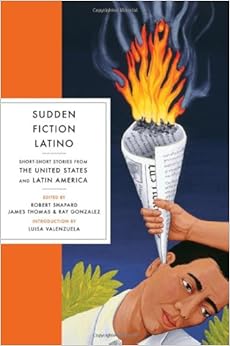
Sudden Fiction Latino: Short Short stories from the United States and Latin America


For Passages Academy it seems that Latino History Month and our ELA short story curricular unit are destined to occur at the same time each Fall. Thus, teachers seeking extremely short fiction, totalling about four pages or less, and stories with a connection to Latino/a history, may be interested in this volume.  Although many of the stories will not appeal to reluctant adolescent readers, short pieces by literary greats like Rudolfo Anaya (“The Native Lawyer”) and Gabriel Garica Marquez (“Light is Like Water”), may serve as a worthy introduction to these canonical authors.   “Day Ah Dallas Mare Toes,” by Luna Calderon, and “Counterfeit,” by Edmundo Paz Soldan, on the other hand, have a charm all their own and might just provoke meaningful discussion on themes of truth, deceit, family, and death and the role of names in literary texts and life.  This link from the publisher allows readers to view the entire table of contents, some of which are hyperlinked to permit previews of the text.  --Jessica Fenster-Sparber


Shapard, James Thomas and Ray Gonzalez (Eds.)  Sudden Latino Fiction:  Short-short stories form the United States and Latin America.  New York:  W. W. Norton & Company, 2010.

Wednesday, April 9, 2014

Tom Sawyer (All-Action Classics #2) adapted by Tim Mucci, illustrated by Rad Sechrist


With simple, expressive art and judicious text, this graphic novel adaptation brings the mischief and imagination of Tom Sawyer’s world to vivid life.  Though the format necessitates abridgement, the author and artist manage to include plenty of Tom’s famous adventures - from tricking his friends into whitewashing Aunt Polly’s fence to clearing Muff Potter of murder charges.  This volume is an engaging and accessible introduction to the classic novel and has brought more than one comics-loving student into the library asking, “Do you have any more books like this?”  Backmatter includes a brief and informative biography of Mark Twain, as well as a selected bibliography of his works.  Recommended for avid readers of graphic novels, ready for a new challenge, and for classroom use, as an introduction to Tom Sawyer, or a comparative counterpoint. --Regan Schwartz


Mucci, Tim. All-Action Classics #2: Tom Sawyer. New York: Sterling Publishing, 2008. Print.

Tuesday, December 3, 2013

The Wonderful Wizard of Oz by Eric Shanower


"Lions, and tigers, and bears, oh my!"  The yellow brick road that leads Dorothy Gale and her friends to the Emerald City of Oz is a beloved cultural icon for many.  Because the works of L. Frank Baum have been adapted countless times, in film, stage, television, book, and comic form, it is also a relatively accessible one.  This Eisner Award-winning graphic offering from Marvel is a whimsical and richly detailed work, designed to bring the land of Oz to a new audience.  


The action of the story follows the novel, with no reference to the famous MGM film, which may throw off some readers.  However, teachers of English may be interested in using this, along with the original and, possibly, the film, to address Common Core reading standards aimed at evaluating content presented in diverse media.  Since L. Frank Baum was also a playwright and stage adaptations of his work are available, it may be a good fit for Passages Academy’s drama unit. --Regan Schwartz

Shanower, Eric. The Wonderful Wizard of Oz: Adapted from the novel by L. Frank Baum. New York: Marvel, 2011. Print.

Thursday, October 18, 2012

Beowulf (Graphic Novel Adaptation) by Gareth Hinds


As a mythical hero who accomplished unparalleled deeds, Beowulf should need no introduction.  This graphical adaptation tells the story of his battles against Grendel, Grendel’s mother, and his final battle against a monstrous fire breathing dragon. It is a beautifully drawn graphic novel which strays from traditional text bubbles.  Instead, text is delivered through stand alone boxes.  Some pages possess a few text boxes while others are left empty with nothing but imagery.  This adaptation could be used to introduce readers to graphic novels as there are never more than three text boxes per page.  Often the pages left with no text are the actual battles between Beowulf and his adversaries.  Having no text during these intense moments allow the reader to be sucked in and appreciate the artwork.  The final chapter changes from full color to black and white perhaps as a symbol of Beowulf’s last battle.  Whether in color or black and white, the novel never loses it’s ability to convey to the reader the gruesomeness, sweat, and effort of each of Beowulf’s battles.  If you’ve never read Beowulf this is the perfect introduction. --Claudio Leon

Hinds, Gareth. Beowulf. Candlewick Press, 2007. Print.

Monday, October 15, 2012

African-American Classics: Graphic Classics Vol 22 edited by Tom Pomplun


Often, graphic novel adaptations of classic literary works struggle to stand on their own, appearing as watered down versions of greats.  Thankfully, that is not at all the case in this top-notch collection.  Modern African-American comic writers and artists have adapted a slew of classic stories and poems by America’s earliest African-American authors, including W.E.B. Dubois, Zora Neale Hurston, and Paul Lawrence Dunbar, and turned them into engaging and dynamic comics in their own right.  From a haunting adaptation of Jean Toomer’s “Becky” by Mat Johnson and Randy DuBurke, to a spare and dreamy “On Being Crazy” illustrated by Kyle Barker, this solid anthology offers something for everyone.  Its use as a tool in analyzing how different texts address similar themes or in comparing versions of the same story told in diverse media, may be of specific interest to teachers of English Language Arts. --Regan Schwartz

Pomplun, Tom. African-American Classics: Graphic Classics Vol 22. Mount Horeb: Eureeka Productions, 2011. Print.

Wednesday, October 10, 2012

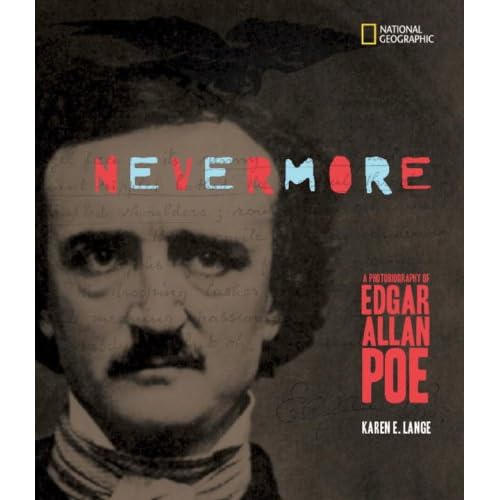
Nevermore: A Photobiography of Edgar Allan Poe by Karen Lange

This approachable and engaging photobiography is a great match for anyone with even the slightest bit of curiosity regarding Edgar Allan Poe. All too often, Poe’s life is glossed over during short story and poetry units of study.  Packing a number of extant photos of Poe and his contemporaries, as well as the arc of his tumultuous 40 years of life into a slim 57 pages, this volume is a perfect introduction or second text on the subject of the life and times of Edgar Allan Poe.  Lange neatly covers real-life tragedies that lent themselves to literary masterpieces like “The Raven” and “The Tell-tale Heart” and inspired contemporary literature like Snicket’s Series of Unfortunate Events.  She similarly covers Poe’s tragic loves and places his writing in literary history, crediting him with the invention of detective fiction.

Backmatter includes a chronology, a list of quote sources, books, articles, and websites for further reading, an index, and illustration credits.  An excellent non-fiction text to supplement or include in ELA curricular studies, this volume straddles the divide between a simple text and a more challenging text in regard to layout, structure, and language features.--Jessica Fenster-Sparber

Lange, Karen.  Nevermore:  A Photobiography of Edgar Allan Poe.  Washington D.C.:  National Geographic, 2009.  Print.

Friday, April 29, 2011

20,000 Leagues Under the Sea by Jules Verne, adapted by Jacqueline Morley (Barron's Graphic Classics series)


What I like most about comics is that I don’t have to use my imagination in the way that I would reading a "regular" book. The illustrations allow me to simply enjoy the story and watch what is happening. It is a trend right now to adapt classic literature into graphic novels, and I think the graphic versions have reinvigorated the original stories. One of my favorite parts in 20,000 Leagues Under the Sea is when the characters come across a giant octopus almost twice the size of the submarine, which is large enough to house a crew of a few hundred sailors. Being able to actually see the size comparison drives home the massiveness of the beast, which I think could often get lost in the original text. Strangely, one or two chapters from the original story seem to be missing from this graphic novel, but students discovering the story for the first time won’t notice. They will, however, enjoy the color illustrations and will likely appreciate the glimpse into the past as Captain Namor and his Nautilus journey across the underwater world in the 19th century. --Claudio Leon