Showing posts with label book club. Show all posts

Friday, February 4, 2022

Concrete Rose by Angie Thomas

 Maverick and Lisa are very much in love,  but during a brief breakup Mav spent one night with Iesha.   Now he is sure that Iesha’s three month old son isn’t his - so sure that he hasn’t told Lisa about that one night with Iesha.

Iesha asks Mav to take a paternity test to prove to her boyfriend King -  who is Mav’s best friend - that her baby isn’t Mav’s.  But after the test,  no one’s life will be the same. 

Themes of gang loyalty, family,  paternity, and incarceration are explored with unmatched emotional intelligence and humor.  Concrete Rose is a prequel to Thomas’ On the Come Up.  Recommended for all high school aged readers and perfect for book club discussions as well.--Jessica Fenster-Sparber


Thomas, Angie.  Concrete Rose.  New York: Balzer and Bray, 2021.

Monday, February 24, 2020

No Crystal Stair: A Documentary Novel of the Life and Work of Lewis Michaux, Harlem Bookseller by Vaunda Micheaux Nelson with Artwork by R. Gregory Christie


No Crystal Stair tells the inspiring story of businessman, bookseller, and activist Lewis Michaux who started the first black bookstore in the country and was the Harlem haunt of Malcolm X.  Told through many voices and perspectives, and thoroughly researched, the book is accessible and compelling for readers interested in history. Highly recommended for interdisciplinary co-teaching and middle and high school book clubs.  Includes research notes, family tree, source notes, bibliography, index, and suggestions for further reading.--Jessica Fenster-Sparber

Tuesday, October 10, 2017

Dear Martin by Nic Stone


Seventeen-year old Justyce McAllister’s ex-girlfriend, Melo, is too drunk to drive her Benz home at 3am and Justyce knows it.  Justyce is arrested by a local police officer while attempting to save Melo from her inebriated self.  The incident shades Justyce’s evolving perceptions of his economically-advantaged peers at the boarding school he attends on scholarship.  Justyce decides to to process his thoughts in letters he writes to Reverend Dr. Martin Luther King Jr., wondering what the late, great activist would have done in his shoes and in this cultural and historical moment, which has given rise to the Black Lives Matter movement.

Plot twists abound and recommend this to fans of Sitomer’s Caged Warrior.  Narrative shifts through genre and perspective, as well as the topical content, invite comparisons to How It Went Down , The Hate U Give, and Tears of a Tiger.   Highly recommended for independent reading for older middle school readers and up.  Book clubs may enjoy discussing this title as well.  --Jessica Fenster-Sparber


Expected release date: October 17th, 2017.  The text reviewed was an Advanced Readers' Copy.

Stone, Nic.  Dear Martin.  New York: Random House, 2017. Print.

Tuesday, October 3, 2017

American Street by Ibi Zoboi


Passing through customs in New York City’s JFK airport, teenage Fabiola and her mother are separated.  Not understanding her mother’s detainment, Fabiola is directed to proceed to Detroit where her three cousins and aunt Jo await her.  Fabiola has no choice but to continue her journey alone, and she is surprised and dismayed by the reception she receives among family in Detroit.  The title of the book will draw some readers looking for urban fiction, and expectations will be initially dashed as the exposition is slow to bring Fabiola into immediate danger.  Readers who persevere, however, will be hooked by page 157.  Some magical realism, literary language, perspective changes, and Haitian Kreyol make this a good selection for students who have already developed some confidence, and the 300+ page length requires a moderate amount of stamina--somewhat less than The Hate U Give’s 25% longer duration.  Highly recommended independent reading for teens.--Jessica Fenster-Sparber

Zoboi, Ibi.  American Street.  New York: HarperCollins, 2017.

Click here for discussion questions from Reading Group Choices’s website, and here for discussion questions from Maria Stuart at redblkgrl.com’s website.

Thursday, June 1, 2017

Born a Crime: Stories from a South African Childhood


Apartheid in South Africa is not a topic students or teachers usually approach with humor, which makes Noah’s book unique in a school library collection.  Using both his lived experience as well as his famous trademark humor, Noah recounts his childhood in South Africa as a multiracial young person through anecdotes.  The book is structured to provide enough context between anecdotes to offer readers the necessary schema to both laugh at Noah’s jokes and begin to comprehend the horrors of the South African system of apartheid.  In doing so, this book is sure to broaden readers’ comparative perspectives on state-sponsored racism and is likely to lead a curious mind to wonder about the history of a nation they may previously only have connected to the name Nelson Mandela.  Teens may enjoy discussing Noah’s perspective on serious matters like, crime, poverty, and domestic violence, all of which are woven throughout the book.  Recommended for older teen readers as well as book clubs. --Jessica Fenster-Sparber

Noah, Trevor.  Born A Crime: Stories of a South African Childhood.  New York: Spiegel & Grau, 2016.  Print.

Click here for a short discussion guide published on the blog Book Chatter.

Monday, November 28, 2016

Never Fall Down: A Novel by Patricia McCormick


Arn knows his aunt cannot afford to send him and his five siblings to school as well as feed and clothe them, so he has dropped out of his elementary school to sell ice cream on the street when one day the teenage soldiers of the Khmer Rouge roll into town and order everyone to follow them into the countryside.  What follows is a tautly paced first-person narration of the Cambodian genocide from the perspective of an eleven-year-old character whose story, while presented as a novel, is based on the true tale of Arn Chorn-Pond.  A powerful tale on its own, in McCormick’s expert hands, Chorn-Pond’s story has been transformed into brilliant YA literature.  Students living in detained settings may not find this book immediately relatable because the narrator’s voice belies his relationship to English as a secondary language. Intrepid readers (or those with the support of a teacher) will be rewarded by McCormick’s exploration of how adults in powerful positions manipulate young people to achieve their goals.  While Post-traumatic stress disorder is not named, the text’s empathetic portrayal of a teenager surviving years of trauma and opening a new chapter in his life are realistic and ultimately heartening.  Recommended for more experienced high-school-aged readers who have enjoyed The Boy in the Striped Pajamas and Sold.--Jessica Fenster-Sparber

McCormick, Patricia.  Never Fall Down.  New York: Balzer + Bray, 2012.

The publisher has made a brief teaching guide available here.  A wonderful interview with the author is available on her website here.

Tuesday, June 21, 2016

The Skin I’m In by Sharon G. Flake


If there is ever a time when one feels as though they are on an island unto themselves and simultaneously on center stage with Broadway lights highlighting all of their perceived flaws, it would be the middle school years. A time when you feel so lonely, but are surrounded by so many people, people whose eyes and words singe deeply. Sharon Flake does an impeccable job portraying this scenario from the perspective of a thirteen-year-old girl, Maleeka Madison-the-third [sic], a bright student whose past and low self-esteem lingers in her everyday choices. It is a new, tough teacher, Miss Saunders, who is always in Maleeka's business and whose own imperfections act as a lens for her in learning to love the skin she's in. With this lesson, Maleeka takes control and is finally able to break free from the hold of the most popular girl in the grade, Char. With vocabulary that is accessible to a wide range of readers, I highly recommend this title to middle and high school girls.--Allison Trevaskis

Flake,  Sharon G. The Skin I’m In. New York: Jump at the Sun Hyperion Paperbacks for Children, 1998.  Print.

Click here for the Anti-Defamation League’s discussion guide and resource links pertaining to The Skin I’m In.

Friday, March 18, 2016

Stuck in Neutral by Terry Trueman


Shawn McDaniel is fourteen years old and has a great sense of humor about his life in Seattle, Washington. He appreciates his older brother and sister and his special ability to remember everything he has ever heard since he was three or four years old.  Especially since he can’t talk, or walk, or move much at all.  Reluctant readers may not immediately be able to relate to the narrator, but will be hooked when they learn of his plight and that his father might actually be trying to kill him.  Literally.  A post-novel FAQ and followed by an author Q & A reveals Trueman’s personal connection to the protagonist of this suspenseful short novel which, among other things, can go a long way in helping readers develop empathy.  A great selection for a mixed-age book club.  --Jessica Fenster-Sparber

Trueman, Terry.  Stuck in Neutral.  New York: HarperCollins, 2000.  Print.

Click here for some discussion questions for Stuck in Neutral put together by the Arrowhead Library System in Wisconsin.

Friday, February 12, 2016

The Terrorist’s Son: A Story of Choice by Zak Ibrahim with Jeff Giles


I dare you to read the first four pages of this short book and abandon it.  This is a memoir from the American-born son of a terrorist who is serving a life sentence for plotting the bombing of the World Trade Center.  Current students will not remember the incident which occurred in 1993, but many will relate to the challenges of growing up poor and with an incarcerated parent.  Most readers will, I imagine, marvel at the author’s articulation of the suffering he endured as a result of his father’s choices, his ultimate rejection of the indoctrination of hatred, and his loving embrace of his right to make his own choices about how to be a human being.  Highly recommended for teen and adult book clubs as well as independent reading for students interested in current events and stories relayed by narrators who have grown up with tremendous challenges and overcome adversity.  The Terrorist’s Son winningly combines brevity, heft, and inspiration.--Jessica Fenster-Sparber


Ebrahim, Zak with Jeff Giles.  The Terrorist’s Son.  New York: Simon and Schuster, 2014.  Print.

A curriculum guide by Pam B. Cole, Associate Dean and Professor of English Education and Literacy, Kennesaw State University, Kennesaw, GA, can be found here.  The TED talk Ebrahim gave that led to the writing and publication of this text can be found here.

Friday, March 6, 2015

Guest Review: Every Day by David Levithan


He is himself – but every day that “self” is different. Figuring out some things – boy or girl, fat or thin, skin color, hair, eye color – can be accomplished by a quick look in a mirror. The body is easy – the life is hard. And “A” has just one day to live the “life” without messing it up. His cardinal rule: make no choices that the “body” will have to suffer the consequences for. Do not become involved, especially not with the love of your life.  David Levithan’s unique look at fitting in allows all readers to see themselves at least once, because at some point, A lives the life of just about every kind of teen. From the frightened drug addict to the jock, the head cheerleader to the abused girlfriend, straight, gay, a loner, popular – A lives them all for a day. With the added twist of a romance, a “body” set on revenge and a preacher who just might know what’s going on, A has enough drama in his life to satisfy any reader. It is a great selection for book clubs – just a discussion on “which life and why” will keep the conversations lively! And my club had even more fun with their own take on what might happen next.  --Kathie Wilkins


Levithan, David. Every Day. New York:  Alfred A. Knopf, 2012.

Click here for a list of discussion questions from Northern Arizona University and here for a discussion guide from Siouxland Libraries in South Dakota.

Kathie Wilkins is the school librarian for the Blandford and Oak Ridge campuses of Yvonne B. Miller HS, located at the Virginia Department of Juvenile Justice's Beaumont site. She enjoys reading and has been a mystery fan since becoming hooked on Agatha Christie more years ago than she'd like to admit to. When she's not reading, she spends as much time as possible with her five grandchildren.

Thursday, February 26, 2015

Knockout Games by G. Neri


Erica’s dad leaves her and her mom with the parting gift of an HD video camera.  The two move to a rough part of St. Louis, Missouri, as a result of her parents’ split.  Erica struggles to make new friends, entering her new, racially mixed school in the middle of the year.  Shortly thereafter, her only friend, Destiny, sees Erica using her camera and drags her off to capture what Destiny thinks is just about the most interesting thing going on: middle school boys selecting a weak-looking adult to approach and surprise with a single knockout punch.

Where Neri takes this scenario is dutifully complex.   Booktalking this book today revealed that the knockout game is not unfamiliar to Passages’ students, suggesting that this novel is both timely and needed as Neri mentions in his author’s note.  Longer and more challenging than Caged Warrior, Knockout Games could make a great book club or classroom read as it is realistic and rich with the moral quandaries facing Erica, and broader themes of racial injustice and complexity in our times. More experienced middle school readers and high schoolers may want to read it independently.  Pairs interestingly with How it Went Down and A Separate Peace.  --Jessica Fenster-Sparber

Neri, G.  Knockout Games.  Minneapolis: Carolrhoda Lab, 2014  

Click here to download a sample chapter and for a discussion guide on the author’s website.

Monday, February 23, 2015

Panther Baby by Jamal Joseph


Jamal Joseph, at 16, was the youngest member of the Panther 21 to be arrested in New York City in 1969 and his memoir, Panther Baby, opens with a gripping scene of Panther weapons training.  Just the thing to draw in readers who may be a bit younger and stand to benefit the most from his look back on his life experiences thus far, including his political participation in the Black Panther Party and the Black Liberation Army, through his six year bid at Leavenworth and into the present. Joseph displays a rare lighthearted humor, inviting the reader to laugh with him at some of the choices he made as a young man and with hard-won deep insight into some of those choices.  Highly recommended for independent readers interested in history, American history, “real life stories,” and Black history.  Teachers may be interested to know that the author uses adult language to authentically capture voices throughout his tale.--Jessica Fenster-Sparber

Click here to register to download a free teaching activity on the Panthers' Ten Point Program from the Zinn Education project.

Joseph, Jamal.  Panther Baby.  New York: Algonquin Books, 2012.

Wednesday, February 11, 2015

Frederick Douglass: Rising Up From Slavery by Frances. E. Ruffin


If success is to be measured not so much by the position that one has reached in life as by the obstacles which he has overcome, as Booker T. Washington said, then Frederick Douglass may be counted as one of the most successful humans who has ever lived.  That he survived, escaped, and outlived American slavery is remarkable, but overcoming these obstacles was only the beginning of what Douglass would go on to do for the rest of the world as a tireless advocate for freedom and equality.  

Ruffin’s thirteen accessible chapters of narrative non-fiction nicely summarize a complex and long life, supplementing Douglass’ accomplishments with one-page features of other luminous figures from history: Nat Turner, William Lloyd Garrison, Benjamin Banneker, Ida B. Wells; as well as some less well-known like John B. Russwurm and Robert Smalls.  Starting off with a timeline, and ending with a glossary, bibliography, photo credits and an index, this book is perfect for curricular explorations of non-fiction, African American history, and interdisciplinary studies of slavery, human rights, and the Civil War.  A perfect companion to the film Lincoln and a schema-building prelude to this year’s award-winning film Selma.  Student readers of biographies who have already enjoyed volumes on Malcolm X and Martin Luther King Jr. may enjoy reading this book independently. --Jessica Fenster-Sparber

Ruffin, Frances E.  Frederick Douglass: Rising Up from Slavery.  New York: Sterling, 2008.


For the Library of Congress' rich collection of documents relating to Frederick Douglass, click here.

Monday, February 9, 2015

The Other Wes Moore: One Name, Two Fates by Wes Moore


What’s in a name? A neighborhood? A brother? A block?  These questions loom large for two young men, both named Wes Moore, born less than a year apart and raised in similar Baltimore neighborhoods.  Both fatherless (one through medical tragedy and one through the tragedy of abandonment), both raised by single mothers in tough circumstances, both eager to prove themselves, and both called to the streets - one is now serving a life sentence for murder and one is a Rhodes scholar.  That scholar set out to find out how and why their paths diverged so wildly - the result is part memoir and part journalistic inquiry.  The Other Wes Moore tells both of their stories chronologically from birth in three large acts, in vivid detail.  Readers looking for true-life stories about street life and the violence encountered there may find what they seek in The Other Wes Moore, though the action is tempered by introspection and the sophisticated language does not evoke the action-packed street books students may be craving. However, the book is practically tailor-made for book groups with backmatter that includes a reader’s guide, discussion questions, a hefty resource guide, and an afterword by Tavis Smiley. --Regan Schwartz

Moore, Wes. The Other Wes Moore. New York: Spiegel and Grau, 2010. Print.

Monday, December 8, 2014

How it Went Down by Kekla Magoon


Tariq, a sixteen-year-old African-American teen, goes to the store for his mother to buy some milk and picks up a Snickers bar for his little sister.  On his way home he is confronted by a neighbor who perceives that Tariq has a gun.  A third person, Jack Franklin, approaches, shoots, and kills Tariq and drives away.  Franklin is subsequently apprehended by the police and let go.  National activist and political figure Reverend Alabaster prepares to make his move into the spotlight while the nation is asking for answers and Tariq’s mother is asking for justice.  Sound familiar?  

Magoon’s polyphonous novel is thick with topical relevance and the challenges of multiple points of view.   It’s first few pages ensnare the reader within a web of suspense structurally furthered by short chapters.  Characters like Brick and Noodle, members of the local Kings 8-5 crew, will appeal to reluctant male readers and others like Jennica, Noodle’s girlfriend and witness at the crime scene; Kimberly, Tariq’s former babysitter-cum-professional stylist; and Tina, Tariq’s little sister, will appeal to female readers, making this a great text for mixed gender book clubs and class discussions. ELA teachers will find this a rich selection for teaching perspective, voice, and character development.  Highly recommended for fans of Walter Dean Myers’ Street Love.  --Jessica Fenster-Sparber


Click here for a discussion guide from the publisher.


Magoon, Kekla.  How It Went Down.  New York: Henry Holt & Co., 2014.  Print.

Monday, December 1, 2014

Why Are We Still Getting HIV? Teens Respond to the AIDS Epidemic Edited by Laura Longhine


35.3 million people are living with HIV around the world, according to UNAIDS, cited on HIVaware.org.uk.  35.3 million.  Asking anyone to contemplate the size of that number is a challenge, and Youth Communication’s Why Are We Still Getting HIV? offers numerous angles from which teachers, parents, and other youth workers (including peer educators) can approach the topic through interviews and personal narratives.  This collection includes both anonymous and credited teen authors’ perspectives on HIV, ranging from what it’s like to go for a first HIV test (“What If…” by Anonymous), to having a peer or adult share their positive status (“Saying Goodbye to Uncle Nick,” by Josbeth Lebron, “A Sad Silence,*” by Desiree Guery), to receiving notification of one’s own HIV positive status (“Date with Destiny” by Anonymous,) as well as dealing with a loved one dying from AIDS (My Uncle Died of AIDS” by Anonymous), and living a long life while HIV positive (“All Too Real: Teens Living with HIV*” by NYC Writers and “Twenty Years Living Positive” interview with Dave Nisbett.)  Back matter includes separate notes to teens and staff trainers as well as a discussion guide for teachers and staff on how to use the book effectively.  While the writing varies in style and tone, it is generally very accessible to teens who are reading proficiently and a worthwhile resource in spite of the fact that there have been some significant updates to the American conversation taking place around AIDS since many of these stories were written. --Jessica Fenster-Sparber


*These two stories are available for free in full-text and with lesson plans provided by YC Teen.


Longhine, Laura (Ed.)  Why Are We Still Getting HIV? Teens Respond to the AIDS Epidemic.  New York: Youth Communication, 2010.  Print.

Tuesday, October 28, 2014

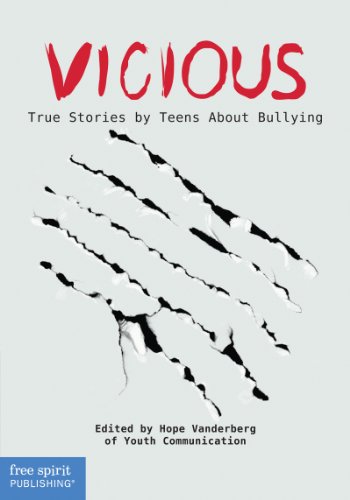
Vicious: True Stories by Teens About Bullying


Vicious: True Stories by Teens About Bullying Edited by Hope Vanderberg

Bullying seems to be a universal experience to the students I’ve gotten to know where I work.  Whether they’ve been bullied, been a bully, or been a bystander, the topic is never unfamiliar.  This collection of writings from teenagers and young adults will let any reader who has experienced bullying know that he or she is not alone.  One of the collection’s strengths is its authenticity; these are the true voices and experiences of contemporary survivors.  The stories are accessible to developing teen readers and their brevity may appeal to both student readers and their teachers.  Recommended for independent reading for teens and educators looking for short stories addressing bullying.  Diverse sub-themes include sexual harassment (“Can I Holla Atcha” by Allajah Young”), LGBTQ (“Gay on the Block” by Jeremiyah Spears and “A Place to Belong” by Lavell Pride), the immigrant experience (“I Showed My Enemies-- and Hurt My Friends, Too” by Elie Elius), and multiple perspectives from foster homes, treatment centers, and residential facilities (like “Standing My Ground” by Xavier Reyes).--Jessica Fenster-Sparber

Vanderberg, Hope (editor).  Vicious: True Stories by Teens About Bullying.  Minneapolis: Free Spirit Publishing, 2012.

Youth Communication provides assorted stories from this collection (and more) on the topic of bullying here.  Titles displaying an apple icon include lesson plan and discussion ideas for teachers.

Thursday, June 12, 2014

Snitch by Allison Van Diepen


Julia DiVino has a plan for her future and it does not involve the gang life.  Julia has managed, with her best friend Q for support, to stay clear of the constant gang-related violence and drama at her Brooklyn high school, despite the fact that some of her friends are in rival gangs.  When gorgeous Detroit-transplant, Eric Valiente shows up, he and Julia fall hard and fast for each other.  But soon he reveals his gang-involved past and joins up again, breaking Julia’s heart in the process.  Then, at a club one night, Julia warns Eric that he’s about to get jumped.  With that one act, her life will never be the same - no one’s will.  Because everyone is not who they seem and she’s not the only snitch.


Snitch is a fast-paced, drama-filled novel that has wide appeal - it is one of the most popular books in our libraries.  Its accessible language and straightforward structure make it a solid independent reading choice for reluctant readers ready to move on from the Bluford High series or similar books. --Regan Schwartz

Those looking to facilitate a book club discussion of Snitch is may want to take a look at the teacher guide available here. 

Van Diepen, Allison. Snitch.  New York: Simon Pulse. 2007.

Tuesday, June 10, 2014

Upstate by Kalisha Buckhanon


Seventeen-year-old Antonio pleads guilty to his abusive father’s murder; whether he did it or not is unclear, but he’ll still have to serve ten years for it.  Natasha, Antonio’s girlfriend, swears she’ll wait for him.  But ten years is a long time, and while Natasha is getting ready to go to college and explore the world, Antonio is stuck in a four-by-ten room.  Upstate allows the reader to see how two intertwined lives can go in complete different directions over the course of ten years.  The entire narrative of the book is wonderfully done in correspondence between Natasha and Antonio.  The letters between the two at first come almost daily and eventually devolve to a handful a year.  Did Antonio really kill his father? Where will Natasha be when Antonio is finally released? Upstate is a great independent read for fans of Paul Volponi’s Riker’s High and Walter Dean Myers’ Lockdown. --Claudio Leon

Teachers and book club facilitators may want to check out Macmillian's teacher guide to upstate here.
 
Buckhanon, Kalisha. Upstate. New York: St. Martin’s Press, 2005. Print.

Tuesday, April 29, 2014

Pretty Girl 13 by Liz Coley


Angie disappeared on a camping trip several years ago and walks into her parents’ house now, three years older, with thick scars around her ankles and no explanation.  She is unaware that three years have passed and she has no memory of what has happened.  While not an urban book by any stretch, teen girl readers at Belmont continue to clamor for this book, drawn in by the horror, mystery and suspense of Angie’s situation.  Teachers and counselors will want to know that this novel includes instances of sexual abuse and a gentle exploration of Disassociative Identity Disorder (DID).  Back matter includes an author’s note explaining her authorial decisions and suggested resources for more information.  Recommended for independent reading for teens and bookclubs for teen girls. --Jessica Fenster-Sparber

Coley, Liz.  Pretty Girl 13.  New York: HarperCollins, 2013.  Print.