Wednesday, February 24, 2016

Lowriders in Space by Cathy Camper, illustrated by Raul the Third


Lupe, Flapjack, and Elirio love working with cars and want to open their own autoshop, but they are broke.  They decide to enter an auto competition with the hopes of winning the prize money that can get them started on their dream.  Collaborating on this project takes them to outer space and back.  

Nothing about the title or premise led me to think that this book would be a particular hit with the adolescents I serve here in NYC where lowrider culture is not as prevalent as it is in other parts of our large country.  But what to give the sixteen-year-old artist I serve who told me that he loves cars and is dyslexic and whose first language is Spanish?  Lowriders in Space has incredible artwork done in pen and the artist writes, “I decided to draw Lowriders in Space with red, blue and black ballpoint pens to revisit the excitement I felt as a kid whenever I drew.” Backmatter includes notes from the artist and author, a glossary for Mexican-American slang, car, and astronomy terms found in the story, and a one page epilogue to whet the reader’s appetite for Volume 2, which will be released by Chronicle on July 5th.  The best part, for developing readers who are already bilingual in Spanish and English, is that the book is 112 pages long and most pages contain 15 words or less. --Jessica Fenster-Sparber

Camper, Cathy.  Lowriders in Space.  San Francisco: Chronicle Books, 2014.  Print.

Click here for a short book trailer video on youtube.  Click here to visit the publisher’s page where you can download a free teaching guide to Lowriders in Space.

Monday, February 22, 2016

Woman Rebel: The Margaret Sanger Story by Peter Bagge


Wife, mother, nurse, birth-control activist, fiery-haired firebrand.  Peter Bagge draws and writes all of these sides of the outspoken Margaret Sanger in this non-fiction graphic novel.  While reading this book, one gets the sense of a life lived so large it can not be contained within the pages.  As the text must leap from milestone to milestone, selections of pivotal points in Sanger’s life can easily be delineated and examined by a class looking to gain historical perspective of the women’s rights movement.  Bagge elaborates further on his text by way of back matter providing historical context, additional information, and revealing editorial decisions.  The comic book style illustrations make Sanger’s story accessible to mature readers.  --Anne Lotito-Schuh

Bagge, Peter. Woman Rebel: The Margaret Sanger Story. Montreal: Drawn & Quarterly, 2013. Print.

Friday, February 12, 2016

The Terrorist’s Son: A Story of Choice by Zak Ibrahim with Jeff Giles


I dare you to read the first four pages of this short book and abandon it.  This is a memoir from the American-born son of a terrorist who is serving a life sentence for plotting the bombing of the World Trade Center.  Current students will not remember the incident which occurred in 1993, but many will relate to the challenges of growing up poor and with an incarcerated parent.  Most readers will, I imagine, marvel at the author’s articulation of the suffering he endured as a result of his father’s choices, his ultimate rejection of the indoctrination of hatred, and his loving embrace of his right to make his own choices about how to be a human being.  Highly recommended for teen and adult book clubs as well as independent reading for students interested in current events and stories relayed by narrators who have grown up with tremendous challenges and overcome adversity.  The Terrorist’s Son winningly combines brevity, heft, and inspiration.--Jessica Fenster-Sparber


Ebrahim, Zak with Jeff Giles.  The Terrorist’s Son.  New York: Simon and Schuster, 2014.  Print.

A curriculum guide by Pam B. Cole, Associate Dean and Professor of English Education and Literacy, Kennesaw State University, Kennesaw, GA, can be found here.  The TED talk Ebrahim gave that led to the writing and publication of this text can be found here.

Wednesday, February 10, 2016

Drowned City: Hurricane Katrina & New Orleans by Don Brown


“What happened at the N’awlins?”


Teen readers are too young to remember Hurricane Katrina, but Beyonce may have just inspired their curiosity with this weekend’s release of her new video “Formation.”  For adolescent readers wondering why the pop star depicts herself atop a submerged police car, and, later, drowning atop that car, or those struggling to connect the dots between the drowning imagery and the video’s juxtaposition of graffiti that reads “Stop shooting us” at 4:26, Don Brown has written and illustrated a compelling, grave, illuminating and now award-winning volume.  In full color with shades and tones of sadness, this text is less than 100 pages long and most pages contain a maximum of two sentences of text, making this highly recommended for reluctant teen readers with a taste for graphic novels and teachers looking for a hybrid non-fiction text.  This book concludes with a thorough listing of source notes, a bibliography, and a closing dedication.--Jessica Fenster-Sparber

Brown, Don.  Drowned City:  Hurricane Katrina & New Orleans.  Boston:  Houghton Mifflin, 2015.  Print.

Friday, February 5, 2016

Black Frontiers: A History of African American Heroes in the Old West by Lillian Schlissel


During an informal survey I conducted this week within our school library, I learned that 100% of the students I currently serve did not know that 25% of American cowboys in the 19th century were of African descent.  Black Frontiers provides the visual evidence that students desired to substantiate this claim.  Chapters on homesteaders and mountain men were of less interest, so I strongly suggest introducing this text with the aforementioned historical photographs or with the chapter on Nat Love, also known as Deadwood Dick, on page 31.  The brief chapter ends with a photograph of Love after he changed lifestyles and career paths to become a Pullman porter in 1890, which can also spark conversations about the development of the railways, the socio-economic opportunities at that time, and career choices.  This book, along with Hoose’s Claudette Colvin: Twice Toward Justice will have students wondering how truth is uncovered when history is investigated and written.  --Jessica Fenster-Sparber

Click here for PBS’ middle school & high school lesson plans on African Americans in the West which is rich with additional resource suggestions.

Schlissel, Lillian.  Black Frontiers: A History of African American Heroes in the Old West.  New York:  Aladdin Paperbacks, 2000.  Print.

Wednesday, February 3, 2016

The Many Faces of Josephine Baker: Dancer, Singer, Activist, Spy by Peggy Caravantes


Born into extreme poverty and a survivor of a harsh childhood, Josephine Baker made it to Paris by the age of nineteen and went on to become an international sensation during a time when African Americans were treated with disdain throughout the United States.  This biography will instruct and inspire adolescent readers with revelations of the last century and the bravery, creativity, and perseverance of its subject.  Presented in twelve chapters which frequently offer boxed features to provide additional context to people, places, and events that arise in the text (e.g. “Eva Peron” and “The March on Washington,”) this book will be of interest to adults not yet familiar with the highs, lows, and complexities of Baker’s life as well. --Jessica Fenster-Sparber

Caravantes, Peggy.  The Many Faces of Josephine Baker:  Dancer, Singer, Activist, Spy.  Chicago: Chicago Review Press, 2015.  Print.

Monday, February 1, 2016

Hold Tight, Don’t Let Go by Laura Rose Wagner


Suffering several tragic family losses in the wake of Haiti’s earthquake, Magdalie is penniless and emotionally adrift in a temporary camp without schooling. Coupled with the loss of her family comes the loss of Magdalie’s sense of security and the future she was working towards.  The tedium of her months in a temporary camp fuel boredom and depression at the prospect of living a life unfulfilled.  We follow Magdalie’s life, a life indefinitely put on hold by the efforts required merely to subsist, as her anger and frustration grow with every failed attempt to better her circumstances.  Will Magdalie learn to let go of her anger and face her days with hope once again? Offering rich portrayals of both the challenges and beauty in urban and rural Haiti, Hold Tight, Don’t Let Go is a novel that leaves a lasting impression.  Recommended for those seeking an inspirational story of finding hope in a seemingly hopeless situation. --Anne Lotito-Schuh


Wagner, Laura Rose. Hold Tight, Don’t Let Go: A Novel of Haiti. New York: Harry N. Abrams, 2015. Print.

Friday, January 29, 2016

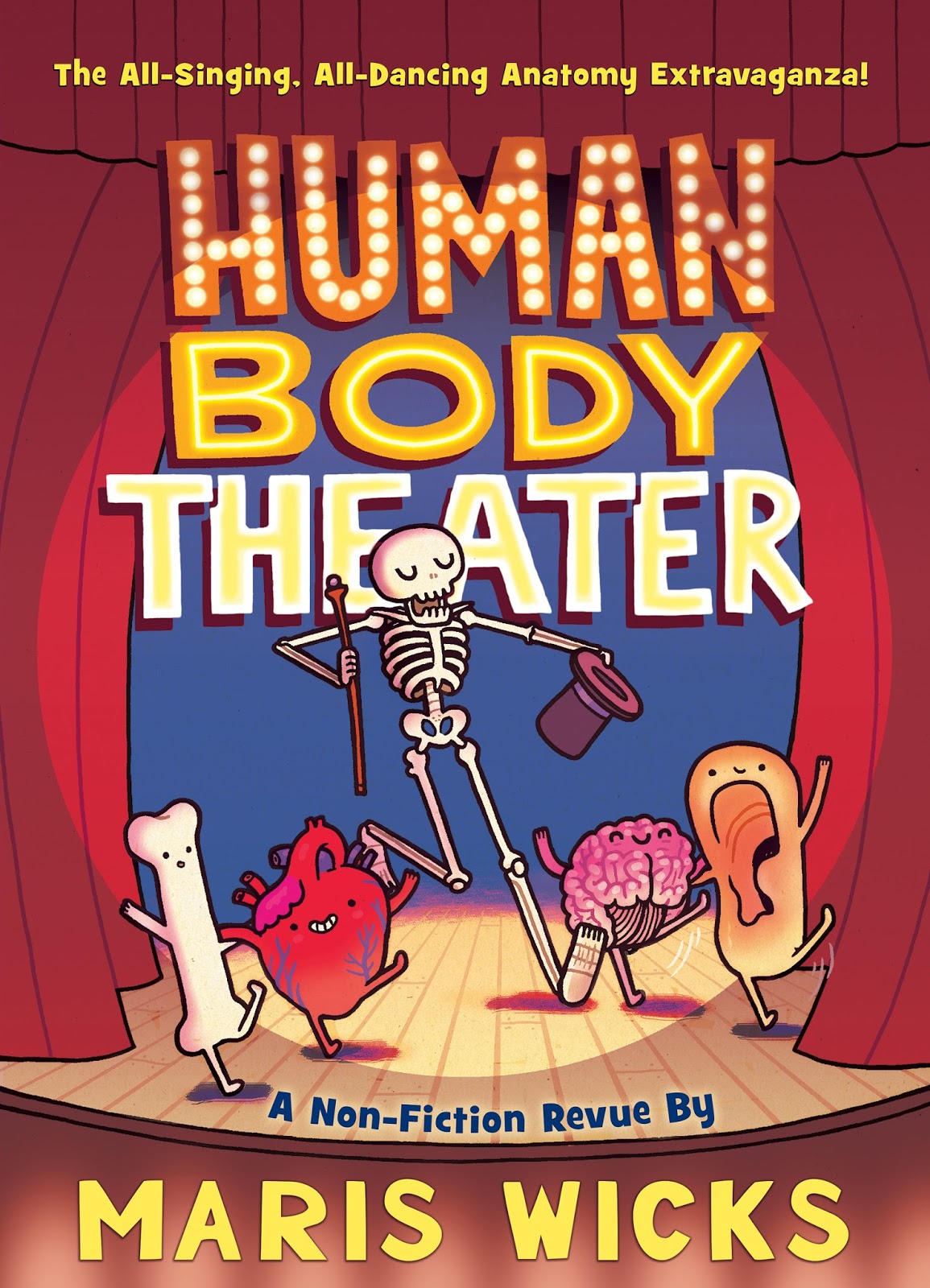
Human Body Theater by Maris Wicks


For readers who like their anatomy lessons with a whole lot of kawaii and a little bit of humor on the side, Wicks has crafted a new hit.  In eleven chapters a humorous skeleton narrates a guided theatrical tour of the skeletal, muscular, respiratory, cardiovascular, digestive, excretory, endocrine, reproductive, immune, and nervous systems, and follows all of that up with an explanation of how our five senses work.  A wonderful text for health and physical education instruction, especially teachers seeking to create and build body schema among students who don’t lean toward textbooks, this text is also an interesting example of a hybrid text for ELA teachers introducing non-fiction.  Human Body Theater includes a table of contents, a glossary, a bibliography, and recommended reading.  Slick production values with gorgeous full-color pages make this title appealing to younger readers as well as its intended middle school audience. --Jessica Fenster-Sparber

Wicks, Maris.  Human Body Theater: A Non-fiction Revue.  New York: First Second, 2015.

Wednesday, January 27, 2016

Untwine: a Novel by Edwidge Danticat


Living in Miami, identical, Haitian-American twins Giselle and Isabelle Boyer have distinct interests and personalities. But underlying their individualities are two souls entwined.  When the family suffers a devastating car accident, Isabelle is killed and Giselle struggles as she feels herself untwine from Isabelle.  Giselle recognizes that she is a living physical reminder of the girl Isabelle was and will continue to grow into the woman Isabelle would have looked like.  Old relationships transform into something different in this new reality, as does Giselle’s own perception of herself.  A good read for older teen readers seeking a bit of introspection. --Anne Lotito-Schuh


Danticat, Edwidge. Untwine: a Novel. New York: Scholastic Press, 2015. Print.

Monday, January 25, 2016

Between Me and the World by Ta-Nehisi Coates


Is this relatively small, relatively short book going to appeal to Passages’ students?

Addressed to Coates' fifteen-year old son, which Tressie McMillam Cottom discusses as a literary device, this book is alternatingly approachable and impenetrable for less sophisticated readers thanks to its uneven, complex structure.  Teens will be interested in the man who talks about “people who think they are white” and takes on America’s history of brutality toward African Americans, but they’ll lose interest during long passages about Coates’ time at an elite historically black college and they’ll question a man who says he knows the streets, but whose father was a university librarian.  Moreover, for students who have not known their fathers, the whole conceit of a man addressing his son in a professorial tone may be alienating.  

This book definitely qualifies as a non-fiction text class read and a solid addition to a classroom library, but you will have to have read and process it first yourself, and that will take longer than the narrowness of the spine might intimate.  I highly recommend this book to educators for personal independent reading.  I expect you will find the sections that will speak most clearly to the students you work with, you’ll excerpt them, and then you can facilitate the meaningful conversations many are aching to have around Coates’ discoveries and philosophies that speak most profoundly to our learners. --Jessica Fenster-Sparber


An excerpt of the text may be found here.
Discussion questions by Alexis Elafros at the University of Central Florida can be found here.

Coates, Ta-Nehisi.  Between the World and Me.  New York: Random House, 2015. Print.

Friday, January 22, 2016

One for the Murphys by Lynda Mullaly Hunt


Can there be genuine love and affection between foster parents and the children they are caring for?  In One for the Murphys, Lynda Mullaly Hunt explores this type of relationship in a very unique way. Twelve-year-old Carley is taken to the Murphys where she will be living as a foster child while her only known relative, her mother, is in the hospital.  Her social worker, Mrs. MacAvoy, assures her that she will be with an excellent family, but Carley does not believe her and expects the worst. She tries to connect to the Murphys’ way of living and as she adapts she begins to wonder what it would be like to live with this family permanently.  This book is an excellent read for anyone who has ever been in foster care or is considering caring for children in foster care.  Many of the students at Passages will find this story interesting and will be able to connect with Carley.  This book can also be used for a read-aloud.  It has many discussion points that teachers can use. --Elaine Roberts

Hunt, Lynda Mullaly. One For The Murphys. New York: Puffin Books, 2012. Print.

Wednesday, January 20, 2016

Heroes of Olympus Series by Rick Riordan


Picking up where the Percy Jackson series leaves off, Rick Riordan's Lost Hero series bring in the Roman side of mythology.  According to the Oracles (Greek) and Auguries (Roman), the gods decreed that the demi-gods must never know there are both Roman and Greek demi-gods in the world, and so they have lived in ignorance of each other.  When the Prophecy of Seven brings them together to save Olympus from Gaea, Mother Earth, history comes to light.  Jason, son of Jupiter, teams up with Percy, five other Greek and Roman demi-gods,  and a pugnacious satyr chaperone to cross the Atlantic and take the fight back to Rome, where it began.  It will be the most perilous quest yet.  This battle will either save Olympus, or doom it. --Julie Weber


Riordan, Rick. The Lost Hero. New York: Disney-Hyperion Books, 2010. Print. Heroes of Olympus (Book One).
Riordan, Rick. The Son of Neptune. New York: Disney-Hyperion Books, 2013. Print. Heroes of Olympus (Book Two).
Riordan, Rick. The Mark of Athena. New York: Disney-Hyperion Books, 2014. Print. Heroes of Olympus (Book Three).
Riordan, Rick. The House of Hades. New York: Disney-Hyperion Books, 2015. Print. Heroes of Olympus (Book Four).
Riordan, Rick. The Blood of Olympus. New York: Disney-Hyperion Books, 2014. Print. Heroes of Olympus (Book Five).

Wednesday, January 13, 2016

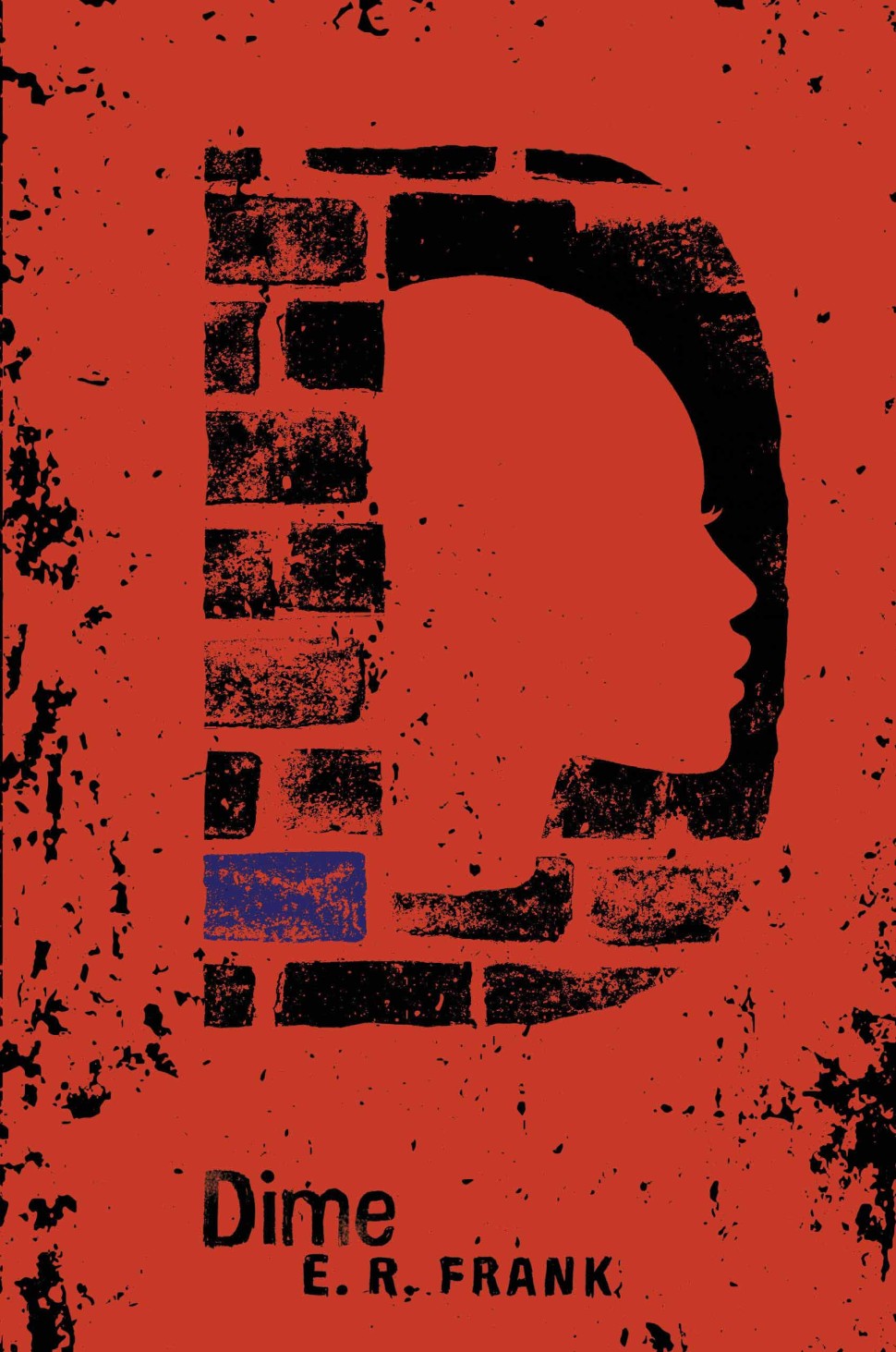
Dime by E.R. Frank


Dime has nowhere to go on a bitterly cold day when a local prostitute offers her a warm and seemingly safe haven.  Feeling she has little choice, Dime is taken in by a pimp and made to feel loved, special, and like part of the family.  Playing with literary devices like personification, Dime narrates her story by imagining the voices of characters like Greed and Sex.  Older teens looking for gritty, urban, realistic fiction will read this suspenseful tale with interest.  Frank succeeds in creating complex characters readers will empathize with and painting a nuanced, disturbing portrait of a pimp who has mastered the psychology of manipulation in order to minimize his need to use drugs and physical violence to control the young women and children he sexually exploits. --Jessica Fenster-Sparber

Click here for a discussion guide from the publisher.
Frank, E. R.  Dime.  New York: Simon and Schuster, 2015.  Print.

Wednesday, January 6, 2016

Girls Like Us by Gail Giles


Biddy’s grandmother does not want to take care of her now that the state will no longer send support checks.  Quincy’s last foster family has moved away.  The two classmates are now legally able to live independently and they have graduated from high school.  Where will they live?  How will they navigate life?  And can they get along?  Written in a vernacular much like Sapphire’s Push, and alternating between Biddy’s and Quincy’s first person perspectives, Girls Like Us offers readers two engaging voices and two different viewpoints of intellectually disabled characters. I recommend this title for more sophisticated readers who have enjoyed Push, and for girls’ book clubs.  This volume is likely to engender compassion for differently-abled peers while it explores themes of victimhood, survival, friendship, cooperation, and self-acceptance. --Jessica Fenster-Sparber

Unleashing Readers offers some discussion questions on their blog here.

Giles, Gail.  Girls Like Us.  Berryville: Candlewick Press, 2014.

Monday, January 4, 2016

If I Stay by Gayle Forman


Want an emotional ride? Gayle Forman’s book, If I Stay, is the book to read.  The reader embraces Mia and is carried along with her from the family’s car crash to the end of the book.  Mia’s being, or spirit, travels with her extended family throughout the hospital and the reader is caught up emotionally with what she is feeling and decisions she has to make.  From the very first page the reader is involved with the family.  The book is full of suspense and Gayle Forman did a tremendous job.  This is a must read for anyone who likes to be caught up in a book, emotionally, and maybe even shed a few tears. --Elaine Roberts

Forman, Gayle.  If I Stay.  New York: Penguin, 2009.  Print.

Friday, December 18, 2015

WW Encyclopedia: The Definitive Guide to World Wrestling Entertainment by Brian Shields and Kevin Sullivan


Have you ever heard of Buddy Rogers, Shawn Michaels, Hulk Hogan, or maybe John Cena?  The WW Encyclopedia serves as an archive of World Wrestling Entertainment’s various characters spanning nearly 50 years; it is, as the title states, a definitive guide not only for WWE fanatics, but those new to the sport. Entertainers and Tag Teams are cataloged alphabetically by their ring name, then further distinguished by the formatting to signify when the personalities were active. Although not every detail of each performer’s career is highlighted, their most memorable events, battles, and adversaries are noted alongside the common statistics of height, weight, land of origin, and signature move, if relevant. Breaking up the alphabetical rhythm of the encyclopedia are topics pertinent to a WWE enthusiast, such as Hall of Fame, Signs, and WWE Studios. An index located at the end makes this guide a quick reference companion while talking or viewing the WWE.--Allison Trevaskis

Shields, Brian and Sullivan, Kevin. WW Encyclopedia: The Definitive Guide to World Wrestling Entertainment. Indianapolis: DK/BradleyGAMES, 2009. Print.

Noble Warrior by Alan Sitomer


In this sequel to Caged Warrior, underground teen MMA fighter McCutcheon Daniels is now working undercover for the FBI. He opts to take down the leader of the High Priests, the gang he thought he’d left behind in Detroit, by willingly entering the city’s most notorious prison while disguised as an inmate.  Well-plotted and full of street language and extreme violence, Noble Warrior will be immediately popular with fans of Caged Warrior and readers looking for “jail books.”  Weak editing, especially at the start of the story, will lessen the appeal of this book to many ELA teachers.  Strongly recommended independent reading for older teens looking for something to sink their teeth into. --Jessica Fenster-Sparber


Sitomer, Alan. Noble Warrior. New York: Hyperion, 2015.

Thursday, December 17, 2015

Percy Jackson and the Olympians series by Rick Riordan


Rick Riordan takes the Greek myths we all grew up loving and creates a dynamic and compelling modernized setting for the melodramas to re-unfold.  Riordan’s demi-gods are all products of single-parent homes and mostly diagnosed with both dyslexia and ADHD.  These qualities, rather than bringing the characters down, are spun to be empowering.  Characters are raised by single parents because their absent parent is a god or goddess, forbidden from significant involvement in their children's lives.  The demi-god brain is hardwired for reading and writing in ancient Greek and each must be prepared for battle at a moment's notice; they aren't supposed to sit still.   When Percy Jackson, the eponymous son of Poseidon, and the other demi-gods arrive at Camp Half-Blood, Chiron, the esteemed teacher-centaur, explains it all as they train for their adventures.  In each of the 5 novels, selected demi-gods (and satyrs, and cyclopes...) go on quests in order to prevent Kronos, the fallen king of the Titans, from rising up and defeating the Olympians.--Julia Weber

Riordan, Rick. The Lightning Thief. New York: Disney-Hyperion, 2006. Print. Percy Jackson and The Olympians (Book 1).

Riordan, Rick. The Sea of Monsters. New York: Disney-Hyperion, 2007. Print. Percy Jackson and the Olympians (Book 2).

Riordan, Rick. The Titan's Curse. New York: Disney-Hyperion, 2008. Print. Percy Jackson and the Olympians (Book 3).

Riordan, Rick. The Battle of the Labyrinth. New York: Disney-Hyperion, 2009. Print. Percy Jackson and the Olympians (Book 4).

Riordan, Rick. The Last Olympian. New York: Disney-Hyperion, 2010. Print. Percy Jackson and the Olympians (Book 5).

Tuesday, December 15, 2015

Class Trip: Pedal Punk


On Thursday, December 10th, nine students from Passages Academy's Belmont site visited the New Victory Theater to take in Cirque Mechanics' Pedal Punk performance.  Students were prepared during the days leading up to the trip by lessons co-taught in the library with Erica Nadel, ELA and Special Education teacher, and with a pre-theater visit from the talented New Victory teaching artists Chad Beckim and Shela Rhoulhac.  Literacy for Incarcerated Teens generously purchased the tickets for students and staff, all of whom seemed to enjoy the experience.  Said one participant, "After the show I felt very calm and satisfied.  I felt this way because the show was so entertaining that it had me concentrated and amused." Indeed.  --Jessica Fenster-Sparber

Wednesday, December 9, 2015

Spotlight Interview: Elaine Roberts


-->

Thank you for joining us!  We are in the middle of introducing our newest team members.  Please meet Elaine Roberts who took over the school library at Crossroads this September.--Jessica Fenster-Sparber

JFS:  Can you tell us a little bit about what you were doing before you arrived at Passages' Crossroads school library?

ER:  Prior to working at Passages I worked at The Laurelton School in Laurelton, Queens.  I taught elementary classes, seventh grade ELA and was also the literacy coach.  As a coach I worked with all the grades planning curriculum and selecting books to complement the curriculum.

JFS:  What is your favorite kind of text to read?
ER:  I love reading religious or historical fiction.  I love history because it shows how society changes based on the action of the citizens.  It also shows how things may change but how our fundamental characteristics remain the same.

JFS:  What was your favorite book when you were a teenager?

ER:  Little Women by Louisa May Alcott


JFS: What is your favorite book to share with teenagers at Crossroads?

ER:  The Giver by Lois Lowry.  This book shows how following rules and doing what is expected will be noticed. This gives one the capacity to make the right decisions.

Monday, December 7, 2015

What My Father Gave Me Edited by Melanie Little


This collection of short stories is a powerful read on the theme of father-daughter relationships. Each of the seven stories features a different family dynamic used to demonstrate how said relationships evolve over the course of time and how complex they can be. From an abusive father to the perfect stepdad, each story is carefully told to show the reader how these relationships affect the daughter’s future relationships and for some their future lives. Although short (8 to 16 pages,) writers manage to convey their thoughts and feelings in a way that encourages the reader connect with the characters. Some of the stories are followed by an interview with the story’s author where she answers questions about her life and what inspired them her to write. My favorite story was by Jessica Raya. She writes about the string of stepfathers in and out of her mother’s life. In and out until the least likely one to stick around does. He sees her grow into a young woman and helps their family as a whole overcome their past challenges. This title would be a good resource for students and teachers seeking short narrative nonfiction as well as looking for alternative texts within the short stories unit.--Claudio Leon


Little, Melanie (Ed.) What My Father Gave Me. Buffalo: Annick Press, 2010. Print.

Thursday, December 3, 2015

Spotlight Interview: Allison Trevaskis


Passages Academy Libraries is pleased to introduce our new team members.  First up is Allison Trevaskis who took over the library at Bronx Hope this September.--Jessica Fenster-Sparber

JFS: Can you tell us a little bit about what you were doing before you landed in Bronx Hope's library?

AT:  This is my 8th year with Passages Academy, I have held a lot of different courses along the way such as ELA, Art, Math, Science and Health, but at heart and in practice I am a Physical Educator. 
JFS: What is your favorite kind of text to read? 
AT:  love learning a little something about every topic that impacts or interacts with my life, so I would say my favorite kind of text is Informational, second to the broader category of texts included in Health, Mind & Body.
 
JFS:  Where is your favorite place to read?
 
AT:  My ultimate reading spot is snuggled up in a thick blanket and sitting in a soft recliner.
JFS:  What was your favorite book as a teenager?
 
AT:  The book that got me really into reading as a teenager was J.D. Salinger's The Catcher in the Rye, and the book that I most enjoyed learning about how to read for details and deeper meaning and writing was The Bean Trees by Barbara Kingsolver.
 
JFS:  What is your favorite book to share with teenagers at Bronx Hope?
 
AT:  I like to connect students with books on a topic that speaks to them. I feel as though I've won the lottery when I get to know a student and they come back to say they read the entire book I recommended to them!
 
JFS:  What do you like to do for fun when you're not reading?
 
AT:  Outside of reading I spend my time with my nine month old daughter and family.

Thursday, October 15, 2015

Welcome Back!


The 2014-15 school year at Passages is now well underway.  Pardon our absence over the summer and last month while we regrouped.  We are looking forward to introducing you to our new team members in the days ahead.  We will resume reviews next week-- stay tuned! --Claudio Leon and Jessica Fenster-Sparber