Showing posts with label foster care. Show all posts

Friday, January 22, 2016

One for the Murphys by Lynda Mullaly Hunt


Can there be genuine love and affection between foster parents and the children they are caring for?  In One for the Murphys, Lynda Mullaly Hunt explores this type of relationship in a very unique way. Twelve-year-old Carley is taken to the Murphys where she will be living as a foster child while her only known relative, her mother, is in the hospital.  Her social worker, Mrs. MacAvoy, assures her that she will be with an excellent family, but Carley does not believe her and expects the worst. She tries to connect to the Murphys’ way of living and as she adapts she begins to wonder what it would be like to live with this family permanently.  This book is an excellent read for anyone who has ever been in foster care or is considering caring for children in foster care.  Many of the students at Passages will find this story interesting and will be able to connect with Carley.  This book can also be used for a read-aloud.  It has many discussion points that teachers can use. --Elaine Roberts

Hunt, Lynda Mullaly. One For The Murphys. New York: Puffin Books, 2012. Print.

Wednesday, January 6, 2016

Girls Like Us by Gail Giles


Biddy’s grandmother does not want to take care of her now that the state will no longer send support checks.  Quincy’s last foster family has moved away.  The two classmates are now legally able to live independently and they have graduated from high school.  Where will they live?  How will they navigate life?  And can they get along?  Written in a vernacular much like Sapphire’s Push, and alternating between Biddy’s and Quincy’s first person perspectives, Girls Like Us offers readers two engaging voices and two different viewpoints of intellectually disabled characters. I recommend this title for more sophisticated readers who have enjoyed Push, and for girls’ book clubs.  This volume is likely to engender compassion for differently-abled peers while it explores themes of victimhood, survival, friendship, cooperation, and self-acceptance. --Jessica Fenster-Sparber

Unleashing Readers offers some discussion questions on their blog here.

Giles, Gail.  Girls Like Us.  Berryville: Candlewick Press, 2014.

Wednesday, October 29, 2014

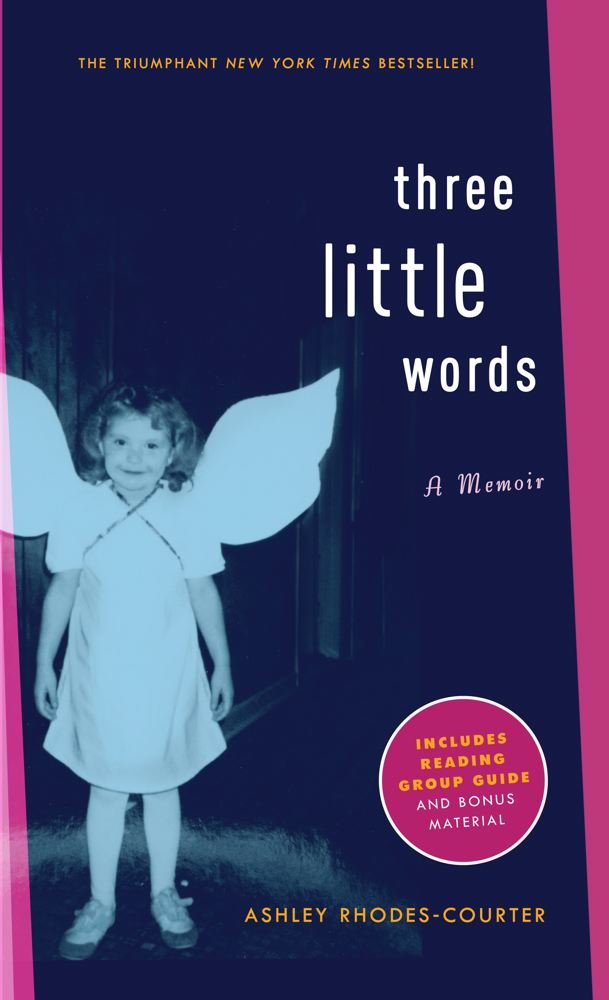
Three Little Words: A Memoir by Ashley Rhodes-Courter


Ashley Rhodes-Courter has met the President of the United States, spoken in front of groups of hundreds of people around the country, been published in newspapers and magazines, and appeared on television.  But her start in life was far from auspicious.  After being taken from her drug-addicted mother at the age of three, Ashley spent the next nine years in a series of foster and group homes, some acceptable, a few kind, one run by an abusive, cruel, and manipulative woman.  As Ashley clung to her mother’s promises and her younger brother, the foster care system failed her again and again.  In this memoir, Ashley details her journey in painstaking detail, offering an important glimpse into the many ways that emotional trauma impacts a child’s thoughts, feelings, and behavior.  Three Little Words may be a great match for sophisticated readers interested in personal stories of foster and state care.  Those looking for stories of survivors of abuse may like to know that Rhodes-Courter's account is markedly less sensational than Pelzer's series.  Backmatter includes a helpful guide for reading groups.-- Regan Schwartz

Rhodes-Courter, Ashley.  Three Little Words.  New York: Simon & Schuster, 2009. Print.


.

Wednesday, September 19, 2012

Locomotion by Jacqueline Woodson

This slim, poignant novel in verse introduces the reader to Lonnie Collins Motion, four years after a tragic accident took his parents and separated him from his beloved younger sister.  Bounced from home to home, Lonnie has finally found some stability in his foster mom, Ms. Edna, and his teacher, Ms. Marcus.  Told in Lonnie’s voice, through his poetry, Locomotion is an engaging and accessible glimpse into the mind of a bright and loving, but traumatized, young man.  Readers interested in exploring novels in verse will find in Locomotion a great place to start with its judicious use of white space, uncomplicated forms, and realistic middle grade vocabulary.  Throughout the book, Woodson uses the conceit of classroom writing, allowing her to naturally introduce and explain a variety of poetic forms, making Locomotion a fantastic introduction to a unit on poetry. --Regan Schwartz

Woodson, Jacqueline. Locomotion.  New York: Puffin Books, 2003.

Monday, January 9, 2012

Something Like Hope by Shawn Goodman


Shavonne is living out a life that seems to have gotten away from her. First incarcerated in the eighth grade, and filled with shame and anger, she lashes out at those around her in the most self-destructive ways - all but ensuring that she will be moved to an adult prison on her approaching 18th birthday. Shavonne faces many obstacles: an absent, crack-addicted mother; a little brother who seems to exist only in her distant memories; a baby girl growing up in foster care; and an institution that doesn’t seem to know how to, or want to, help her. But in the unlikeliest of places, with the unlikeliest of allies, she may just find something like hope.

Goodman has created a fascinating and complex character in Shavonne, whose thoughts, feelings, and actions feel authentic. Fans of Paul Griffin’s Ten Mile River and Matt de la Pena’s We Were Here will find in Shavonne a hero facing familiar demons with remarkable insight. --Regan Schwartz

Monday, November 15, 2010

Ten Mile River by Paul Griffin


Ray’s book smarts and Jose’s street smarts make them a bit of an odd couple. But their shared experiences in foster care and juvenile detention have forged a strong friendship between the two, one in which both are able to demonstrate survival skills. This amazing first novel from author Paul Griffin chronicles 14-year-old Ray and 15-year-old Jose’s experience living on the streets and on their own. An attention grabbing opening scene, in which the boys are paid by a local auto body shop owner to smash windshields, and the authentic dialogue immediately draw Passages’ students into this coming-of-age tale. The boys’ brief stint at “Spofford” provides an immediate text-to-self connection for our readers. The novel continues to explore themes of friendship, loyalty, love, morality, and family, offering endless discussion opportunities for literature circles. Passages Academy students at Crossroads are enthusiastically reading Ten Mile River in preparation for an upcoming visit from Paul Griffin before Thanksgiving. --Anne Lotito Schuh

Griffin, Paul. Ten Mile River. New York: Penguin, 2008.