Showing posts with label science. Show all posts

Tuesday, October 4, 2022

Don’t Mess With Me By Paul Erickson


Have you ever been curious about venomous sea creatures? Well you’re in luck!  Don’t Mess With Me is filled with tidbits of information about some of the most insane and deadly creatures living in the sea! On every page beautiful images are accompanied by text explaining how and why the featured creature attacks, and  sometimes highlighting something extraordinary about it. Anyone interested in dangerous animals or sea life should pick this one up!--Claudio Leon

Erickson, Paul. Don’t Mess With Me. Tilbury House: Thomaston, 2018. Print.

Wednesday, June 20, 2018

Interdisciplinary Collaborations-- Hidden Figures

Interdisciplinary Hidden Figures Unit Leadership Team meets at the start of 2018 to co-plan at the Intrepid.
Ms. Chau supervises an NSD student bottle rocket launch after teaching students how to create their own rockets in February.

The books are ready to be distributed to every student at Belmont.

Ms. Ikawa leads "I Have, Who Has... in Ms. Ernyey's Advisory


At the Intrepid, students are challenged to complete simple tasks with gloves on to simulate the challenges faced by astronauts in outer space.

At MoMath in March!
Interdisciplinary Collaborations-- Hidden Figures

At the end of January we kicked off an interdisciplinary collaborative literacy initiative in advisory classes with two language learning activities to prepare students to engage with Hidden FiguresYounger Readers’ Edition.  Our school’s principal purchased a copy of this new paperback for each and every student and we had the fun job of partnering with advisors to distribute these gifts.  Students expressed satisfaction that they would be able to keep the books and were generally eager to begin reading them.

Ms. Ikawa, Speech-Language Pathologist, led students through a round of “I Have… Who Has” first, and then I introduced the terms associated with front matter and back matter.  We walked through the back matter together and concluded with a small competition to see who could utilize the index most efficiently.  Students did not want to stop looking things up at the end of the period.
-->

Approximately one month later, the unit concluded with hands on learning experiences at the IntrepidMuseum (for placement students) and the National Museum of Mathematics (for detention students.)  We were so consumed with the work at hand--science, literacy, social studies were all involved-- we had little time left over to post, but here are a few photos of the highlights. --Jessica Fenster-Sparber, School Librarian, Belmont

Wednesday, January 31, 2018

Hidden Figures Younger Readers’ Edition by Margot Lee Shetterly


In this younger readers’ edition of her popular adult non-fiction title, researcher and writer Shetterly makes the fruits of her seven-years research available to anyone who has not yet developed the vocabulary and stamina to consume her original text. Hidden Figures: The American Dream and the Untold Story of the Black Women Mathematicians Who Helped Win the Space Race is rendered accessible in this version to anyone able to read and understand English text on a fourth-grade reading level. Wider margins, double-spaced text, and simplified language make the 198-page book a natural pick for students who are able to comprehend non-fiction narrative but not yet ready to tackle the original title intended for sophisticate readers. Many readers will already be familiar with the story of several African-American omen who bravely contributed their talents to NASA and eventually send the US into space for the first time while confronting horrendous racism and sexism at work. Back matter includes an index, a glossary, suggested further reading, and source notes as well as a timeline, lending itself well to instruction on previewing texts as well as providing a wealth of support for less-experienced readers. Highly recommended for book clubs, interdisciplinary reading initiatives, and independent readers reading at upper-elementary levels and beyond. --Jessica Fenster-Sparber
 
Shetterly, Margot Lee.  Hidden Figures Young Readers Edition: The American Dream and the Untold Story of the Black Women Mathematicians Who Helped Win the Space Race.  New York: Harper, 2016. Print.

Thursday, June 22, 2017

The Elements: A Visual Exploration of Every Known Atom in the Universe by Theodore Gray, Photographs by Theodore Gray and Nick Mann


Plutonium is illegal to buy anywhere in the United States, but some Americans carry it inside their pacemaker batteries.  Bananas are radioactive, but only slightly more so that many other things we consume.  Gray mixes fascinating tidbits like these with narrative descriptions of each element’s properties and finds a way to inject the end of each page with a bit of suspense sprinkled with humor.   The two-page spreads dedicated to each element are preceded by Gray’s introduction to the periodic table.  Gray’s writing is remarkable science writing on its own, but the accompanying photographs illustrating both the element being described and some of its uses with captions is a winning formula for readers who may not think they like to read about chemistry.   Backmatter includes a narrative walk through the names of elements 101 to 118 on the table and is followed by an author’s note on the joys of element collecting, an image of the author,  a bibliography, acknowledgements, and an index.  All patrons may enjoy browsing and reading the images within; students reading at upper elementary/middle school levels and beyond may enjoy the text, and science teachers may reach for this in designing lessons to familiarize students with the variety of elements on Earth.  Highly recommended for every school library collection serving middle school and high school readers.—Jessica Fenster-Sparber

Gray, Theodore and Nick Mann.  The Elements: A Visual Exploration of Every Known Atom in the Universe.  New York: Black Dog & Leventhal, 2009.  Print.

Wednesday, June 21, 2017

Programming Spotlight: American Museum of Natural History

Students exploring dinosaurs at the American Museum of Natural History yesterday.  Photo: Jessica Fenster-Sparber

How did the universe come into being and how has it changed over the last 13 billion years?  What is dark energy and how do we know it exists?  How are species endemic to Cuba affected by what we do here in the United States?  How much krill can a blue whale consume in one day?

Students residing in Lutheran and St. Johns houses were invited to wonder about these questions and more in conjunction with a field trip yesterday to NYC's most popular field trip destination, the American Museum of Natural History.  Four of us teachers at Belmont crafted a mini-interdisciplinary unit for the end of the instructional school year melding science, information literacy, advisory, and special education to scaffold a positive learning experience and provide access to the museum for detained youth.  We thank Literacy for Incarcerated Teens for funding the gift of the visit to our students.--Elaine Latham, Shelley Leibusor, Milena Mihalache, and Jessica Fenster-Sparber

Thursday, May 25, 2017

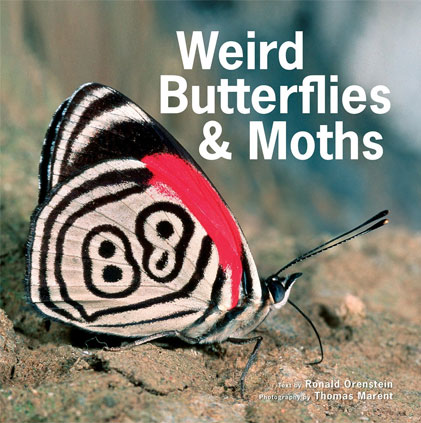
Weird Butterflies & Moths Text by Ronald Orenstein Photography by Thomas Marent

Both images are from the photographer's website, www.thomasmarent.com


Thomas Marent’s stunning high-definition photographs of moths and butterflies are each accompanied by six to eight sentences from Dr. Ronald Ornstein who holds a PhD in zoology and has authored numerous books on science and nature.  His tack in this title is to whet the reader’s appetite for more with intriguing facts about butterflies and moths.  The last third of the book showcases some of the more surprising images of caterpillars and a couple of pupas. This book will work well for developing a student’s interest in an inquiry undertaking and can be read from start to finish or browsed.  Backmatter is limited to an index and Orenstein’s one-page introduction provides a welcoming invitation to this 63-page volume.  Perfect for reluctant readers and less-sophisticated adolescents reading at an upper-elementary or lower-middle school level. —Jessica Fenster-Sparber

Orenstein, Ronald and Thomas Marent.  Weird Butterflies & Moths.  New York: Firefly Books, 2016.  Print.

Friday, January 29, 2016

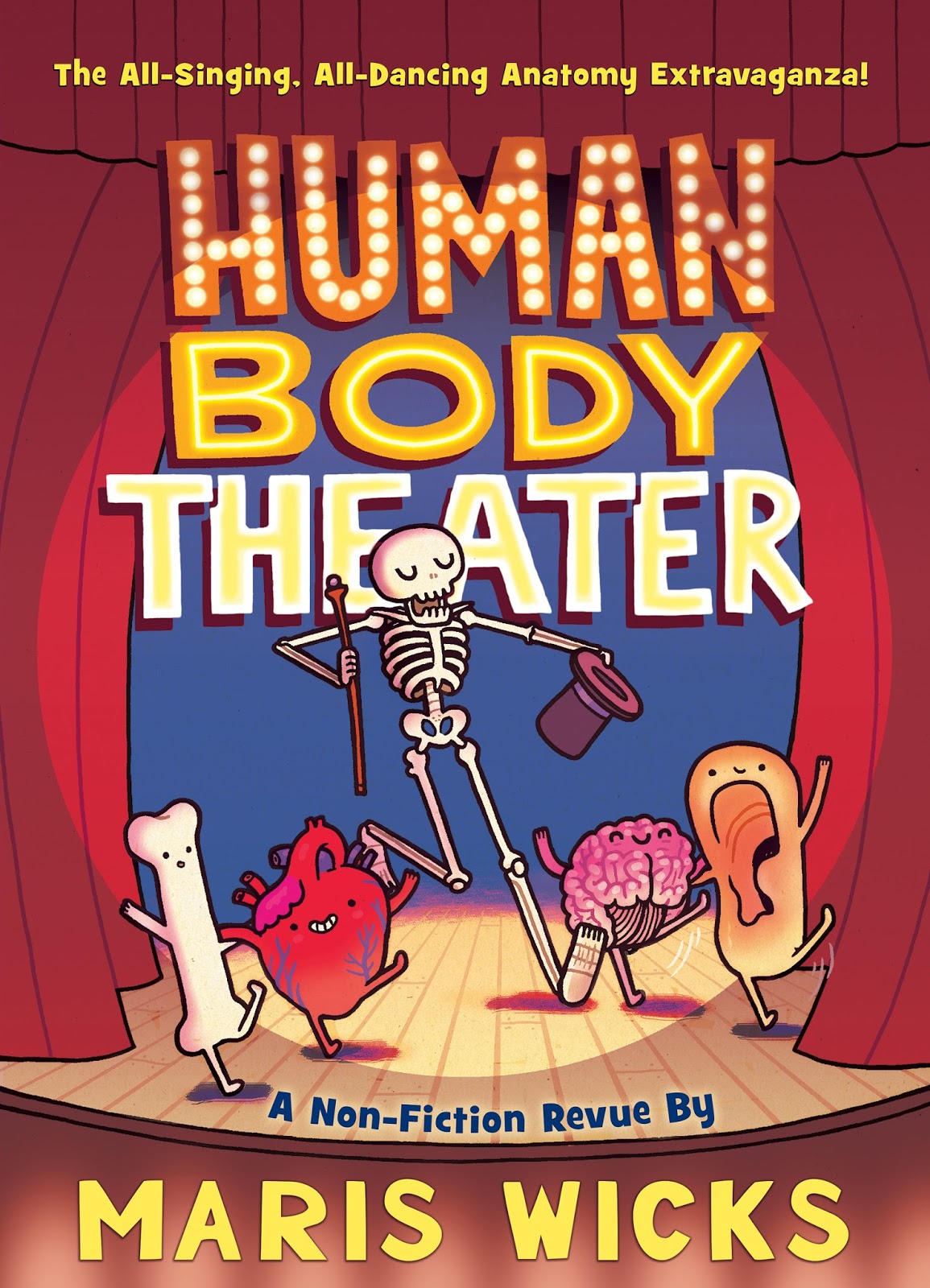
Human Body Theater by Maris Wicks


For readers who like their anatomy lessons with a whole lot of kawaii and a little bit of humor on the side, Wicks has crafted a new hit.  In eleven chapters a humorous skeleton narrates a guided theatrical tour of the skeletal, muscular, respiratory, cardiovascular, digestive, excretory, endocrine, reproductive, immune, and nervous systems, and follows all of that up with an explanation of how our five senses work.  A wonderful text for health and physical education instruction, especially teachers seeking to create and build body schema among students who don’t lean toward textbooks, this text is also an interesting example of a hybrid text for ELA teachers introducing non-fiction.  Human Body Theater includes a table of contents, a glossary, a bibliography, and recommended reading.  Slick production values with gorgeous full-color pages make this title appealing to younger readers as well as its intended middle school audience. --Jessica Fenster-Sparber

Wicks, Maris.  Human Body Theater: A Non-fiction Revue.  New York: First Second, 2015.

Monday, November 24, 2014

Volcano: Iceland’s Inferno and the Earth’s Most Active Volcanoes edited by Ellen J. Prager


There is little on earth to rival the sheer majesty and destruction of a volcano.  They are a fact of life for so many people (did you know that 1 in 12 people live in an active volcano zone?), yet  for many of our students they are only the stuff of history books and remote news reports.  Volcano brings their power, danger, and beauty to brilliant life on every page.  Beginning with an overview of the geology of volcanoes, the text is organized geographically, highlighting major volcanoes from each region.  The one-page history on each volcano is accompanied by a sidebar listing brief facts and pages of dynamic, full-color photographs with informative captions depicting both the volcano and the people living in its shadow.  Backmatter includes sources and credits.  While the text recommends the book to confident readers, the high-interest subject matter, photographs, and large-font quotes make it a popular choice for anyone interested in natural disasters.--Regan Schwartz

Prager, Ellen, ed. Volcano: Iceland’s Inferno and the Earth’s Most Active Volcanoes. Washington DC: National Geographic, 2010. Print.

Thursday, November 20, 2014

The Wolf Almanac by Robert H. Busch


Stunning photographs liberally illustrate The Wolf Almanac, a detailed and well-researched overview of all things wolf - from their biology and behavior to folklore, from big game hunting to zoos and conservation.  The text is a bit dense, but makes judicious use of maps, charts, and graphs to present scientific information and a thorough table of contents and index allow the reader to pinpoint the information they are looking for.  With a thorough bibliography and list of wolf conservation organizations rounding out the back matter, this title is ideally suited to student inquiry. --Regan Schwartz

Busch, Robert H. Wolf Almanac, New and Revised: A Celebration Of Wolves And Their World.  Guilford, CT: Lyons Press, 2007. Print.

Tuesday, June 11, 2013

Science Ink by Carl Zimmer

“Miss, you got any tattoo books?” is asked at least once a day, every day, here inside Passages’ libraries.  But until now, there have not been any absolutely fabulous tattoo books that marry tattoos and... science.  Thank you Carl Zimmer and Mary Roach!  239 glorious matte color pages of science tattoos make their subjects one of immediate intrigue and coolness.  The handsome hardcover volume includes a half or whole page of text providing context for each tattoo image.  Zimmer gives accessible, well-crafted introductions to the topic along with a few words about the person wearing the tattoo and his or her connection to the subject at hand.  The book is organized by theme with chapters on physics, chemistry, evolution, neuroscience, DNA, and the like.  Back matter includes a handy visual index, as well as information about the authors and a standard index.  Science teachers, rejoice! --Jessica Fenster-Sparber


Zimmer, Carl.  Science Ink.  New York: Sterling, 2011.  Print.

Click here for seventeen slides from the book provided via the New York Times.

Wednesday, April 17, 2013

Hubble: Imaging Space and Time by David Devorkin and Robert W. Smith


This large-format, stunning collection of full-color enhanced images from the Hubble telescope is perfect for those students who are fascinated by the natural world.  When my inquisitive students turn their wondering gaze to the sky, I’m ready with Hubble: Imaging Space and Time.  While the text is dense and somewhat inaccessible, it does not affect the book’s appeal.  Nearly every page contains large, detailed photos captured by the Hubble telescope, including planets, stars, nebulae, star clusters, galaxies, black holes, and galaxy clusters - rendered in fascinating detail with informative captions.  There are billions of galaxies in the universe, each with billions of stars - and Hubble: Imaging Space and Time is a fantastic introduction to them. Front matter includes a table of contents and foreword by Neil deGrasse Tyson and John Grunsfeld and back matter includes an index, endnotes, suggested reading, and about the authors. --Regan Schwartz

Devorkin, David and Robert W. Smith. Hubble: Imaging Space and Time. Washington D.C.: National Geographic, 2011. Print.

Monday, December 17, 2012

Encyclopedia of Sharks by Steve Parker


Sharks are older than dinosaurs and just as fascinating.  These mysterious predators come in all shapes and sizes, from the 6-8 inch dwarf lantern shark, to the 40-foot whale shark, and the Encyclopedia of Sharks has them all.  Chock-full of glossy, full-color photographs, charts, and maps, it’s clear that the immediate appeal of this book is visual.  However, the casual browser is soon roped in by the interesting snippets of information presented in sidebars and captions.  Each page of the book is a separate section, clearly organized with titles and subtitles, making it easier for fluent readers to skim for information.  These sections are grouped into chapters, such as “Shark Design” and “Hunters and Killers.”  The Encyclopedia of Sharks includes an extensive index and glossary, as well as a list of places to see sharks and shark-related resources. --Regan Schwartz

Parker, Steve. Encyclopedia of Sharks. Buffalo, NY: Firefly Books, 2008. Print.

Wednesday, January 19, 2011

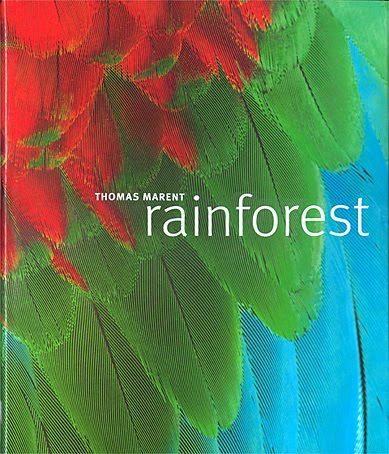
Rainforest by Thomas Marent


Few things are freakier to our New York City students than purple beetles, bright blue crayfish, and iridescent spiders. These and so many more wonderfully interesting-looking creatures are portrayed page after page in this collection of colorful and vivid photographs taken by Thomas Marent in rainforests all around the world. Thankfully, every picture gets a caption, which is often necessary for figuring out what the subject is exactly. In addition to the close-ups of animals and insects, there are pictures of waterfalls, trees and other plant-life, within the dense forest and sweeping landscape shots taken from above. The rainforest really looks like it might be paradise until the reader stumbles upon the pictures of the many varieties of tarantulas and jumping spiders that call these forests home. This book is a fantastic choice for many students, including struggling and reluctant readers -- the pictures are so captivating; it is hard to avoid getting sucked in.

Marent, Thomas. Rainforest. New York: DK Publishing, 2006.

Wednesday, October 13, 2010

Swimming With Hammerhead Sharks by Kenneth Mallory


Have you ever contemplated swimming with sharks? If not, you might enjoy the opportunity to vicariously follow author Kenneth Mallory as he takes the reader by the hand in preparing for a trip to the Cocos Islands to suss out schools of hammerheads. Supported by relevant pictures and sidebars on SCUBA, El Nino, and rebreathers, Mallory’s story is a narrative detailing his opportunity to travel with hammerhead expert Pete Klimley as he searches for answers to shark questions and attempts to get live footage for an IMAX film. Teachers will find the last pages of the book most valuable as they list as-yet-unanswered questions, related conservation issues, what you can do to help sharks, and both print and web bibliographies for further reading. This book is probably not one that students will decide to read through on their own, but will come in handy while teaching non-fiction genres, careers, and, of course, for students studying hammerhead sharks.

Click here for a web directory on hammerhead sharks by Tim Spalding including links to National Geographic lesson plans for middle school students.

Mallory, Kenneth. Swimming With Hammerhead Sharks. New York: Houghton Mifflin Harcourt, 2002.