Wordless friendship is probably be the best way to describe this fantastic graphic novel about a dog and his robot friend. Through the use of imagery alone, Sarah Varon does a great job demonstrating the friendship between the dog and his mail-ordered robot. Together both characters share many adventures and have a great time, until they go to the beach. Dog encourages Robot to jump in the water with him. Robot reluctantly agrees and eventually joins Dog in the water. After their swim they both decide to lay down on the sand, but when it’s time to leave, Robot is unable to move. Dog is forced to leave Robot at the beach where he comes to visit Robot every day. When winter comes and the beach closes, Dog can no longer visit Robot. Will Robot still be there when the beach opens next summer? Dog doesn’t know it, but Robot’s adventures are just about to begin.
Robot Dreams is suitable for any reading level since the only text found in this graphic novel is onomatopoeia; the rest of the novel is textless. Students will enjoy looking at each panel and flying through the pages as though they were watching a silent film.--Claudio Leon
Varon, Sara. Robot Dreams. New York & London: First Second, 2007. Print
Wednesday, December 19, 2012
Monday, December 17, 2012
Encyclopedia of Sharks by Steve Parker
Sharks are older than dinosaurs and just as fascinating. These mysterious predators come in all shapes and sizes, from the 6-8 inch dwarf lantern shark, to the 40-foot whale shark, and the Encyclopedia of Sharks has them all. Chock-full of glossy, full-color photographs, charts, and maps, it’s clear that the immediate appeal of this book is visual. However, the casual browser is soon roped in by the interesting snippets of information presented in sidebars and captions. Each page of the book is a separate section, clearly organized with titles and subtitles, making it easier for fluent readers to skim for information. These sections are grouped into chapters, such as “Shark Design” and “Hunters and Killers.” The Encyclopedia of Sharks includes an extensive index and glossary, as well as a list of places to see sharks and shark-related resources. --Regan Schwartz
Parker, Steve. Encyclopedia of Sharks. Buffalo, NY: Firefly Books, 2008. Print.
Monday, December 10, 2012
Can’t Get There from Here by Todd Strasser
The New York City streets that Maybe and her tribe of homeless teens have called home for months are growing colder and more desolate with each passing day. As the winter wears on and intensifies, the group struggles to survive, spending their days and nights in ever-more-desperate searches for shelter and food. For Maybe, life on the streets is a better option than going home, but trust is hard to come by. She learned a long time ago that adults lie and cheat and generally want something in return for any small kindness. As the temperature drops and her friends begin to disappear, can Maybe learn to trust in time to save herself?
Written in Maybe’s humble voice, the narrative is fairly straightforward and easy to follow. However, it is interspersed with short biographical sketches that may prove a bit confusing at first. While the situations and events portrayed are uncomfortable and ugly, the language is not, making this book suitable for sensitive middle grade readers and classroom use. --Regan Schwartz
Strasser, Todd. Can’t Get There From Here. New York: Simon Pulse, 2004. Print.
Labels:
book club,
fiction,
homelessness
Wednesday, December 5, 2012
Ray Charles: Find Another Way! by Susan Sloate
Don’t be fooled by this slim biography. Yes, it’s easy on the eyes with large font, plenty of white space and large color photographs, but it’s also filled with interesting information about the late rhythm and blues great, Ray Charles. In a mere thirty-two pages, I learned several memorable things about the man that I had never heard before. For instance, he changed his name from Ray Robinson, so as not to be confused with the boxer, he played chess against people with sight, and he even drove a car sometimes! These personal facts are intertwined with the historical context of his career, and Sloate includes a few anecdotes about Ray’s participation in the Civil Rights Movement.
The back of the book has an abbreviated timeline, a glossary, a bibliography, and an index. If you want to learn more about Ray Charles, Sloate includes a few books to consider reading as well as a few websites. This book is a great choice for struggling and reluctant readers, especially as the the Common Core State Standards ask all classes to incorporate more nonfiction texts. --Anja Kennedy
Sloate, Susan. Ray Charles: Find Another Way! New York: Bearport Publishing, 2007. Print.
Labels:
biography,
common core,
non-fiction,
nonfiction,
reluctant readers
Monday, December 3, 2012
Amazing Baby by Desmond Morris
From their button noses to their teeny toes, babies are designed to enthrall us, and Amazing Baby is your one-stop guide to them. This book, full of gorgeous full-color photographs, tackles every aspect of human infant development, from gestation to toddler. With sections on “staying healthy,” “how babies learn,” and “emotional life,” Amazing Baby covers a wide range of topics thoroughly and succinctly. Each topic is amply illustrated with photographs and full-color overlays, and broad categories are broken down into a series of 1-2 page subtopics, each further broken down into 1-2 paragraph sections, allowing the reader to skim for pertinent and interesting information. This book proves ever-popular, especially with our female students. When it comes time to browse for books, you can be sure there will be a group of two or three poring over the images and information in this one.
Because it covers such a broad range, the readability of the text varies quite a bit from topic to topic. Some of the sections dealing with physiology are quite dense, while others dealing with play or common routines are very readable. The text is well organized, with a table of contents and a comprehensive index. However, the real appeal of this book is in the stunning images. --Regan Schwartz
It should be noted that there are two images of a nursing infant and one image of a topless, pregnant torso, which may make this volume unsuitable for some readers or environments.
Morris, Desmond. Amazing Baby. Buffalo, NY: Firefly Books, 2008. Print.
Labels:
childhood,
health,
nonfiction,
pregnancy
Friday, November 30, 2012
You're Invited: Biblioball 2012
Thursday, November 29, 2012
Programming Spotlight: Arts & Dreams
| Bronx Hope Social Workers and Reading Specialist show off their affirmations. |
Tuesday, November 27, 2012
Saint Iggy by K.L.Going
It is a week before Christmas and third-year freshman, Iggy Corso, has been suspended again (this time it’s looking permanent), but that is hardly the worst of his concerns. His mom has been missing for weeks, presumably on a meth-fueled bender, and his father is too drunk or stoned to care. With his principal’s admonition to do “something that contributes to the world” ringing in his ears, Iggy makes a plan. It has five steps:
1. make a plan
2. get out of the Projects
3. do something with [his] life
4. change everyone’s mind about [him]
5. get back into school
For
assistance and advice he turns to his friend and mentor, Mo, a wealthy
college dropout with an escalating drug habit that is about to get them
both into a lot of very serious trouble. Can Iggy’s relentless optimism
and drive get both their lives back on track? How many ways can a
sixteen year old, with little education and no skills, contribute to the
world?Written in the first person, from Iggy’s perspective, Saint Iggy is a gritty, urban drama with an amusingly wry voice. Despite its Lexile level of 1190, Saint Iggy’s generous use of whitespace, and realistic teen voice, make it an accessible and engaging read for a fluent high school reader. --Regan Schwartz
Going, K.L. Saint Iggy. New York: Harcourt, Inc., 2006. Print.
Friday, November 16, 2012
Programming Spotlight: International Games Celebration
Fun! On November 14th and 15th students at Passages 4 largest sites participated in the American Library Association’s International Games Day. Students recalled their favorite games from childhood and school, thought about the purposes of games, played games, and reflected on the value and roles of games in their lives. Our libraries offered board games like chess, Bananagrams and Scrabble, video games like Big Brain Academy, and word games like crossword puzzles, Scattergories and word searches. Social work team members contributed their engaging presence and socio-emotional expertise, and Literacy for Incarcerated Teens provided essential funding. Game on!
Labels:
programming spotlight
Thursday, November 15, 2012
Papertoy Monsters: 50 Cool Papertoys You Can Make Yourself by Brian Castleforte
Like monsters? Wish they weren’t quite so large and dangerous? Have I got the book for you! Paper Toy Monsters is a treasure trove of so-ugly-they’re-cute miniature monsters you build yourself. Armed with a little time, some glue, and a lot of patience, you can craft an army of tiny, full-color monsters with names like Lil Vamp, Wolfman Joe, and Halloweeny. Rated “easy” to “advanced,” there’s a monster for everyone. Once you’ve worked your way through all of the artist-designed monsters, there are templates for you to design your own!
Not only is Paper Toy Monsters a craft book, it is a wonderful introduction to the features of nonfiction texts and technical writing. With a table of contents, headings, subheadings, pictures with captions, and multi-step directions, there is plenty of information for students to explore. --Regan Schwartz
Castleforte, Brian. Papertoy Monsters: 50 Cool Papertoys You Can Make Yourself. New York: Workman Publishing, 2010. Print.
Labels:
craft,
how to,
non-fiction,
nonfiction,
technical writing
Wednesday, November 14, 2012
Programming Spotlight: Papertoy Monsters
To celebrate the start of our non-fiction unit, on November 8th Passages Academy Libraries simultaneously ran a program across three of its sites. The Horizon, Bronx Hope and Crossroads libraries invited classes to participate in the crafting of paper toy monsters. Students explored features of non-fiction text and technical writing by reading and following written instructions from the title Papertoy Monsters. The book which comes filled with perforated pages of pre-designed monsters, instructed students to remove the pieces from the book and fold and glue them in order to create a three dimensional figure.
During the program students were brimming with excitement as they pulled pieces apart and glued them together. Many verbally requested to make more monsters, stay an extra period or come back the next day. After the program ended a student passed by the Horizon library smiling and saying “I have a lot of monsters. I made seven!”. A review of the book is coming soon! --Claudio Leon
Thursday, November 8, 2012
Take Me There by Carolee Dean
Dylan Dawson seems to take after his dad, the convicted cop-killer; a fact which has dogged him his entire life. From the streets to juvie and back again, Dylan can’t seem to get his act together, not even long enough to learn to read. Dylan was on probation, working at an auto shop, staying clean and falling in love with the girl of his dreams. Then life threw him a deadly curve ball and now he’s on the run from the law with his best friend and heading to Texas to get some answers from his father on death row. But, Dylan and his father are both running out of time. Will Dylan find what he needs to get life back on track before it’s too late?
The pro-literacy message of Take Me There may, occasionally, come on too strong, but fans of Simone Elkele’s Perfect Chemistry series will find another good girl/troubled boy romance to get wrapped up in. While the text has a Lexile of 760, the story is told through flashbacks, excerpts from Dylan’s father’s memoir, and straight narration, creating a more challenging reading experience. --Regan Schwartz
Dean, Carolee. Take Me There. New York: Simon Pulse, 2010. Print.
Monday, November 5, 2012
Save the Date: Biblioball
![]() |
| image by The Desk Set |
Dear Readers,
Grab your calendar (in whatever form it may take these days) and set aside the evening of December 8th because you won’t want to miss the Desk Set’s annual Biblioball at the Bell House in Brooklyn! All proceeds benefit Literacy for Incarcerated Teens, whose hard work and generosity make much of our work possible. Hope to see you there!
Thursday, October 25, 2012
Spotlight: Family Literacy at Parent/Teacher Conferences
| Family Literacy at Belmont |
| Table at Horizon invites parents to get resources and explore the content on our library iPads |
Tuesday, October 23, 2012
Teenie by Christopher Grant
Smart, self-conscious, petite Martine Lashley is about to have a very tough year. A freshman at the immense Brooklyn Tech High School, she is under a lot of pressure, both academically and socially. Determined to earn a scholarship into a study abroad program in Spain, her grades start to slide as she deals with ostracizing cliques, her best friend’s dangerous lack of judgement, and the increasingly forceful attentions of the star of the basketball team. Not knowing where to turn for help, she tries to handle everything on her own, but that’s a lot for a girl nicknamed Teenie to carry.
Christopher Grant’s first book is full of complex characters and realistic situations brought to life by its vibrant descriptions of familiar Brooklyn settings. While it is written at a middle school reading level, the content is high school appropriate, as the book deals with sexual assault and violence. --Regan Schwartz
Grant, Christopher. Teenie. New York: Ember, 2010. Print
Labels:
book club,
fiction,
high school,
novel
Thursday, October 18, 2012
Beowulf (Graphic Novel Adaptation) by Gareth Hinds
As a mythical hero who accomplished unparalleled deeds, Beowulf should need no introduction. This graphical adaptation tells the story of his battles against Grendel, Grendel’s mother, and his final battle against a monstrous fire breathing dragon. It is a beautifully drawn graphic novel which strays from traditional text bubbles. Instead, text is delivered through stand alone boxes. Some pages possess a few text boxes while others are left empty with nothing but imagery. This adaptation could be used to introduce readers to graphic novels as there are never more than three text boxes per page. Often the pages left with no text are the actual battles between Beowulf and his adversaries. Having no text during these intense moments allow the reader to be sucked in and appreciate the artwork. The final chapter changes from full color to black and white perhaps as a symbol of Beowulf’s last battle. Whether in color or black and white, the novel never loses it’s ability to convey to the reader the gruesomeness, sweat, and effort of each of Beowulf’s battles. If you’ve never read Beowulf this is the perfect introduction. --Claudio Leon
Hinds, Gareth. Beowulf. Candlewick Press, 2007. Print.
Labels:
classic,
classic literature,
fiction,
graphic novel
Tuesday, October 16, 2012
Extreme Pumpkins: Diabolical Do-It-Yourself Designs to Amuse Your Friends and Scare Your Neighbors by Tom Nardone
Tired of the boring old jack-o-lantern with a cheesy grin? Well, this is what you’ve been waiting for. In Extreme Pumpkins (and Extreme Pumpkins II), Nardone, shows off his creativity with the pumpkin -- making unusual, and sometimes gory, displays with just a few extra props and materials. In addition to looking at the photographs of his imaginative jack-o-lanterns, readers can learn about how to re-create his designs, as well as how to dispose of pumpkin carcasses and random trivia relating to the designs. For instance, in the “Roadkill-Eating Pumpkin” chapter, readers might find the sidebar on actual roadkill statistics quite sobering: an estimated 41 million squirrels are killed annually, and 26 million cats! In “Crime Scene Pumpkin,” we learn about the variety of uses for fake blood on Halloween. My personal favorite of all the creations, “Property-Defender Pumpkin” might take a little extra work, and a few extra pumpkins, but it’s sure to be memorable amidst all the regular pumpkins out there this month.
Students have often looked through these books to get inspiration for the pumpkins they carve in their facilities and for future pumpkin-carving at home. ELA teachers may find these books useful in the upcoming nonfiction unit; science teachers may appreciate the how-to steps. --Anja Kennedy
Nardone, Tom. Extreme Pumpkins: Diabolical Do-It-Yourself Designs to Amuse Your Friends and Scare Your Neighbors. New York: Penguin, 2007. Print.
Monday, October 15, 2012
African-American Classics: Graphic Classics Vol 22 edited by Tom Pomplun
Often, graphic novel adaptations of classic literary works struggle to stand on their own, appearing as watered down versions of greats. Thankfully, that is not at all the case in this top-notch collection. Modern African-American comic writers and artists have adapted a slew of classic stories and poems by America’s earliest African-American authors, including W.E.B. Dubois, Zora Neale Hurston, and Paul Lawrence Dunbar, and turned them into engaging and dynamic comics in their own right. From a haunting adaptation of Jean Toomer’s “Becky” by Mat Johnson and Randy DuBurke, to a spare and dreamy “On Being Crazy” illustrated by Kyle Barker, this solid anthology offers something for everyone. Its use as a tool in analyzing how different texts address similar themes or in comparing versions of the same story told in diverse media, may be of specific interest to teachers of English Language Arts. --Regan Schwartz
Pomplun, Tom. African-American Classics: Graphic Classics Vol 22. Mount Horeb: Eureeka Productions, 2011. Print.
Labels:
African-American,
classic literature,
graphic novel
Friday, October 12, 2012
Scary Stories to Tell in the Dark collected by Alvin Schwartz
Yes, they’re corny, and no, they’re not that scary. But, they are short and slightly spooky, and perfect for students who just want to read a little story at a time. Better yet, they’re a good fit for students who like to tell scary stories and need more material. This book, along with More Scary Stories to Tell in the Dark and Scary Stories 3, also has a lot of potential for ELA teachers currently working on short stories with their classes. With the accompanying CDs (sold separately, but available in some of our libraries) that include stories from all three volumes of Schwartz’s scary story collections, teachers will certainly be able to find at least a few to entertain, all while demonstrating the traditional elements of short stories. Note that the illustrations by Brett Helquist are far lighter than the original publications’ drawings by Stephen Gammell; the original books would certainly be scarier, and probably more appealing to teens.--Anja Kennedy
Schwartz, Alvin. Scary Stories to Tell in the Dark. New York: Harper Collins, 2010.
Labels:
audiobooks,
scary,
short stories
Wednesday, October 10, 2012
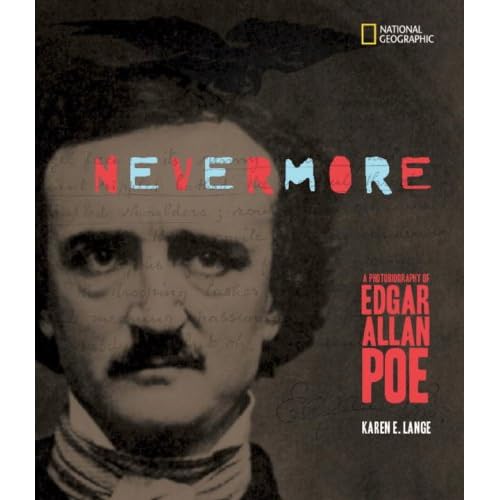
Nevermore: A Photobiography of Edgar Allan Poe by Karen Lange
This
approachable and engaging photobiography is a great match for anyone
with even the slightest bit of curiosity regarding Edgar Allan Poe. All
too often, Poe’s life is glossed over during short
story and poetry units of study. Packing a number of extant photos of
Poe and his contemporaries, as well as the arc of his tumultuous 40
years of life into a slim 57 pages, this volume is a perfect
introduction or second text on the subject of the life and times of
Edgar Allan Poe. Lange neatly covers real-life tragedies that lent
themselves to literary masterpieces like “The Raven” and “The Tell-tale
Heart” and inspired contemporary literature like Snicket’s Series of
Unfortunate Events. She similarly covers Poe’s tragic loves and places
his writing in literary history, crediting him with the invention of detective fiction.
Backmatter includes a chronology, a list of quote sources, books, articles, and websites for further reading, an index, and illustration credits. An excellent non-fiction text to supplement or include in ELA curricular studies, this volume straddles the divide between a simple text and a more challenging text in regard to layout, structure, and language features.--Jessica Fenster-Sparber
Lange, Karen. Nevermore: A Photobiography of Edgar Allan Poe. Washington D.C.: National Geographic, 2009. Print.
Labels:
biography,
Bronx,
classic literature,
common core,
non-fiction,
nonfiction,
photobiography,
poetry
Subscribe to:
Posts (Atom)