Tuesday, March 17, 2015

Slam Dunk! The Top 10 Lists of Everything in Basketball by Sports Illustrated Kids


Greatest basketball player of all time...well, let’s just say that SIK’s pick won’t surprise you and this book is full of rankings that will inspire controversy among readers passionate about basketball.  The large format size emphasizes the full-color photos, sure to appeal to social readers and browsers, as well as serious fans and players.  Foregoing an introduction in favor of jumping right into “Top 10 Greatest Players,” this volume encompasses thirty-two lists, some spread out over several pages, and including topics such as “coolest jerseys,” “teams,” “trades,” and “WNBA players,”... What’s that?  You can’t believe that women don’t show up until page thirty-four and none are among the “greatest players?”  Me neither.  This book will be popular anyway.  Fodder for discussion on multiple fronts.--Jessica Fenster-Sparber

Sports Illustrated Kids.  Slam Dunk!  Top 10 Lists of Everything In Basketball.  New York: Time Hope Entertainment, 2014.

Tuesday, March 10, 2015

Programming Spotlight: Paul Griffin Visits Crossroads

Yesterday, author Paul Griffin visited two classes at Passages Academy - Crossroads.  He spoke with students about his life and career, answered questions about his books (Ten Mile River, Orange Houses, Stay With Me, and Burning Blue), and worked with students on telling “the best story in the world” - their own.  Each student received a gift copy of Ten Mile River, graciously provided by Literacy for Incarcerated Teens, which Paul personalized.  Said one student, holding his book, “I need to read books; books keep me going.” We are indebted to Paul for writing the books that keep our students going. --Regan Schwartz

Monday, March 9, 2015

Nazi Hunters: How a Team of Spies and Survivors Captured the World’s Most Notorious Nazi. By Neal Bascomb


Nazi Hunters is a compelling example of narrative non-fiction that reads like a true spy novel. The pages are filled with primary sources gathered during the suspenseful hunt for Adolf Eichmann, the orchestrator of the Nazi’s Final Solution. Nazi Hunters begins with the retelling of Eichmann’s rise to power in the Nazi Party, the end of World War II, and his escape to Argentina. Sixteen years later he was found and a team of special Israeli spies was sent out to secretly capture him and smuggle Eichmann back to Israel where he could stand trial. Through the spies’ retelling of the story, we learn about the preparation and dangers of the mission. From disguises to hidden cameras, the Israeli spies employed every trick up their sleeves to confirm the man they would capture was indeed the man they sought for his involvement in the death of millions.

Nazi Hunters is a great read for high school students interested in the Holocaust, spy novels or the events surrounding World War II.  The text is supplemented by photographs, maps, and documents used during the reconnaissance, capture and escort phases of the mission. --Claudio Leon

Bascomb, Neal. Nazi Hunters: How a Team of Spies and Survivors Captured the World’s Most Notorious Nazi. New York: Arthur A. Levine Books. 2013. Print.

For a few discussion questions from the folks at Unleashing Readers, click here.

Friday, March 6, 2015

Guest Review: Every Day by David Levithan


He is himself – but every day that “self” is different. Figuring out some things – boy or girl, fat or thin, skin color, hair, eye color – can be accomplished by a quick look in a mirror. The body is easy – the life is hard. And “A” has just one day to live the “life” without messing it up. His cardinal rule: make no choices that the “body” will have to suffer the consequences for. Do not become involved, especially not with the love of your life.  David Levithan’s unique look at fitting in allows all readers to see themselves at least once, because at some point, A lives the life of just about every kind of teen. From the frightened drug addict to the jock, the head cheerleader to the abused girlfriend, straight, gay, a loner, popular – A lives them all for a day. With the added twist of a romance, a “body” set on revenge and a preacher who just might know what’s going on, A has enough drama in his life to satisfy any reader. It is a great selection for book clubs – just a discussion on “which life and why” will keep the conversations lively! And my club had even more fun with their own take on what might happen next.  --Kathie Wilkins


Levithan, David. Every Day. New York:  Alfred A. Knopf, 2012.

Click here for a list of discussion questions from Northern Arizona University and here for a discussion guide from Siouxland Libraries in South Dakota.

Kathie Wilkins is the school librarian for the Blandford and Oak Ridge campuses of Yvonne B. Miller HS, located at the Virginia Department of Juvenile Justice's Beaumont site. She enjoys reading and has been a mystery fan since becoming hooked on Agatha Christie more years ago than she'd like to admit to. When she's not reading, she spends as much time as possible with her five grandchildren.

Thursday, March 5, 2015

The Naturals by Jennifer Lynn Barnes


Cassie is seventeen and has preternatural profiling abilities.  She can size up most people without even thinking about it and often make predictions about future behaviors.  When the FBI recruits her for a top secret initiative, it doesn’t take her long to decide that she wants to press her natural talent into service working on cold cases.  Flown by private jet to live in a group home, of sorts, with other talented teens, she has some big adjustments to make, teen drama to live through, and minor mysteries to solve until a bigger one with higher stakes reveals itself and sucks her in.  Will her talent allow her to save others?  Or will it become her downfall?  

Chapters alternating between Cassie’s first-person narration and an anonymous serial killer’s second-person narration keep the suspense going and ratchet it up as the story progresses.  A thriller along the lines of I Hunt Killers geared toward readers under sixteen, The Naturals features a female protagonist with a sharp mind looking for a feeling of belonging.  Recommended for independent reading, this book will appeal to those looking for a mystery and those who enjoy psychological drama and bloody murder descriptions.--Jessica Fenster-Sparber

Barnes, Jennifer Lynn.  The Naturals.  New York: Hyperion, 2013.

Tuesday, March 3, 2015

UnConference Save the Date! April 24th, 2015


Mark your calendars - the fourth annual UnConference for School Libraries Serving Incarcerated and Detained Youth is being held on April 24th!  Do you provide literacy services or programs to detained youth?  Are you interested in spending a day sharing ideas and resources with like-minded professionals?  The UnConference may be for you - click here for more information.--Regan Schwartz

Monday, March 2, 2015

Up Close: Ella Fitzgerald by Tanya Lee Stone


How did fifteen year-old Ella Fitzgerald get locked up in New York, AWOL, and, while experiencing homelessness at seventeen, start gigging at the Savoy Ballroom?  Tanya Lee Stone’s Up Close: Ella Fitzgerald draws readers in by setting the record straight and taking the reader on a ride through the history Fitzgerald made as one of the most internationally successful jazz vocalists of all time.  Stone takes care to highlight some of Fitzgerald’s personal qualities and values that likely contributed to her incredible achievements and the author enthuses about Fitzgerald’s role in fighting the racial segregation she faced through the thirties, forties, fifties and sixties.  Readers who enjoy music and teen readers looking for true life stories of hard-won success will enjoy reading this independently.  Teachers and librarians looking for texts to recommend and utilize to supplement curriculum on women’s history, African-American history, American history, and jazz may enjoy this text as well.--Jessica Fenster-Sparber


Stone, Tanya Lee.  Up Close: Ella Fitzgerald.  New York: Penguin, 2008.

Click here for a discussion guide (comprehension questions and a few critical thinking questions) from the publisher.

Friday, February 27, 2015

The Crossover by Kwame Alexander


Poetry about basketball? About rapping and braids, girls and family drama? The Crossover (the 2015 Newbery Medal Winner) has all this, and more! Written entirely in verse, the book is told from the point of view of Josh “Filthy McNasty” Bell. Each chapter is, in reality, a poem through which Josh expresses his love for basketball and his family, but also his anxiety about the way people change and his struggle to make sense of this ever-changing world. This book gives all readers a taste of new and different ways of self-expression, and reminds readers that there are many ways to tell our stories, rap and poetry included! Reading The Crossover is an excellent way to finish celebrating Black History Month with a bang, or a great way to start off your celebration of National Poetry Month in April. --Katrina Ortega


Alexander, Kwame. The Crossover. New York:  Houghton Mifflin Harcourt, 2013. Print


Click here for an educator guide to The Crossover from its publisher.


Katrina Ortega is a Young Adult librarian at the NY Public Library's Hamilton Grange Branch. In the past, Katrina has provided library services to non-traditional communities, including adults and teens experiencing incarceration and homelessness. Katrina is an avid reader of all literature, and has recently become a huge fan of YA books. She loves helping library patrons discover books that might be considered unusual, like graphic novels, comic books and manga, and poetry.

Thursday, February 26, 2015

Knockout Games by G. Neri


Erica’s dad leaves her and her mom with the parting gift of an HD video camera.  The two move to a rough part of St. Louis, Missouri, as a result of her parents’ split.  Erica struggles to make new friends, entering her new, racially mixed school in the middle of the year.  Shortly thereafter, her only friend, Destiny, sees Erica using her camera and drags her off to capture what Destiny thinks is just about the most interesting thing going on: middle school boys selecting a weak-looking adult to approach and surprise with a single knockout punch.

Where Neri takes this scenario is dutifully complex.   Booktalking this book today revealed that the knockout game is not unfamiliar to Passages’ students, suggesting that this novel is both timely and needed as Neri mentions in his author’s note.  Longer and more challenging than Caged Warrior, Knockout Games could make a great book club or classroom read as it is realistic and rich with the moral quandaries facing Erica, and broader themes of racial injustice and complexity in our times. More experienced middle school readers and high schoolers may want to read it independently.  Pairs interestingly with How it Went Down and A Separate Peace.  --Jessica Fenster-Sparber

Neri, G.  Knockout Games.  Minneapolis: Carolrhoda Lab, 2014  

Click here to download a sample chapter and for a discussion guide on the author’s website.

Wednesday, February 25, 2015

Caged Warrior by Alan Lawrence Sitomer


“The first thing I think about when the cage closes is, I hope God forgives me for what I’m about to do.” --Anonymous

And so begins Sitomer’s latest YA novel aimed at the same readers who ate up Homeboyz.  Fortunately, Homeboyz has a great many fans hankering for more.  Unfortunately, readers are in for a bashing read which leaves nothing to the reader’s imagination.  McCutcheon Daniels, the novel’s protagonist, is a brutal underground MMA fighter and an excellent student when he shows up to his sophomore classes.  Functioning as a single parent to his five year old sister, Gemma, and enabler to his abusive father, MD realizes within the first 100 pages that his father is exploiting him.  Readers who don’t shrink from gory descriptions may enjoy the fight scenes and some will undoubtedly appreciate MD’s role as family provider and surrogate parent to his sister.  This reader wishes the book had the editing it deserves; the last few chapters are the tightest and the strongest. --Jessica Fenster-Sparber

Sitomer, Alan Lawrence.  Caged Warrior.  New York: Hyperion, 2014.

Tuesday, February 24, 2015

Grumpy Cat: A Grumpy Book by Grumpy Cat


We all have those days.  Those days where everything and everyone is horrid and displeasing.  Those days where you just can’t put on a happy face.  Grumpy Cat is having one of those lives and he’s put together this handy book so that you, too, can embrace and nurture your grumpy self.  This slim volume is full of the memes that made Grumpy Cat an internet sensation, along with tips for fostering grumpiness, games and activities, and peeks of Grumpy Cat’s daily life.  This sardonic text has proven popular with a wide variety of readers looking for a humorous diversion and is a great choice for shared reading. --Regan Schwartz

Cat, Grumpy. Grumpy Cat: A Grumpy Book. San Francisco: Chronicle Books. 2013.

Monday, February 23, 2015

Panther Baby by Jamal Joseph


Jamal Joseph, at 16, was the youngest member of the Panther 21 to be arrested in New York City in 1969 and his memoir, Panther Baby, opens with a gripping scene of Panther weapons training.  Just the thing to draw in readers who may be a bit younger and stand to benefit the most from his look back on his life experiences thus far, including his political participation in the Black Panther Party and the Black Liberation Army, through his six year bid at Leavenworth and into the present. Joseph displays a rare lighthearted humor, inviting the reader to laugh with him at some of the choices he made as a young man and with hard-won deep insight into some of those choices.  Highly recommended for independent readers interested in history, American history, “real life stories,” and Black history.  Teachers may be interested to know that the author uses adult language to authentically capture voices throughout his tale.--Jessica Fenster-Sparber

Click here to register to download a free teaching activity on the Panthers' Ten Point Program from the Zinn Education project.

Joseph, Jamal.  Panther Baby.  New York: Algonquin Books, 2012.

Friday, February 13, 2015

Programming Spotlight: Origami


Students at Belmont, Bronx Hope, Crossroads and Horizon gave away their hearts this week -- paper hearts that is. All four of our largest sites offered origami library programs. Happy Valentine's Day!

Thursday, February 12, 2015

Easy Origami by Mary Meinking


Are you intimidated by origami? Not sure where to begin? Easy Origami is a good place to start. With a short introduction to the craft and the materials needed, a slightly longer section on how to read the folding symbols (complete with clear, color photographs), this book is a very friendly text for beginners. Continuing in the “keep it simple” vein, there are directions for ten easy projects -- each explained by step-by-step instructions and helpfully illustrated with photographs and a picture of the completed work. At Passages, we’ve often used the heart as our go-to beginning origami project for programs around Valentine’s Day. Other student favorites include the paper cup, the spinning top and the fortune teller. --Anja Kennedy


Meinking, Mary. Easy Origami. Mankato, Minnesota: Capstone Press, 2009. Print.

Wednesday, February 11, 2015

Frederick Douglass: Rising Up From Slavery by Frances. E. Ruffin


If success is to be measured not so much by the position that one has reached in life as by the obstacles which he has overcome, as Booker T. Washington said, then Frederick Douglass may be counted as one of the most successful humans who has ever lived.  That he survived, escaped, and outlived American slavery is remarkable, but overcoming these obstacles was only the beginning of what Douglass would go on to do for the rest of the world as a tireless advocate for freedom and equality.  

Ruffin’s thirteen accessible chapters of narrative non-fiction nicely summarize a complex and long life, supplementing Douglass’ accomplishments with one-page features of other luminous figures from history: Nat Turner, William Lloyd Garrison, Benjamin Banneker, Ida B. Wells; as well as some less well-known like John B. Russwurm and Robert Smalls.  Starting off with a timeline, and ending with a glossary, bibliography, photo credits and an index, this book is perfect for curricular explorations of non-fiction, African American history, and interdisciplinary studies of slavery, human rights, and the Civil War.  A perfect companion to the film Lincoln and a schema-building prelude to this year’s award-winning film Selma.  Student readers of biographies who have already enjoyed volumes on Malcolm X and Martin Luther King Jr. may enjoy reading this book independently. --Jessica Fenster-Sparber

Ruffin, Frances E.  Frederick Douglass: Rising Up from Slavery.  New York: Sterling, 2008.


For the Library of Congress' rich collection of documents relating to Frederick Douglass, click here.

Tuesday, February 10, 2015

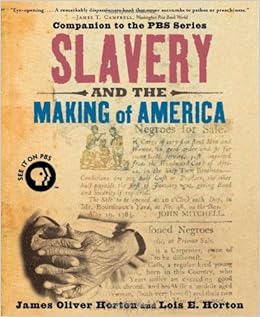
Slavery and the Making of America by James Oliver Horton and Lois E. Horton


I had the opportunity to read Slavery and the Making of America. This is an explicit account of the slave trade from the late 1400s to the 1960s, and it brings the horrors of that era to life. This book’s topic is a part of American history that all people, young and old, of all races should take the time to read. Slavery and the Making of America should be integrated into Global History for all ages in different stages. From Nat Turner's rebellion to the Civil War, this book made me reflect on what African Americans endured over a 400 plus year time span. I recommend this book. Such a great read. --Andre Saintilien Jr.

PBS has produced a television series which this book is a companion to.  Click here for a timeline of key events in the history of slavery.  Click here for additional print and electronic resources on slavery, including the WPA texts that chronicle the experiences of people who survived slavery and shared their remembrances.  Click here for related lesson plans.

Andre Saintilien Jr. works with youth placed in group home detention as a youth counselor.  He loves to read and is particularly fond of  non-fiction books  that are both instructive and focused on a single topic. He enjoys writing music in his free time.

Monday, February 9, 2015

The Other Wes Moore: One Name, Two Fates by Wes Moore


What’s in a name? A neighborhood? A brother? A block?  These questions loom large for two young men, both named Wes Moore, born less than a year apart and raised in similar Baltimore neighborhoods.  Both fatherless (one through medical tragedy and one through the tragedy of abandonment), both raised by single mothers in tough circumstances, both eager to prove themselves, and both called to the streets - one is now serving a life sentence for murder and one is a Rhodes scholar.  That scholar set out to find out how and why their paths diverged so wildly - the result is part memoir and part journalistic inquiry.  The Other Wes Moore tells both of their stories chronologically from birth in three large acts, in vivid detail.  Readers looking for true-life stories about street life and the violence encountered there may find what they seek in The Other Wes Moore, though the action is tempered by introspection and the sophisticated language does not evoke the action-packed street books students may be craving. However, the book is practically tailor-made for book groups with backmatter that includes a reader’s guide, discussion questions, a hefty resource guide, and an afterword by Tavis Smiley. --Regan Schwartz

Moore, Wes. The Other Wes Moore. New York: Spiegel and Grau, 2010. Print.

Friday, February 6, 2015

Who Moved My Cheese? for Teens by Spencer Johnson


Part storytelling, part self help- Who Moved My Cheese? for Teens tells two tales which emphasize the same goal, dealing with change. The book is divided into three parts. It begins with the story of a group of high school students coping with some big changes at their school. One of the students, Chris, seems to be handling the situation better than the rest, so the other students ask Chris for his secret. This leads to the second part of the book, where Chris tells his friends the Who Moved My Cheese? story. In the last section of the book, Chris and his friends reflect on the story.


The book is a guide to getting students, as a class or independently, to look at change and how they handle it. It gives advice on how to become better at noticing the signs that change is on the horizon and adapting to it. The story is simple, yet if explored, can lead to deeper conversations about personality and how we react to situations we don’t necessarily have control over. A concise summary can be found every few pages in the telling of the Who Moved My Cheese? story. These summaries are helpful scaffolds for students reading independently. While the book delivers an obvious message, students may get much more out of the text with some guidance from a caring adult. I would recommend Who Moved My Cheese? for Teens to any teen who is looking for self help books, is dealing with big changes in their life, or has a difficult time dealing with issues that they have very little control over. --Claudio Leon


Johnson, Spencer. Who Moved My Cheese? for Teens. New York: G.P. Putnam’s Sons, 2002. Print.

Wednesday, February 4, 2015

Escape to Freedom: A Play About Young Frederick Douglass by Ossie Davis


An impactful play in eighty-eight pages and five scenes, Escape to Freedom dramatizes the incredible life of Frederick Douglass.  Beginning with his childhood and ending with his escape from slavery in 1838, this short text focuses primarily on Douglass’ boyhood.  Written in the seventies and set in what feels like the distant past, students are not likely to pick this up on their own.  ELA teachers, however, may be interested in acquiring multiple copies of this affordable text for use with their middle school students.  As is often the case with plays, it takes a team to make it come to life.  Playwright Ossie Davis succinctly captures the power of reading in a world where it is forbidden to some. Social Studies teachers may appreciate the depiction of American slavery in the south in the 1800s.--Jessica Fenster-Sparber

Davis, Ossie.  Escape to Freedom: A play about young Frederick Douglass.  New York: Scholastic, 1976.

Wednesday, January 28, 2015

Laugh-Out-Loud Jokes for Kids by Rob Elliot


Q: Why wouldn’t the lion eat the clown?  
A: He tasted funny.  

Nothing lightens the heavy mood common in detention centers more easily than jokes, even the groan-inducing variety.  Laugh-Out-Loud Jokes for Kids keeps it clean and punny with this light volume divided into five sections, the largest of which are riddles, animal jokes, and knock-knock jokes.  The other two, tongue twisters and “Some Things to Think About” are pleasant add-ons for the reader whose mouth is beginning to hurt from laughing but not yet ready to put the book away.  Perfect for younger students who are just now ready for language play and looking for an easy laugh, or a developing reader who enjoys the performative and/ or social aspects of literacy. --Jessica Fenster-Sparber

Elliot, Rob.  Laugh-Out-Loud Jokes for Kids.  Grand Rapids: Spire, 2010.

Thursday, January 22, 2015

Bad Girls by Jane Yolen and Heidi E.Y. Stemple


History is full of women who would not behave - some were criminals while some were fighting for a place in a society that had no place for them.  Unfortunately, their stories have often gone overlooked and untold.  In Bad Girls, the mother-daughter team of Yolen and Stemple have profiled twenty-four infamous ladies, capping each woman’s chapter with a one-page comic of the authors performing their research, debating the subject’s badness, and discussing the cultural context for each subject’s actions.  The book’s conclusion focuses on this cultural context and how gender roles have changed over time.  It encourages readers to draw their own conclusions about the women featured within which may make for lively debate.  With an extensive bibliography and index, Bad Girls is an excellent text for inquiry, in addition to being an engaging read. --Regan Schwartz

Discussion guide available from the publisher here.

Yolen, Jane and Heidi Stemple. Bad Girls: Sirens, Jezebels, murderesses, thieves, and other female villains. Watertown, MA: Charlesbridge, 2013. Print.

Friday, January 16, 2015

Programming Spotlight: Paul Griffin Visits Belmont


L-R: Student, Erica Nadel, Mackenzie Magee, Paul Griffin, Student, Ms. Shenice
photo by Jessica Fenster-Sparber

Three groups of students at Passages Academy's Belmont site received a visit and books from Paul Griffin, author of Stay With Me, Burning Blue, The Orange Houses, and Ten Mile River.  Paul fielded questions with his trademark graciousness and encouraged students to work on telling their own stories.  "Very inspirational!" remarked one participant, summing up the experience of many.  --Jessica Fenster-Sparber

This program was initiated by the American Association of Publishers' Adopt-A-School initiative.

Thursday, January 15, 2015

DIY Nail Art by Catherine Rodgers


Calling all manicurists, manicure-lovers and nail art admirers. Are you looking for creative inspiration? This slim volume is packed with fun ideas for a wide range of technical skills, illustrated with full color, realistic photographs. In just a few succinct pages, the reader learns how to prep the nails for a flawless and long-lasting manicure and exactly which tools will be needed to achieve the decorative designs. The following format is straightforward and simple; the left page has a picture of the finished manicure, the right side has pictures of each step along with written instructions. Students and staff alike enjoy flipping through the pages and choosing their favorites. Recommended for how-to collections, for both independent reading and instructional use on procedural nonfiction. --Anja Kennedy


Rodgers, Catherine. DIY Nail Art. Avon, MA: Adams Media, 2013. Print.

Tuesday, January 13, 2015

Lion Boy by Zizou Corder


In the future, private automobiles are illegal, cell phones are powered by the sun, and Charlie’s African dad and British mum have been kidnapped by idiots and are being held on a submarine. What’s a boy to do?  In Charlie’s case, he has the secret special ability to speak Cat.  Yes, Cat, the language of cats.  Will his ability to talk to cats in their own language help him reunite with his parents?

Lion Boy is a trilogy bearing some resemblance to the Harry Potter series, though it never became the world-wide phenomenon.  It will appeal to readers looking for another series taking place in a semi-fantastical world where dark threats abound and magical things can happen… sometimes.  -Jessica Fenster-Sparber

Corder, Zizou.  Lion Boy.  New York: Penguin, 2003.

Wednesday, January 7, 2015

Diary of a Wimpy Kid by Jeff Kinney


Why, you ask, would an incarcerated or detained teen be interested in carrying around a book with the words “wimpy kid” on the cover? Well, that same question crossed my mind when I first began working at Passages, and I mistakenly didn’t order these books for the library because I didn’t think there would be any demand for them. I was so wrong. As students steadily began to ask me about them, I added the series to my order list and they haven’t stopped flying off the shelves since.

In the first book, the main character of the series, Greg, is a fairly geeky middle schooler who thinks pretty highly of himself -- according to him (it is his journal after all), his classmates are morons, his teachers are clueless, and he spends a lot of time trying to figure out the politics and social dynamics of middle school. He can behave like a bully himself, especially towards those lower on the social ladder, but readers can’t help but laugh at the many ridiculous situations he and his best friend Rowley find themselves in. Told in first person narrative with cartoonish illustrations and a handwritten-style font, both attributed to Greg, this book and the rest of the series is highly engaging and popular with a wide variety of students. Because they are now available in paperback, students in secure facilities can enjoy them soon! --Anja Kennedy

Kinney, Jeff.  Diary of a Wimpy Kid.  New York: Amulet-Abrams, 2007.  Print.