Wednesday, November 16, 2011

In Your Face: The Culture of Beauty and You by Shari Graydon


Beauty is a loaded concept. Defined by culture, media, and personal aesthetic, and constantly shifting, we all seem to know it when we see it and we definitely know it when we don’t. From birth we are told stories about beauty that lead us to believe it will make us happier, kinder, more successful, and simply better. In the pursuit of beauty men and women have starved, bound, painted, and mutilated themselves. But is beauty all it’s cracked up to be?

In In Your Face, Shari Graydon takes on our beauty culture, from the brothers Grimm to Hollywood, touching on the changing ideal body through the ages, the development of cosmetics, beauty contests, body modification, and the photo-retouching age. As Graydon takes the reader through this history, she discusses the powers-that-be behind the modern idea of beauty and gives readers excellent advice for reading magazines and advertisements critically.

Part self-help, part critical cultural analysis, and part information literacy workbook, In Your Face is an accessible and well-researched primer for anyone ready to question the beauty ideal. --Regan Schwartz

Graydon, Sherri. 2006. In Your Face: The Culture of Beauty and You. New York: Annick Press.

Monday, November 14, 2011

Stan Lee's How to Draw Comics by Stan Lee

Know how to draw? Tired of the same old tips? Well, you’re in luck! Unlike other drawing books out there, Stan Lee’s How to Draw Comics doesn’t drill the same old basic skills. In fact, there are only a few dedicated pages to teaching the reader how to draw characters from scratch. Instead, this book takes a more advanced approach by discussing points of view, lighting, shading, custom creating and many more areas of drawing that have made Marvel characters so recognizable and their comics so exciting to read. Because the book spends the majority of the time addressing more advanced techniques, the information might go over the heads of newer artists. This book is recommended for those artists who are ready for a level or two up from trace-and-draw style books. -- Claudio Leon

Thursday, November 10, 2011

After by Amy Efaw


It’s 7am and Devon is lying on the couch instead of getting ready for high school when her mom comes home from her graveyard shift. Devon says she isn’t feeling well and her mom doesn’t wonder if she’s faking it. A few moments later a knock at the door causes her mom to usher a police officer inside their home. The police officer is seeking information regarding a newborn baby that was found in the trash next to their apartment complex earlier that morning. He pulls back the blanket covering Devon and discovers her blood seeping through her clothes and onto the couch beneath. Devon is quickly arrested and charged with attempted murder, among other things. The prosecution request that Devon be tried as an adult for her heinous crime. Efaw’s novel is a harrowing read for a new parent. Students may appreciate the psychological state of shock and Devon’s resilience as she navigates her court dates and incarceration at the juvenile detention center. End notes from the author discuss her seven year journey to pen the novel and the research she did on the subject of mothers abandoning newborns provide real-life context.--Jessica Fenster-Sparber

Monday, November 7, 2011

The Scholastic Rhyming Dictionary by Sue Young


Writers’ block? Stuck searching for the perfect rhyme? For poets and lyricists alike, this has been the go-to book in the library to complete rhymes -- in song lyrics, raps and poems. While the listed rhyming words are by no means exhaustive, there are many suggestions to get the writer past the stuck phase. Its simple organization allows most readers and searchers to find a little help without the frustration that can come with using more complex reference guides. For instance, to find a rhyme for “hawk,” just look for the guide “ock” to see “clock, crock, doc, dock, etc.” The index in the back of the book tells the reader to search “ock” and not “awk.” Looking for another way to use this handy volume? Some students just consult the list and build their rhymes from there. Who wouldn’t be inspired to write something after reading the list “crinkle, sprinkle, twinkle, wrinkle, periwinkle, Rip Van Winkle?” --Anja Kennedy

Young, Sue. The Scholastic Rhyming Dictionary. New York: Scholastic, 1994.

Friday, November 4, 2011

Guest Post: The 7 Habits of Highly Effective Teens by Sean Covey


In The 7 Habits of Highly Effective Teens, Sean Covey offers some insight into how to live a more productive and meaningful life. As we make life-altering decisions, navigate personal challenges and embrace the potential for a brighter future, students can look to many of Covey's concrete suggestions about what brings about true happiness and success. Though life's obstacles can often seem insurmountable, Covey simultaneously shows teens how even the smallest choices impact their lives in positive ways. The book helps the reader consider their private and public persona to analyze how both sides of ourselves can help and hinder us…and what to do about that. The book supports both classroom instruction and personal exploration. Teachers might engage a whole class in a reading of Part I, Habit II, “Be Proactive,” debating whether or not individuals they encounter in the units and their lives did or did not abide by this principle of “being proactive”. Students can use the book to explore a topic such as “goals” or “abuse” to help them make good decisions for their lives. The book's graphics, activities and quotes can be used both for personal reflection and as tools to empower students to take action. I personally like how the book opens with a consideration of our paradigms and principles and how it ends, with positivity and hope. --Tara Ramirez
Tara Ramirez is the author of the English Language Arts curriculum currently in use at Passages. She has 13 years experience working with teens and educators. You can reach her at TRamirez2@schools.nyc.gov for any comments and questions.

Wednesday, November 2, 2011

Crap. How to deal with annoying teachers, bosses, backstabbers, and other stuff that stinks by Erin Elizabeth Conley, Karen Macklin, and Jake Miller


Need advice on dealing with life’s ups and downs? Sugar-coated aphorisms and uplifting stories not for you? Crap may be just what you’ve been looking for. Once readers get past the title and the very unappetizing color of this petite book, they will find a treasure trove of very useful advice for dealing with life’s unpleasantness. Crap’s snappy chapter titles include “What is this crap?” and “Breaking the stank cycle” and it is sprinkled liberally with quotes and sidebars about actual biological waste, making it both an easy-to-navigate tool and a very quick read. One might expect a book so irreverently titled and taking such joy in its wordplay to be little more than an amusement, but Crap is packed with insightful psychological observations and concrete suggestions for dealing with the negative in school, work, and play. For example: “We fear failure so much that we often decide to do nothing instead of risk failing. But if you don’t take chances, you’ll never live up to your full potential (and you’ll become the recipient of more and more crap).” This is followed by a step-by-step guide to over coming a fear of failure. All in all, Crap is a fast, funny, and motivating read.--Regan Schwartz


Conley, Erin Elisabeth; Macklin, Karen; Miller,Jake. Crap: How to deal with annoying teachers, bosses, backstabbers, and other stuff that stinks. San Fransisco: Zest Books. 2009

Monday, October 31, 2011

What's Good?: Spotlight Interview: Regan Schwartz


Passages Academy Libraries couldn't be happier to have a new librarian on our team. Please meet Regan Schwartz, who has re-ignited Passages' library at Crossroads since September and enriches the team through her numerous contributions. --Jessica Fenster-Sparber

JFS: Can you tell enews readers a little bit about your background in teaching and what you were doing last school year?

RS: Sure! I've been teaching English as a Second Language to middle schoolers for the past seven years in Queens. I have spent the last four years working exclusively to provide ESL services to students with disabilities in self-contained and inclusion settings. For the last three years I have also been working my school's library, helping to automate it and get the first RFID system in New York City's public schools up and running. It was volunteering my time there, doing readers advisory and collection development that inspired me to start my own library journey.

JFS:
What is your favorite thing to read and your favorite place to read?

RS:
I feel like such a librarian stereotype - but I really do read anything and everything. Right now my favorite thing to read is anything by Terry Pratchett, and my favorite place to do so is curled up in the corner of my couch, with my dog at my side and the morning light pouring over my shoulder.

JFS:
What was your favorite book when you were a teenager?

RS: That is a tough question. I'd say Weetzie Bat by Francesca Lia Block and The Grapes of Wrath by Steinbeck. The first for showing me this amazing, magical world full of love and whimsy. The second for introducing me to the idea of social justice. And for descriptive language so precise, I could taste the Oklahoma dirt in my suburban bedroom air.

JFS: What do you like to do for fun when you're not reading?

RS: I recently adopted a senior, half-blind dog with some severe behavioral issues. He was found on the streets of Queens right in the middle of this snowy winter and came to us with a lot of baggage. Working with him and our trainer has been my all-consuming hobby for the last few months! I also enjoy painting, and baking!

Saturday, October 29, 2011

On Site!


Best parent-teacher conferences yet! On Wednesday and Friday, families arriving to meet with teachers picked up a free indestructible and wordless picture book (thank you LIT! thank you Workman publishing!), signed up for library cards and the Imagination Library program, and helped themselves to handouts on library programs and literacy development. Michael Blake, Assistant Principal, Passages Academy--Horizon, shows off his love of reading with six new NYPL cards-- one for each member of his family.--Jessica Fenster-Sparber

Wednesday, October 26, 2011

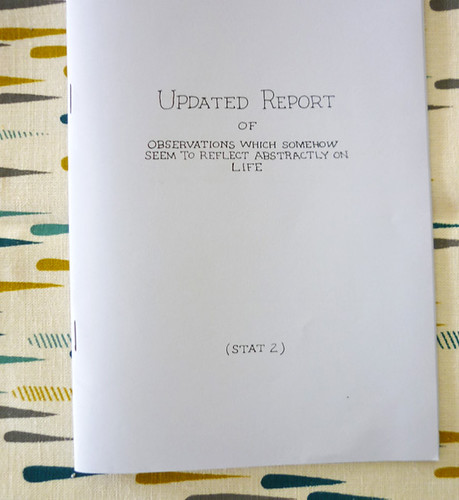
Updated Report of Observations Which Somehow Seem to Reflect Abstractly on Life (Stat 2) by Sarah McNeil


Graphic representations of data abound in non-fiction, reports, and they have been highlighted recently at the Museum of Modern Art’s Talk to Me exhibit. Students are constantly asked to interpret pie charts and bar graphs, but rarely do they have as much fun with them as McNeil in this ½ size zine. In a very uncluttered presentation, McNeil graphs personally relevant information like “Books I’ve Read & Finished This Year” & “People I Usually Talk to in a Day” as pie charts, “Tattoos” (which plots “Tattoos I Have” against “Level of Regret”) as a line graph, and throws in a bar graph on podcasts in an effort to gain new perspective on her life. This zine includes a table of contents and an author’s note, and, as Passages’ own Brendan Daly pointed out, it makes a great companion to the hilarious Graphjam.--Jessica Fenster-Sparber

Tuesday, October 25, 2011

Bart Simpson’s Treehouse of Horror: Spine-Tingling Spooktacular by Matt Groening

The Treehouse of Horror series, a special publication within the regular Simpsons comic book series, may be perfect for Halloween, but the books excite readers all year long. Since acquiring a handful of these last year, they have been some of the most often-handled, picked up and flipped through books in the library. Some students ask if we have any books based on TV shows, and these and the Boondocks comics are among the first that I point them towards. Described by one student as “mad colorful,” these Simpsons comics are eye-catching, in sharp contrast to the black and white art of the Boondocks. Presented as episodes that stand alone, each segment allows for bite-sized enjoyment. In Spine-Tingling Spooktacular, ELA teachers might want to look for the Simpsons’ take on Kafka’s classic Metamorphosis, where Homer turns into a bug-breath beetle. --Anja Kennedy

Monday, October 24, 2011

100 Words Almost Everyone Mispronounces from the Editors of American Heritage Dictionaries

How do you say mischievous? Or epoch? Or chaise lounge, for that matter (lovely to sit on, excruciating to pronounce)? And, perhaps more importantly, how are we supposed to say them? As someone who learned most of the “ten dollar” words she knows from reading them, I have a long and embarrassing history of very public mispronunciations. I am happy to say those days have come to an end, thanks to this slim volume of phonetically confounding words. Each entry gives the accepted pronunciations as well as a history of the word’s usage and the explanation for the popular mispronunciations we all hear and use. Not only is this a helpful guide to pronunciation, it is a fascinating and accessible bit of etymology - so much so I actually read it cover to cover! --Regan Schwartz

Friday, October 21, 2011

Onsite! BRC


One of Passages’ new sites, Brooklyn Residential Center, (I should say “new to Passages,” because the OCFS site has been around awhile) has a new mural. Photo courtesy of Mr. B, who also shared this quote from one of the students who planned the artwork: “I chose wings for this mural because to me it means this program is just starting. It is lifting off like if a baby bird hatched out of its egg and took off to fly for the first time and was successful at it. " --R. --Jessica Fenster-Sparber

Thursday, October 20, 2011

Programming Spotlight: BPL Kidsmobile


Earlier today two groups of students at Boys Town had the pleasure of climbing aboard the Brooklyn Public Library's Kidsmobile. Lee Gabay, English Teacher, was momentarily allowed behind the wheel for a photo op. 100% of the students who evaluated the program said they would describe it as “very good” or “excellent.”

Bleach by Tite Kubo

Just finished reading all fifty-something volumes of the Naruto manga series? I’d recommend Bleach. The similarities are embedded deeply within the story, but they are certainly there. Bleach is about a teenager in high school who is one of the most powerful guardians on Earth. Ichigo, the main character, can see the dead souls that failed to travel to the afterlife and are now trapped in our world torturing the living. It is Ichigo’s job to help them cross over by helping them finish the task that is keeping them earthbound. This is the beginning of a complex story line that entwines loyalty, betrayal, family drama and eventually the fate of the world hanging in the balance, while waiting for Ichigo to find his true strength to conquer it all. Like Naruto, Ichigo must look within himself to overcome the challenges that will test his will and rely on his friends to face the plot twists that take the readers for a long and amazing ride. As is typical in manga this one is drawn in black and white. --Claudio Leon

Wednesday, October 19, 2011

Food Play by Saxton Freymann


No words are necessary in this fun, and strange, little book of photographs depicting creatures made exclusively out of food. With ordinary fruits and vegetables, Freymann creates a fantasy world where a little mushroom person can fly with the help of a radish balloon and a school of bell pepper fish swim through the page. Perfect for anyone in need of a smile, this book has brought just that to plenty of non-readers, reluctant readers, proficient readers, and everyone else in between. It’s a definite stress-free read. --Anja Kennedy

Freymann, Saxton. Food Play. San Francisco: Chronicle Books, 2006.

Tuesday, October 18, 2011

Angry Black White Girl: reflections on my mixed race identity by Nia


In five photocopied pieces of 8.5 x 11’’ paper, Nia’s zine is a breath of fresh air for readers looking for a short, honest, non-fiction perspective of what it’s like to walk in someone else’s shoes. Two pages are quotes, two pages are Aaron McGruder comic strips, and the balance of this half-size zine (no staples! thank you!) is full of direct talk from a woman who knows how to speak her mind in a zine, and some anecdotes detailing her self-imposed silencing in real life. Informative and instructive in both form and content. Coming to Summit Friday. --Jessica Fenster-Sparber

Monday, October 17, 2011

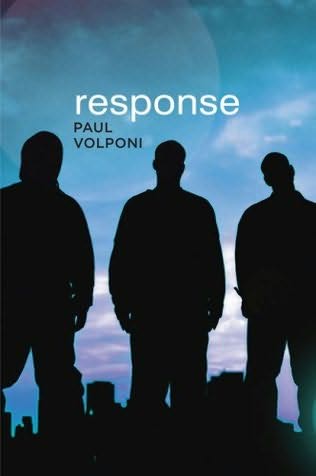
Response by Paul Volponi


With one brutal swing of a baseball bat, Noah Jackson’s life is changed forever. Having headed over the town line into nearly all-white Hillsboro to boost a car, Noah ends up the victim of a vicious, racist trio of teens. Now he has a chance to turn his life around and stand for something bigger than a quick payday. What will be Noah’s response?

Volponi’s short novel is a fast, accessible read, that works hard to ground the concept of a hate crime in relatable life experience. While some of the characters are flat and lack the nuance that would make Response a revelation, it is nonetheless an engaging read that leaves the reader hungry for more. Fans of Walter Dean Myers and Sharon Draper will enjoy this book, but students who are eager for grittier novels, such as Tyrell or Ten Mile River, may be left unsatisfied. Educators may find Response a useful companion piece for a unit seeking to address hate crimes in a modern, urban context. --Regan Schwartz

Friday, October 14, 2011

Show Me The Money! by Sian Keogh


Like moths to a flame, enthusiastic and reluctant readers alike are drawn to this ever-popular title. Essentially a game, each two-page spread challenges the reader to find a specific number of dollars or euros. Much like the perennially popular Where’s Waldo? series, Keogh’s books appear easy enough to draw you in and prove challenging enough to keep you glued to their full-color pages. Unlike the better known series, this book, along with the similarly formatted Hunt the Cupcake! and Find the Golf Balls feature answer keys at the end to the fifty photo puzzles, offering sweet relief to the easily frustrated. Perfect for National Gaming Day and recreational independent reading for all ages.--Jessica Fenster-Sparber

Keogh, Sian. Show Me the Money! New York: Firefly Books, 2009.

Friday, October 7, 2011

Guest Post: You Don't Even Know Me by Sharon G. Flake


The boy code of silence is broken, and a perfect blend of powerful poems and short stories written by boys is created in Sharon G. Flake’s You Don’t Even Know Me. In this book, Flake gets us to contemplate on what it really means to know someone. The boys in this book share their stories of foster care, thoughts of suicide, obesity, unplanned pregnancy, love, revenge and the need to be understood with us in hopes of being accepted into our world. This book is a great invitation for all our boys to read and rise and write and inspire. I highly recommend You Don’t Even Know Me as a good read, especially for our reluctant readers. Sharon G. Flake did it again and this time the voices of boys is heard loud and clear. --Denice Martin-Thompson

Denice Martin-Thompson is a Reading Specialist at Passages Academy’s Summit site in the Bronx. She’s the creator of RAW- Ready, Able & Willing to Read and Write, an intervention service for Pre-K--Adults and she is also a published poet. Struggling to Survive The Story of a First Year Teacher Told Through Poetry is available here. Her passion for the arts comes alive in her writing; she believes in the liberating power of poetry and hopes to self publish her other titles one day. You can read more about Ms. Martin-Thompson by visiting her website here.

Wednesday, October 5, 2011

Programming Spotlight: NYPL Visits Horizon


Today we are wrapping up a record-setting 12-consecutive group visits (over the course of two days) from the New York Public library at Horizon. Ms. Jeanine Thomas and Mr. Avondale Dyer of NYPL’s Mott Haven branch have been so good to our students and it has been such a treat to connect with them. --Jessica Fenster-Sparber

Tuesday, October 4, 2011

The Paranormal Caught on Film by Dr. Melvyn Willin


“What is that? Is that real?” Students ask these questions every time they open this book to photographs of what really look like ghosts, apparitions, and other unexplainable visions caught on film. In his introduction, Dr. Melvyn Willin welcomes the reader to “the world of the extremely weird.” He doesn’t claim that all of the photographs represent paranormal activities, but he does give each one the opportunity to convince the reader with its companion story. Each photographic mystery is assigned a chapter: Ghostly Figures, Strange Lights & Apparitions, Simulacra, The Unexplained, and Back From the Dead, and is then paired with the context or history in which the image was captured. This book has plenty of material for students to wonder at; be sure to steer them to the text for the full experience. --Anja Kennedy


Willin, Dr. Melvyn. The Paranormal Caught on Film. Cincinnati, OH: David & Charles, 2008.

Monday, October 3, 2011

Sold by Patricia McCormick


Lakshmi has spent all of her thirteen years in her small village in the mountains of Nepal, working hard and trying to make the best of things despite her thoughtless, gambling step-father. But when the family loses what little they have in a monsoon, her stepfather’s solution is to sell Lakshmi into prostitution. Thinking she is going to the city to work as a maid, Lakshmi ends up captive in a brothel in Calcutta, told she must earn her way free.

Told in captivatingly sparse free-verse, Lakshmi’s story unfolds in a series of powerful vignettes. Through Lakshmi the reader meets a cast of richly detailed supporting characters, who create a vivid world where Lakshmi’s struggle for freedom and justice comes to life.

Sold is a very intense look at the realities of child sex trafficking. While McCormick deals very sensitively and honestly with an incredibly difficult and brutal topic, teachers and librarians may still want to recommend this book to mature readers. -- Regan Schwartz


McCormick, Patricia. Sold. New York: Hyperion, 2006.

Friday, September 30, 2011

What’s Good in Queens today


Very excited about this weekend’s NY Art Book Fair which kicked off last night. I’ll have the honor of sitting on a panel this afternoon with Lauren Adelman of Artistic Noise who doubles as the amazing outreach arts educator we get to partner with and moderated by the exceptional Jennifer Tobias, PhD, Reader Services Librarian at the Museum of Modern Art. There’s a special surprise guest on her way down from upstate as I write this and we’ll all be talking about Artists’ Books in the Juvenile Justice System. Please stop by and say hello!--Jessica Fenster-Sparber

Thursday, September 29, 2011

Runaways by Marvel Comics


What would you do if you saw your parents murder someone? Teens may think of their parents as evil, but what if they really were? Runaways is a Marvel series in which the parents of a group of teens are underground criminals who, behind the scenes, have control of the city. The young adults find out about their parents’ secret lives when they make the mistake of spying on them. It is there that they become witnesses to their parents committing a crime and the story begins to unfold. The teens are forced to make the tough choice of either joining their parents as criminals or to runaway from them -- of course, they choose to run away. As runaways each of the teens discovers that their respective parent had intended for them to continue the family business and must deal with that information in his/her own way. The art style is very Marvel-like as in there is no blood, the colors are bright and super powers can be expected. The story is intricate enough to keep you wanting more but not too complex for younger readers. -- Claudio Leon

Tuesday, September 27, 2011

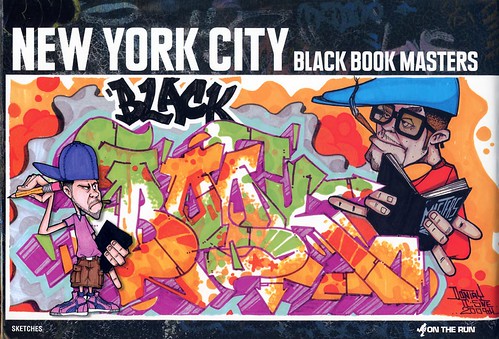
New York City Black Book Masters edited by Alain “KET” Mariduena


“That old saying ‘practice makes perfect’ rang in my head.” So says YES 2, one of a handful of writers whose quotes appear between the pages of this book which collects paper-based sketches and illustrations from KET and other New York City writers who KET deems “masters.” In 125 pages of glorious color, this book offers insight into a side of graffiti rarely seen by outsiders: the black book. For the uninitiated, this term refers to a writer’s sketchbook which, traditionally, had a black cover. In this humble reader’s opinion, the most stunning example of what this medium can lead to is shown on page 121 in a sweeping undersea piece featuring an octopus and subway train tentacles. This book proffers the developing writer creative ideas for lettering and layout, and the educator the opportunity to illustrate how alternate mediums offer alternate opportunities to realize one’s vision. It may also be useful to teachers wishing to introduce the concept of a writer’s notebook to the graffiti crowd. --Jessica Fenster-Sparber

Mariduena, Alain “KET”. New York City Black Book Masters. Germany : From Here to Fame Publishing, 2009.

Monday, September 26, 2011

Homeboyz by Alan Lawrence Sitomer


When Teddy’s younger sister is killed in a gang-related drive-by shooting, his entire family nearly falls apart. Everyone except Teddy, that is. He vows to keep it together for his fallen sister and to get revenge, even though he’s not a gang member. His first plan isn’t smooth enough -- he gets arrested for attempted murder and finds himself inside a juvenile detention facility. Luckily, a new mentoring program gets him out on house arrest, provided he report often to the program and take Micah, a tough acting middle-schooler, under his tutelage. As Teddy continues to refine his plans for revenge, Micah inadvertently teaches him that some things are more important.

Homeboyz is the third and final installment of Sitomer’s Hoopster trilogy, and it’s by far the most popular with our students. It has a great cover (publishers, if you’re out there and reading, this is what a good cover looks like!), and a story that’s both realistic and poignant. Students recommend this book to each other all the time. -- Anja Kennedy

Sitomer, Alan Lawrence. Homeboyz. New York: Hyperion Books for Children (Jump at the Sun), 2007.

Friday, September 23, 2011

Guest Post: Something Wicked This Way Comes by Ray Bradbury


Few writers would dare combine an uplifting coming-of-age story with sci-fi and horror themes, but Ray Bradbury does, and he does it very well, in Something Wicked This Way Comes. Students find the 14-year-old main characters, Will Halloway and Jim Nightshade, engaging and they are fascinated by the detailed descriptions of the villains—particularly the illustrated man whose tattoos change to foretell the future. This is a short novel suitable for middle school reading abilities. Teachers will find many curricular connections. Teachers working with the Holocaust or Slavery as subjects may be able to use Something Wicked This Way Comes as a way to help students understand how hope and love can survive in situations that seem hopeless and loveless. --Fred Lauf

Fred Lauf teaches ELA to high schoolers at Passages Academy’s Summit site in the Bronx. He’s been teaching at schools like Passages for 18 years and he still enjoys coming to work every day.

Thursday, September 22, 2011

The Dark Tower: The Gunslinger Born by Stephen King, Adapted by Peter David and Robin Furth, Illustrated by Jae Lee and Richard Isanove


This comic book series is dark, gritty, and definitely written for a mature audience, which is fitting for an original work by Stephen King. Like the novels, the comic series follows the story of Roland, our hero, who is the last of his kind, a Gunslinger on a journey across the land of a fictional world that is dying. His quest is to find the cause, which is trapped in a Dark Tower. The first book introduces the origins of Roland and how he became a Gunslinger at a very young age. The Gunslinger Reborn explores themes such as death, adultery and magic. And although not everything is depicted in detail, there is a substantial amount of gore which goes hand in hand with revealing a world on the brink of death. The artists did a phenomenal job at portraying the decay and looming darkness that is overtaking the world. The reader, in every frame, will get the feeling that there is something lurking in every corner and the feeling that this world which Roland is trying to save does indeed needs saving. This reader appreciated that the comic series follows a more chronological order of events than the original books, where the origin of Roland isn’t even addressed until book four. The comics also give more background and depth to the story than the books, something which can often be lost in translation. --Claudio Leon

Wednesday, September 21, 2011

Programming Spotlight: Bookmobile Visits Boys Town

A bus pulled up outside our door and hungry readers were greeted and welcomed into a brightly lit library collection inside. A dream come true for the boys at Boys Town who had the chance to receive Brooklyn Public library cards on the spot and check out as many books as they wanted this morning. --Jessica Fenster-Sparber

Programming Spotlight: Our first MoMA field trip of the school year!

Our community partnership with the Museum of Modern Art is off to another exciting year of programming. Yesterday, some very appreciative students (and staff!) from Passages Academy--Summit went on a VIP tour through the galleries of MoMA on their only day of the week closed to the public, led by the ever-inspiring museum educator Lauren Adelman. We stood in front of van Gogh's Starry Night and other famous works of art; all of us feeling very special when we had the art all to ourselves. After the tour, Ms. Adelman facilitated an art-making workshop where students created sculptural pieces inspired by art that we saw in the Talk to Me exhibition. One student perfectly summed it all up at the end, singing "Today was a wavy day." --Anja Kennedy

Tuesday, September 20, 2011

Sentences: The Life of M.F.Grimm by Percy Carey


It’s the ‘80s and life for many in New York City is very violent and all too short. There are a few ways to make it on the mean streets and the new world of hip hop represents the best and the worst of them: talent, drive, perseverance, violence, and drugs. With incredible candor, Carey’s autobiographical graphic novel details in rich illustration and lyric prose the troubled rise, the epic fall, and the gradual redemption of one of hip hop’s underground stars: his alter-ego, M.F.Grimm. Featuring cameos by Suge Knight, Dr. Dre, Snoop Dogg, and Chuck D., this compelling memoir is an action-packed walk through Hip Hop’s birth and rise and one man’s story of a life-long struggle to tame a wild temper, learn from bad decisions, and make a mother proud.

Sentences is not a pretty tale, though it is a stunning book, dynamically illustrated in black and white. It is the story of a life full of violence and criminal activity and the consequences of these choices are clearly drawn out. This is a book sure to connect with many urban youth looking for a way up and out and a great way to introduce students to biographies. --Regan Schwartz

A note for educators: at times the artistic renderings of previously introduced characters is inconsistent , making it difficult to follow supporting characters whose faces shift from page to page. Teachers and librarians may wish to seize this opportunity to teach students about the challenges inherent in visual literacy.

Carey, Percy. Sentences: The Life of M.F. Grimm. New York: Vertigo, 2007.

Monday, September 19, 2011

Up Close: Bill Gates a twentieth-century life by Marc Aronson


Want to be like Bill Gates? Established non-fiction writer Marc Aronson understands that young readers can’t help but wonder how one goes about becoming one of the richest people in the world. He also understands, he says, that much of what is truly fascinating about Bill Gates is how he has shaped the world we live in now. With these twin aims he organizes Gates’ biography into eleven chapters, the bulk of which address what Aronson casts as the eight principles of getting rich fast. Following Gates from his childhood in a wealthy, competitive family and in his early years at a public school, Aronson explains how the teenage Gates used everything he could draw on to become extremely wealthy in a shockingly short period of time. Aronson does a good job of helping the reader understand Gates’ critics and wonders about Microsoft’s cofounder turning into a major philanthropist. A satisfying biography of a singular contemporary icon dually useful to the curious reader as well as a student looking for report material. Notes, an index, and a bibliography help the non-fiction writer consider the writer’s perspective and process. --Jessica Fenster-Sparber

Aronson, Marc. Up Close: Bill Gates : a twentieth-century life. New York: Penguin Group, 2009.

Friday, September 16, 2011

Bronxwood by Coe Booth

The long-awaited sequel to Coe Booth’s Tyrell is finally here and it does not disappoint. With his little brother in foster care and his mom unable or unwilling to get the family back together, Tyrell has been living with his drug-dealing friends, doing his best to stay out of the game and take care of his family. Now that his dad is out of jail and up to the same business that got him locked up in the first place, Tyrell knows that everyone expects him to move back home and step down as man of the family. But Tyrell can see what’s coming as everyone falls back into their old patterns of behavior. He has a lot of important decisions to make in the last few weeks of August - decisions about friendship, love, and family that will have serious consequences.

With sharp prose and excellent observation, Booth paints a gritty, gripping portrait of survival. Readers are drawn to Tyrell’s voice and his lived experience because it is so stunningly rendered. Students who enjoy the work of Walter Dean Myers, Allison Van Diepen, Ni-Ni Simone, and Sharon Draper will enjoy this fast-paced glimpse back into Tyrell’s life in Bronxwood. -- Regan Schwartz

Thursday, September 15, 2011

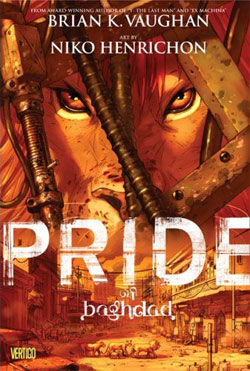
Pride of Baghdad by Brian K. Vaughn


This graphic novel is drawn with vivid colors and beautiful detail. From the moment you open the novel until the very end, the intricate specificity behind every character and scene found inside will compel you turn the page. The story, almost deceptively simple, briefly skims the surface of deeper themes, like the fight for oil in the east, the bombing of Baghdad, and the 2003 invasion of Iraq. For better or worse, the story touches on these issues so briefly that those without prior knowledge will not feel excluded from the main plot. The story follows a pride of four lions who manage to escape the Baghdad Zoo during the invasion of Iraq. As the reader trails their journey across the city, they encounter other animals, some wild and others who have also escaped the zoo. The pride’s internal struggle forces them to break up and eventually brings them back together through the progress of their journey. Although it may sound like a long story, it is rather short and very satisfying. Mostly though, this is a visual feast. --Claudio Leon

Please note there is suggestive sexual content in two sections of this graphic novel.

Vaughn, Brian K. Pride of Baghdad. New York: Vertigo Comics, 2006.

Monday, September 12, 2011

LeBron James: Basketball Legend


This extremely slim volume will grab the attention of basketball-loving browsers. Six short sections familiarize readers with LeBron James, the popular basketball star. Most pages have two sentences each and all text appears opposite a large color photo. The writing is simple and never moves in the direction of depth or interesting details, but we do learn the basics of James’ birth, childhood, and early NBA career. The sections are followed by a brief timeline, glossary, and index which makes this title a solid non-fiction pick for emergent readers with an interest in basketball. --Jessica Fenster-Sparber

Worthy, Shanya. LeBron James: Basketball Legend. New York: Gareth Stevens, 2010.

Two the Hard Way by Travis Hunter


When Romeo’s older brother Kwame gets released from prison, Romeo has to adjust to having him around again -- and it isn’t easy. Especially not with all the other drama in his life: his girlfriend is upset about another girl’s accusations, their mother is back on the scene after a long crack-addicted absence, and the home they share with their grandmother is burglarized. And while Kwame might be feeling freedom for the first time in a while, life isn’t easy for him either as he transitions back into the old neighborhood. Told in alternating chapters from the brothers’ points of view, this is a young adult departure for Travis Hunter, author of a long list of urban books for adults. It’s a good choice for fans of Ni-Ni Simone -- written in a similar style with the appeal of modern slang and dialogue. This is a fast-paced urban story sure to satisfy readers looking for drama; a few lessons about being a man are weaved in as well. --Anja Kennedy

Hunter, Travis. Two the Hard Way. New York: Dafina Books, 2009.

Monday, September 5, 2011

Spotlight Interview: Claudio Leon


Welcome back! September 6th kicks off a new school year for us at Passages and we have two library team members we'd like you to meet if you don't know them already. First up is Claudio Leon, who first joined our team in early 2008.

JFS: Can you tell our readers a little bit about your background and what you've been up to?

CL: I was born in Dominican Republic, migrated to the United States when I was 10 and found my love for everything digital at around the same time. Later on, in high school, I discovered my passion for reading and writing. I was in the service for 4 years, and had been employed by the Department of Records as an Assistant Systems Administrator. These days you can find me working on a few small independent projects as well as providing technology services for those who need it. Currently, I am finishing my undergrad in Computer Information Systems Technology, yes it is a mouthful.

JFS:
What is your favorite thing to read and your favorite place to read?

CL: Favorite thing to read will have to be anything science fiction, especially graphic novels, just love them. I have two favorite reading places, the subway and my bedroom before going to bed.

JFS: What was your favorite book when you were a teenager?

CL: Favorite book... tough choice but it would have to be The Three Musketeers, "One for all and all for one!"

JFS: What do you like to do for fun when you're not reading?

CL:
I normally like to catch up on technology trends in my spare time, but that involves reading, so video games would be my second favorite hobby.

Monday, August 1, 2011

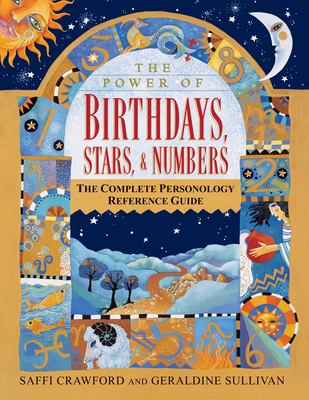
The Power of Birthdays, Stars, & Numbers: The Complete Personology Reference Guide


“When is your birthday?” A favorite ice-breaker during bookcart service, this hefty volume has never yet failed to interest a prospective reader. Crawford, a numerologist, and Sullivan, an astrologist, have combined forces to co-author this paperback reference work. The book devotes two pages to each of the 366 days of the year. Each spread contains a three- or four- paragraph summary of the personalities of individuals born on that day, followed by sections labeled “Your Secret Self,” “Work and Vocation,” “Numerology,” and “Love and Relationships.” Sidebars address fixed stars, the date’s primary star’s influence, and a list of dates likely to be the birthdate of “your special someone.” Opening chapters introduce the novice to astrology, fixed stars, and numerology with a fair amount of detail, and an appendix of fixed stars is provided for those wanting to know more. Most readers, however, will dive right into locating their birthday, and after that, a loved one’s birthday, or a potential date’s birthday. An interesting starting point for inquiry projects on numerology, astrology, and human psychology and personalities, a tool for explaining the concept of a reference book, and a resource for birthday card writers, office parties, and individuals engaged in correspondence. In a place full of anonymity, The Power of Birthdays offers readers a chance to consider self-knowledge, or a text to take an authoritative stance against. --Jessica Fenster-Sparber

Crawford, Saffi and Geraldine Sullivan. The Power of Birthdays, Stars, & Numbers: The Complete Personology Reference Guide. New York: Ballantine Books, 1998.

Thursday, July 28, 2011

Top Ten Books In Your Facility: What are they?

Amy Cheney, the programming goddess who works in Cali, recently asked those of us on the Yalsa-lockdown listserv “What are the 10 most popular titles right now?” While I can’t speak for the entire school as I am only serving youth at one site this summer, I can say that at that one site, Horizon, the most popular books seem to be:

1) Anything at all by Walter Dean Myers (he just visited and there is nothing on the carts which is driving everyone crazy)

2) Tyrell by Coe Booth

3) Street Pharm by Alison Van Diepen

3) Homeboyz by Alan Sitomer

4) 16 on the Block series by Babygirl Daniels

5) Where’s Waldo

6) The Power of Birthdays

7) Rikers High by Paul Volponi

8) Played by Dana Davidson

9) Anything at all by Ni Ni Simone

10) Random Family by Adrian Nicole LeBlanc

We'll do an official school-wide list this fall. What are *your* top ten? Post in the comments!

Wednesday, July 20, 2011

Programming Spotlight: Walter Dean Myers


Lucky.

I think that’s how many of us felt yesterday to be in the presence of the inimitable godfather of young adult literature, Walter Dean Myers. Thanks to YALSA’s Great Stories CLUB, the NEA, Lainie Castle at ALA's PPO office, Anne Lotito Schuh, Phoebe Yeh at Harper Collins, and the author himself, almost all the students present yesterday at Horizon Juvenile Detention Center had the chance to hear from the author of Dope Sick, Monster, Carmen, and the recently released We Are America to name a few of the titles from over one hundred he has penned. Disarming as ever, he spoke about second chances, showed students some of his tools as a working writer, and talked about the joys of making a living using one’s mind. If that wasn’t already enough (and it was!) he even sat down and autographed well over a hundred books to be given as gifts to students, teachers, administrators and staff. I am filled with gratitude. He and Phoebe left us with some prizes for readers-- stay tuned!

Monday, July 18, 2011

Dope Sick by Walter Dean Myers


If you could go back in time and change just one moment, what would it be? Where would you start over from? Lil’ J has been shot in the arm by a police officer and fears a cop shooting will be pinned on him as the story opens. He pushes his way into what seems to be a deserted building while looking for an escape, thinking he’ll try the roof. Instead, he runs into not-quite-human-or-is-he? Kelly. Using magical realism, dialogue, first person narration and flashbacks, Myers reveals the context of this life-or-death-or-prison moment in Lil’ J’s life and invites the reader into a critical dialogue via Kelly and Lil’ J’s conversation. How does one shift one’s perspective from blaming outside sources to making one’s life “your own fault?” About once a week a student tells me or another student that Dope Sick is “fire,” which pretty much sums up the popular appeal.

Myers, Walter Dean. Dope Sick. New York: Harper Collins, 2009.

Friday, July 1, 2011

The Barrio Kings by William Kowalski


Rosario thinks he’s got his life pretty straight: he's got a beautiful girlfriend, Connie; an apartment for the two of them and the baby they’re expecting; and a solid legal job while he wraps up his high school diploma. He’s put his past with the Barrio Kings behind him. Or so he thinks, until his homeboy, Juan, shows up, freshly released from prison and itching for revenge against the Barrio Kings’ arch rivals, the Vandals. What’s a reformed gangbanger to do? Flat characters are superceded by quick pacing, white space, larger font and a plot that some will find familiar and/or compelling. This reader is certainly interested in hearing from anyone else whose read titles from Orca Publishing’s “Rapid Read” series. Recommended for striving readers who are looking for realistic fiction to help them anticipate life after re-entry. Or just a quick read or a new series along the lines of the Bluford High Series.

Kowalski, William. The Barrio Kings. Victoria: Orca Book Publishers, 2010.

Wednesday, June 29, 2011

MAUS by Art Spiegelman


“When did you first hear about Auschwitz?” “Right AWAY we heard … even from there – from that other world – people came back and told us. But we didn’t believe.” (conversation between Art and Vladek Spiegelman). Maus is one of those books that will leave you speechless. It follows the life of Vladek Spiegelman, the father of the author, through his horrific survival story of Nazi occupied Poland during WWII. The graphic novel is beautifully written and drawn by using cats to represent the Nazis and mice as the Jews. Although there are comical moments, the story never loses its grittiness even as it switches back and forth between Vladek’s story and Art’s. Spiegelman writes the story showing the reader how he created it, giving the reader a behind the scenes feel to the complexity of his relationship with his father and the challenges he faced as he listened to Vladek’s survival story. Whether you liked graphic novels or not, this one is a work of art that deserves to be read.--Claudio Leon

Thursday, June 23, 2011

Passages Academy Visits the Big Easy

Tomorrow two of us (Jessica and Anja) will head down to New Orleans to learn and share at the world's largest librarian conference. You can find us at YALSA's pre-conference on programming for reluctant readers on Friday, ASCLA's President's Program on Prisoners' Right to Read on Saturday at 10:30am, meeting up with a group of librarians serving incarcerated and detained youth all over the country on Saturday night, and at ALA-OLOS & ASCLA's panel on model services for incarcerated and detained populations bright and early Sunday morning. If you're in town, please stop by and say hello! --Anja and Jessica

Tuesday, June 14, 2011

The Yo Momma Vocabulary Builder by Justin Heimberg and Steve Harwood


“Yo momma’s so execrable, her family planned her funeral with alacrity.” As an educator and librarian, and especially when working with troubled populations and youth, I do not encourage students to sling insults at one another; that being said, The Yo Momma Vocabulary Builder has made me reconsider this precedent. Specifically designed to speak to students who want to perfect the art of the insult and fueled with succulent vocabulary, The Yo Momma Vocabulary Builder tempts students to outsmart and out-versify their opponents. A handbook of vocabulary and wit, the title offers definitions and real world applications of vocabulary words, as well as pronunciation guidelines and viscious examples. An appendix puts students' understanding of the newly vanquished words to test with multiple choice reviews and "quizzles" interspersed within the text. This is an ideal book to rope students into the power of vocabulary, and if they take a liking to the power of eloquence, they can be referred to Blake Harrison and Alexander Rappaport's Flocabulary: The Hip-Hop Approach to SAT-Level Vocabulary Building. --Lisa Buckton

Heimberg, Justin and Steve Harwood. The Yo Momma Vocabulary Builder. New York: Seven Footer Press, 2007.

Monday, June 6, 2011

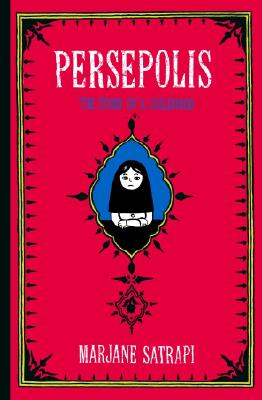
Persepolis by Marjane Satrapi


Have you ever wondered what it might be like to have grown up in Iran? As a teen girl in Iran about forty years ago? Persepolis is a graphic novel memoir based on the teen years of Marjane Strapi, the author, and her life in Iran during the 1970s. Satrapi uses humor and art to tell her story and does a wonderful job of intermingling each with her personal story to paint the picture of what it was like to be an Iranian teen during those years. The comic-lover reader may be surprised to find answers to questions he or she may not have wondered aloud like why Iranian women wear the veil, or why men are only allowed to wear long sleeves. Strapi doesn’t just answer these questions but also demonstrates how she herself dealt with the laws as they were imposed and the perils that came along with trying to oppose them. The story ultimately showed me how little I know about Middle Eastern history and found it amazing that so much information could be packed into this magnificent graphic novel. --Claudio Leon

For a high school lesson plan utilizing Persepolis to introduce students to graphic novels from readwritethink.org click here.

Wednesday, June 1, 2011

Big Cats & Wild Dogs by Rhonda Klevansky and Dr. Jen Green


Ever wonder what, exactly, is the difference between a leopard and a jaguar? Or a puma and a cheetah? Where do they live? What do they eat? How fast do they run? All of these questions and more are answered in this amazing book of facts about large cats and wild dogs. Filled with many color photographs and plenty of accompanying text, the first half is dedicated to the world of carniverous canines and the second half is all about wolves and other wild dogs. Both subjects are very popular with our students, making the book a perfect choice for supplementing inquiry projects. Also use it as a follow-up to answer the many questions students will be asking after viewing David Attenborough’s Life of Mammals: Meat Eaters.

Klevansky, Rhonda and Dr. Jen Green. Big Cats & Wild Dogs. London: Anness Publishing, 2004.