Showing posts with label incarceration. Show all posts

Monday, March 10, 2025

How can you stay connected to a loved one when they are locked away in prison?  

Jay Jay Patton lives in a suburban household with her mother and baby sibling.  She is an earnest student whom we see writing a letter to her dad, thriving in math class, and enjoying her after school dance program.  Then over dinner one night her mother shares the news that her dad is finally coming home.   


The subsequent chapter flashes back to Jay Jay’s budding awareness at age five that her dad is not around.  Then the  story flashes forward to the present and Jay Jay’s reunification with her father and the changes the family must make now that he’s home.  


Markia Jenai’s serviceable illustrations  convey Jay Jay’s diverse emotions which any middle school  child of an incarcerated parent might feel.  There is an element of surprise at the end of the story and rich evidence provided in the back matter to illustrate and substantiate the happy ending.  


Middle school readers with an incarcerated parent may find heretofore unavailable emotional comfort from a story like their own represented in a  graphic format.  All readers can gain something from Jay Jay’s beautiful story and learning from her memoir.  Highly recommended for all school libraries serving middle-school aged youth, this book was recently highlighted by the In the Margins Book Award.--Jessica Fenster-Sparber


Patton, Jay Jay.  Dear Dad: Growing Up With A Parent In Prison and How We Stayed Connected.  New York: Scholastic Graphix, 2024.

Tuesday, June 10, 2014

Upstate by Kalisha Buckhanon


Seventeen-year-old Antonio pleads guilty to his abusive father’s murder; whether he did it or not is unclear, but he’ll still have to serve ten years for it.  Natasha, Antonio’s girlfriend, swears she’ll wait for him.  But ten years is a long time, and while Natasha is getting ready to go to college and explore the world, Antonio is stuck in a four-by-ten room.  Upstate allows the reader to see how two intertwined lives can go in complete different directions over the course of ten years.  The entire narrative of the book is wonderfully done in correspondence between Natasha and Antonio.  The letters between the two at first come almost daily and eventually devolve to a handful a year.  Did Antonio really kill his father? Where will Natasha be when Antonio is finally released? Upstate is a great independent read for fans of Paul Volponi’s Riker’s High and Walter Dean Myers’ Lockdown. --Claudio Leon

Teachers and book club facilitators may want to check out Macmillian's teacher guide to upstate here.
 
Buckhanon, Kalisha. Upstate. New York: St. Martin’s Press, 2005. Print.

Wednesday, November 13, 2013

Juvenile in Justice by Richard Ross

“On any given day, approximately 70,000 young people are in juvenile detention or correctional facilities each night.”  Teaching inside juvenile facilities tends to isolate us from our colleagues throughout the city and nation in unique ways; but we are never as isolated by these facilities as are the students we teach.  Juvenile in Justice captures the loneliness our students share, ironically, with many of the 1.7 million youth charged with an offense annually in the US.  The beds, windows, clothes, doors, furniture, graffiti, and restraints are all strikingly familiar, from our own Bridges and Horizon, both featured in the book, all the way to Hawaii.  The image of a young man in Miami lying on common area seating with his sweatshirt pulled over his head and knees stunned me as penetratingly recognizable .  I know many of this blog’s readers have witnessed the same mini-retreat within one’s own clothing, an identifiable attempt at privacy or sleep.  Each image is coupled with a quote from the youth photographed, offering our students opportunities to connect visually and textually. --Anne Lotito-Schuh

Ross, Richard. Juvenile in Justice. Santa Barbara, CA: Richard Ross, 2012. Print.

Monday, November 11, 2013

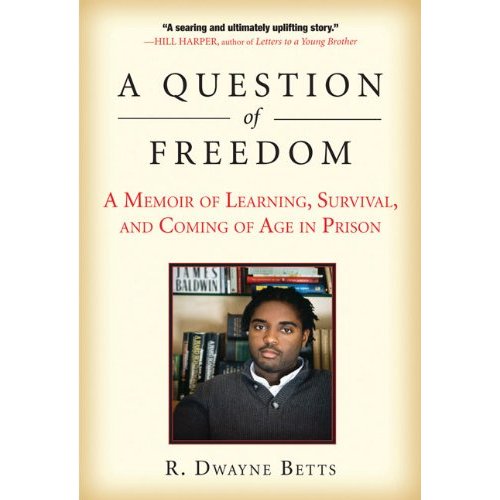
A Question of Freedom by R. Dwayne Betts


“By eighteen I’d been shuffled between a county jail, a prison intake center and three prisons.  I’d been in isolation for thirty-five days and segregation for six months.  I’d been at the prison deemed the warehouse for Virginia’s most violent and dangerous criminals. . . . Red Onion was a level six, a super max.”  (184-5)


While structurally challenging, A Question of Freedom, Betts’ memoir of his years incarcerated after a carjacking at age 16, is undeniably relevant for many, if not most, incarcerated detained youth in New York City.  A Question of Freedom takes its reader on Betts’ harrowing journey through the cold, impersonal corrections system in Virginia and relays the author’s observations and emotional development as a young man.  A cautionary tale for young people who have not yet lost their freedom; an inspiring journey for those who can make it through the two hundred plus pages and appreciate where Betts is today along with the hard lessons he has learned.  A Question of Freedom is a recommended addition to the non-fiction collection of any teacher of urban young men.  Mature independent readers will find this text to be of interest, and it also may be appeal to book clubs, especially in excerpted form. --Jessica Fenster-Sparber

Penguin offers a discussion guide to A Question of Freedom here.

Betts, R. Dwayne.  A Question of Freedom.  New York: Penguin, 2010.  Print.


Wednesday, November 17, 2010

Visiting Day by Jacqueline Woodson


This is not a book we currently have in our libraries, but fans of Jacqueline Woodson, beautiful picture books, and those serving incarcerated youth will want to know about it. You don’t have to do too much digging to figure out that while incarceration effects everyone, there is a highly significant link between incarcerated parents and incarcerated teens, at least in New York City. Sharon Content founded Children of Promise for this particular reason, and Torrey Maldonado wrote Secret Saturdays for younger (middle school) readers who may have a family member (or neighbor or friend) who is “upstate.” But Jacqueline Woodson, never one to shy away from the ways pre-teens and teens are affected by incarceration, joined forces with illustrator James E. Ransome to deliver a heartbreakingly beautiful picture book on the subject for younger children. Visiting Day follows a young female narrator as she and her Grandma get ready to visit Daddy and then make the trip. The young protagonist’s experience is portrayed as familiar and full of love. Author and illustrator notes at the end may cause your eyes to well up. This book will be of interest to students who are incarcerated and parents themselves. It is both warm and a wake up call.

Woodson, Jacqueline. Visiting Day. New York: Scholastic, 2002.