Showing posts with label bookmaking how-to. Show all posts

Tuesday, September 17, 2013

Whatcha Mean, What’s a Zine?: The Art of Making Zines and Minicomics, by Mark Todd and Esther Watson Pearl


Looking for a unique and engaging way for your students to publish their work?  Offering a brief history of zines as well as step-by-step how-to instructions, Whatcha Mean, What’s a Zine? is the perfect volume for teachers interested in leading a zine-making project.  The entire zine-making process is broken down into easily digestible bites, with great potential for application to individual lesson plans.  From brainstorming a topic to write about to distribution methods, each section serves as an example of zine design and layout.  Noteworthy are the photocopier tricks and tips for getting a wow factor from a low budget production method.--Anne Lotito Schuh


Todd, Mark, and Esther Watson Pearl. Whatcha Mean, What’s a Zine?: The Art of Making Zines and Minicomics. Boston: Graphia, 2006. Print.


Tuesday, April 24, 2012

Library Alchemy

William Bevill, librarian at Pima County Public Library's Juvenile Detention Center Branch has landed! He's in town to teach us unconference attendees how to perform a magic trick: turning hardcovers into softcovers for circulation. William kindly provided us with some photos of what we'll be able to do by Friday afternoon. For more information about our upcoming unconference, click here. --Jessica Fenster-Sparber

Thursday, April 28, 2011

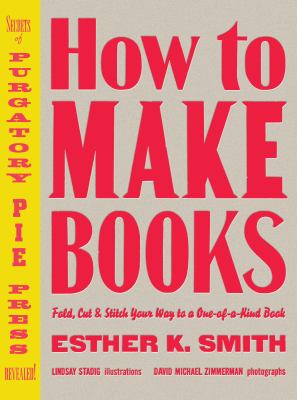
How to Make Books by Esther K. Smith


Looking for new and innovative ways to spice up traditional curriculum? Ester K. Smith's How to Make Books is a hands-on guide to inventive book creation. Complete with diagrams, instructions and historical background, How to Make Books explores a wide variety of book making, including instant books, zines, accordion books, pamphlets, chapbooks, mutant books and stitched books. Students who express interest in writing or illustration often take quickly to the title, and most readers lean in closely when they realize that their ideas can be created, collected and bound by hand! So how does this apply to the classroom? Consider How to Make Books a reference point for imaginative and tactile classroom projects. Whether it be a unit on folktales, exploration of a particular historical period or event, a visual dissection of a plant, or the technical application of geometry, all can be enhanced by incorporating the kinesthetic and personalized activity of book making. --Lisa Buckton


Smith, Esther K. How to Make Books. New York: Potter Craft, 2007.