Wednesday, December 15, 2010

The Brothers Torres by Coert Voorhees


Have you ever watched someone you love walk a dangerous path? A frustrated Frankie Torres Towers is watching his older brother, Steve, becoming more aggressive and irresponsible as he chooses to run with the cholos, a local group of thugs, putting his soccer scholarship at risk and causing tension at home between Frankie, Steve, and their parents. Briefly, Frankie benefits socially from his brother’s new affiliation as he pursues his childhood love interest, Rebecca Sanchez, and butts heads with romantic competitor and local bully, John Dalton. But the plot climaxes as Frankie is forced to choose between gaining the respect of Steve and the cholos and maintaining his own integrity and budding romance with Rebecca. Although the plot is heavily tied to the New Mexican setting, the novel’s themes of friendship, family, first love, violence, loyalty, brotherhood, and peer pressure are universal. This coming-of-age tale has also been selected by the American Library Association as a Great Stories Club book.

Voorhees, Coert. The Brothers Torres. New York: Hyperion Books, 2008.

Tuesday, December 14, 2010

Superman: the Ultimate Guide to the Man of Steel by Scott Beatty


Many people love Superman, but I think most people, even big fans, will find a lot of new information in this oversized guide to one of the original superheroes. Its format is almost like a visual encyclopedia; each double-page spread is dedicated to one Superman theme, and there are captions and little informative blurbs scattered around vivid, full-color drawings against a full-color background. While these themes are not arranged alphabetically, there is a sense of order -- the book is grouped into five main areas of focus: Birth of Superman, City of Tomorrow, Secrets of the Man of Steel, Supervillainy, and Superman’s Career. The back of the book features a detailed timeline of Superman through the years, both his story and the commercial development of the product. There is also a table of contents and an index. This book is very popular with students and adults; everyone likes to point out their favorite characters and story lines.

Beatty, Scott. Superman: The Ultimate Guide to the Man of Steel. New York: DK Publishing, 2002.

Friday, December 10, 2010

Advance Reading Copy: Kick by Walter Dean Myers and Ross Workman


Late one night a witness sees a car careening about before it slams into a lightpole. The two young occupants of the car are no more than thirteen years old. The soccer-playing boy goes to juvie and the girl goes home. Will the girl’s father press charges? Set in suburban New Jersey and told in alternating chapters by the savvy Sergeant Brown and 14-year old Colombian-Irish-American Kevin, advance reading copies of this novel were snapped up by Passages’ students this week. Readers who appreciate the way Walter Dean Myers consistently and deftly weaves sports, a plot involving the threat of juvenile detention, young people coming of age, and themes of family, responsibility, and caring about others will find the satisfaction they’ve come to expect from this author and his co-author.

Two differences set this title apart from Myers’ multiple novels featuring 14-year-old male protagonists who wrestle with becoming adults while they play to win. The first difference is the sport; in Kick, soccer replaces Myers’ favorite athletic team endeavor, basketball. The second difference of note is fact that Mr. Myers co-wrote this book, unusually, with a teenage author, Ross Workman. Mr. Myers visited Passages Academy’s students here at Bridges this Wednesday, which provided a perfect opportunity to re-evaluate the appeal of a variety of his texts. Survey says: most of our students are interested in reading anything Walter Dean Myers has written.

Thursday, December 9, 2010

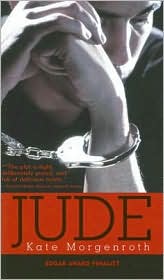
Jude by Kate Morgenroth


Life isn't always fair. In Jude's case, life has been extraordinarily unfair. When his physically abusive, drug-dealing father is murdered in front of him, Jude is caught in a web of lies after he tells the police that he didn’t see the killer -- but he is only lying to protect himself. Life takes another turn when he is reunited with his high-powered District Attorney mother, who he had previously believed abandoned him and his father. Turns out he's been lied to this whole time; his father kidnapped him as a baby and had been hiding out for 15 years. Jude isn't even the name his mama gave him. When he leaves the rough neighborhood he's called home all these years to live with his wealthy mother and attend a fancy private school, it seems as though things are finally looking up. But when Jude is sort-of involved in a classmate's drug overdose, he takes the fall because his mother’s boyfriend convinces him that it will help his mother get elected as mayor. Even though it sounds like a bad idea, Jude goes along with the plan in the hopes of making his mother proud of him, and truly believes all will be forgiven when she learns of his innocence. Readers will surely root for Jude as he suffers injustice after injustice, both in and out of prison in this gripping page-turner.

Morgenroth, Kate. Jude. New York: Simon & Schuster Pulse, 2006.

Tuesday, December 7, 2010

Guest Blog Post: The Maze Runner by James Dasher


Thomas doesn’t know anything about himself except for his first name. He stands in a large, slow moving elevator trying to dig up something from his past but all he can see is blurry faces in no-name towns. The elevator comes to a sudden stop and the doors swing open. The light blinds him for a moment and then he sees dozens of teenage boys, just like him, waiting for his arrival.

Thomas is now part of the Glade, a society of boys without their memory who have built their own society under the control of the Creators. The only way out is through a Maze outside of the Glade’s walls that is constantly changing and filled with danger. The day after Thomas arrives; the Glade gets its newest member and its first girl. She’s lying in the elevator when the doors open, close to death and there is a note in her hand that says “everything changes.”

Even though he doesn’t remember her, Thomas feels a strong connection with the new girl and believes that with her help, he can find a way out of the Glade. All he needs is the support of his fellow Gladers which is easier said than done.

The Maze Runner is action packed and moves very quickly. There is a lot of heartbreak and suspense in the book and you’ll finish it waiting for more. Luckily there is sequel coming out soon! --Lindsy Serrano

Click here for the eerie book trailer.

Lindsy Serrano is a librarian at the New York Public Library and has visited Passages’ students to discuss books, reading, and libraries since 2006. She blogs regularly at http://lindsyinthecity.blogspot.com/ and on NYPL blog channel Stuff for the Teen Age.

Friday, December 3, 2010

Zine Review: Magical Guide to Rainbows by Kacper


Most folks are surprised to hear the word "zine" and "school library" in the same sentence, PA participants from the Zine PD at Boys Town way back in '07 and Mr. B notwithstanding. While yes, it is true that this collection is not readily available inside any of our libraries while I type this, that is a matter soon to be remedied, and all the more reason to tell you about some of the gems in our collection. I'll kick the reviews off with one of my favorites: Kacper's Magical Guide to Rainbows. What's magical about this 8 .5 x 11 stapled zine is Kacper's imaginative cataloging of rainbow types. Of course they don't exist in visible reality, but this zine's rough aesthetics (check out the aforementioned staples and the white-out style font on the photocopied cover) and straightforward listing get the zine format's accessibility across better than any paragraph I could construct. It’s an "If Kacper can do it, you can too." And if Kacper wants to be known at Kacper, the Ambassador of Candyland, well, then we can start a brainstorm session on pseudonyms. After we review mnemonic devices for remembering how to spell "pseudonym."

Until it's moved to a permanent site, email me if you'd like to check out Magical Guide to Rainbows or one of the other dozens of zines in our library collection. If you want to purchase a copy for your own collection, here's the link to Candyland.

Thursday, December 2, 2010

Guest Blog Post: A Long Way Gone: Memoirs of a Boy Soldier by Ishmael Beah


This is the true story of the life of a boy who suffered the unimaginable and inconceivable horrors of war as a child soldier in Sierra Leone. The story of Ishmael Beah’s transformation from a 12 year old boy who loves to dance to American music with his friends into a thoughtless killer is penetrating and real. Every page is powerful because the terrors of war were forced upon the innocence of children and their families. Ishmael’s ability to succeed is not based on heroic or honorable deeds but rather his sheer determination to simply adapt and survive. This book forces the reader to confront his or her own thoughts and feelings of how he or she would have responded. What if it were you who was there? What would you have done…really? Ishmael has more than the war to battle as the loss of family, friends and his emotional control sends him on a path of drug abuse, killing, revenge, rehabilitation, reconnection, and finally safety within the United States. Ishmael’s story offers the reader hope in the power of rehabilitation and the power of opportunity on our behaviors. Ishmael has incredible talents and gifts that were almost stripped away from him because of his circumstances. This book is guaranteed to capture the reader’s attention and hope as he or she joins Ishmael on his quest for survival and safety. Ishmael’s story helps to make the seemingly impossible possible. -- Stephen Wilder

--Stephen Wilder is the principal of Passages Academy and a literacy leader.


Beah, Ishmael. A Long Way Gone: Memoirs of a Boy Soldier. New York: Farrar, Straus and Giroux, 2007.

Wednesday, December 1, 2010

Sports Illustrated: The Football Book


Football season brings many things: incredible plays by the fastest quarterbacks, rough and tumble tackles by the biggest and baddest defensive players, and of course, devoted fans. This book examines the sport from many angles with color and black and white photographs galore and articles compiled from Sports Illustrated magazine. Some standouts are the pictures of old equipment and uniforms, championship rings, ticket stubs and other ephemera from the early days of football. It also touches on the role of famous athletes in advertising, and highlights some of the most memorable ad campaigns. Missing, unfortunately, are any pictures of the cheerleaders who work so hard from the sidelines. This large format book is a perfect fit for football fans, but it is also an appealing resource for those who have a more general interest in sports or for those who enjoy looking at pictures from earlier times. With all of the information included on the history of the game, it will also appeal to fans of pop culture. This book has been especially popular at Summit lately, where students are participating in a football team program through the Division for Youth and Family Justice.

The Football Book. New York: Sports Illustrated Books, 2005.

Monday, November 29, 2010

Microcosmos by Brandon Broll


Did you know that a butterfly’s wings magnified 585X their size reveal that they are made of feather-like scales? Or that shark skin magnified 135X its size reveals it is made of steely tooth-like scales actually called dermal teeth?! Microcosmos is divided into six chapters: Microorganisms, Botanics, Human Body, Zoology, Minerals, and Technology. Each two-page spread contains a full-page color photo of the chapter’s subjects magnified 20X to over 22,000,000X times its size, the subject’s title, a brief description, and how largely it was magnified. I love asking students to guess what the photos are really of before revealing the answer. They dive into this book, pulled in by the strange and bizarre worlds we are unable to see with the naked eye. This book would be perfect for any science classroom, and is a great discussion starter.

Broll, Brandon. Microcosmos: Discovering the World Through Microscopic Images From 20X to Over 20 Million X Magnification. Buffalo, NY: Firefly Books, 2007.

Monday, November 22, 2010

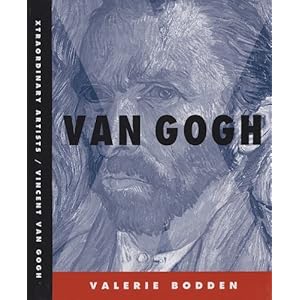
Vincent van Gogh by Valerie Bodden


He experienced life as an outcast, he shot himself, he died in relative obscurity, and one of his paintings recently sold for almost $82 million dollars. Hard not to be interested in this guy. Perhaps this is why Lauren Adelman, outreach educator at the Museum of Modern Art, chose to start her session in Bridges’ library last week with Vincent van Gogh’s Starry Night, a highlight of MoMA’s permanent collection. Whatever the reason, students were quickly captivated by the art-looking she facilitated and were subsequently eager to pore over this volume on van Gogh from the Xtraordinary Artists series. A short 48 pages with 25 full-color reproductions and studies of van Gogh’s art, this book is approachable and full of information to start students on an inquiry project. The author has thoughtfully included several excerpts from van Gogh’s numerous letters so that the reader can encounter the painter in his own (albeit translated) words. Endnotes contain a one-page timeline, a one-page glossary, an index and a bibliography.

Click here to read Tupac’s Starry Night. Connection made by Passages’ student Avian M.


Bodden, Valerie. Vincent van Gogh. Mankato: Creative Education, 2009.

Sunday, November 21, 2010

Get your tickets now! Biblioball 2010: Spellbound


You won't want to miss this! On Saturday, December 4th, The Desk Set is having a huge dance party at the Bell House in Brooklyn to raise money for Literacy for Incarcerated Teens. For those of you who don't know, LIT funds all kinds of literacy initiatives for incarcerated and detained youth, including library collections and author programs. Please come and support this amazing organization!

Watch an invitation to the event that Time Out New York made a critic's pick here: http://vimeo.com/16865892


A special discount applies for Passages' teachers -- get in touch with Anne, Anja or Jessica for the secret code.

We'd love to see you all there.

Friday, November 19, 2010

Tyrell by Coe Booth


Tyrell is feeling the pressure. He and his mom and his little brother just got kicked out of the projects and they’re living in a shelter. His dad is in prison and his mom wants him to start selling drugs to support the family. He’s torn between his long-time girlfriend (whose life seems perfect and nothing like Tyrell’s) and the new girl he met at the shelter (whose life is more similar to his own). With all of these challenges in his life, school is not a priority and he stops going. Booklist, in its starred review of the book, said Tyrell is “heartbreakingly realistic,” and I agree. Tyrell’s life reflects the stressful experiences of many of our students’ own lives. The plot is immediately familiar, as is the characters’ language and dialog. This book flies off the shelves; it gets checked out more times than any other novel in the library, and it is the most difficult one to get returned. One student borrows the book, but it often then gets read by each student in the group home before it comes back to school. This book is highly recommended for independent reading— trust me, it’s not a tough sell. Also exciting for students and teachers, the sequel, Bronxwood, is coming out soon! We are eagerly anticipating Ms. Booth’s visit with our high school students at Summit in December.

Booth, Coe. Tyrell. New York: PUSH Scholastic, 2006.

Wednesday, November 17, 2010

Visiting Day by Jacqueline Woodson


This is not a book we currently have in our libraries, but fans of Jacqueline Woodson, beautiful picture books, and those serving incarcerated youth will want to know about it. You don’t have to do too much digging to figure out that while incarceration effects everyone, there is a highly significant link between incarcerated parents and incarcerated teens, at least in New York City. Sharon Content founded Children of Promise for this particular reason, and Torrey Maldonado wrote Secret Saturdays for younger (middle school) readers who may have a family member (or neighbor or friend) who is “upstate.” But Jacqueline Woodson, never one to shy away from the ways pre-teens and teens are affected by incarceration, joined forces with illustrator James E. Ransome to deliver a heartbreakingly beautiful picture book on the subject for younger children. Visiting Day follows a young female narrator as she and her Grandma get ready to visit Daddy and then make the trip. The young protagonist’s experience is portrayed as familiar and full of love. Author and illustrator notes at the end may cause your eyes to well up. This book will be of interest to students who are incarcerated and parents themselves. It is both warm and a wake up call.

Woodson, Jacqueline. Visiting Day. New York: Scholastic, 2002.

Monday, November 15, 2010

Ten Mile River by Paul Griffin


Ray’s book smarts and Jose’s street smarts make them a bit of an odd couple. But their shared experiences in foster care and juvenile detention have forged a strong friendship between the two, one in which both are able to demonstrate survival skills. This amazing first novel from author Paul Griffin chronicles 14-year-old Ray and 15-year-old Jose’s experience living on the streets and on their own. An attention grabbing opening scene, in which the boys are paid by a local auto body shop owner to smash windshields, and the authentic dialogue immediately draw Passages’ students into this coming-of-age tale. The boys’ brief stint at “Spofford” provides an immediate text-to-self connection for our readers. The novel continues to explore themes of friendship, loyalty, love, morality, and family, offering endless discussion opportunities for literature circles. Passages Academy students at Crossroads are enthusiastically reading Ten Mile River in preparation for an upcoming visit from Paul Griffin before Thanksgiving. --Anne Lotito Schuh

Griffin, Paul. Ten Mile River. New York: Penguin, 2008.

Friday, November 12, 2010

Opposing Viewpoints: Military Draft edited by Viqi Wagner


Looking for a book that encourages critical and independent thinking? A book filled with short essays by scholars, professionals and “ordinary” people, who have opinions on big issues from every angle? The Opposing Viewpoints series has all of this and more. In Military Draft, four chapters with questions around the topic of the draft are explored in essays that argue and attempt to persuade from one point of view. These essays are highly opinionated, often controversial, and full of material for discussion and debate. Also useful and appreciated are the bibliographies throughout the book that list additional and suggested reading on the subject at hand. When I ask students to tell me what they think non-fiction means, they often answer “truth” or “facts.” This book (and all the others in the series) is a well-edited example of how truth can mean so many different things to different people -- and it encourages students to think about where the information comes from. While this is not a book that students choose for independent reading, it is certainly recommended for teaching persuasive writing, non-fiction writing, and information literacy skills.

Wagner, Viqi, ed. Military Draft. Detroit: Greenhaven Press, 2008. Opposing Viewpoints.

Thursday, November 11, 2010

Guest Blog Post: Life on the Outside: The Prison Odyssey of Elaine Bartlett by Jennifer Gonnerman


“For Elaine, the nights were the hardest, when she was locked in her cell…she spent the last hours of every day crying into her pillow, trying to muffle her sobs so the other women wouldn’t hear her. Eventually, after an hour or two, she would wear herself out…Every day began the same way, with a guard outside her cell shouting , ‘On the count!’ ”

If I were still at Passages I would definitely teach this book. Maybe not every kid would read the whole book but definitely I know (have some in mind) who if I brought it to their room they would devour it. In class I would photocopy particular chapters or long passages and teach the book piecemeal. The writing is worth studying because it’s honest, detailed, fair and decent to its subject. It's about how incarceration affects the whole family -- parents, children -- so if it doesn't speak to a student’s personal experience, it will probably connect to an adult he or she knows who faced prison and release. A large takeaway would be the scarlet letter of incarceration -- how one arrest can marginalize you, dehumanize you for your life.

The book hits a lot of the requirements for HS English standards -- journalism, memoir, historical accounts, govt. policy document, which is why I recommend it to teachers planning to cover these topics.

It’s a New York Story - - Rikers, the Lower East Side, Bellevue, The Rockefeller Laws, the G train, part two is titled “Thirty-five Miles from Harlem - - about Elaine Bartlett, her four children, her 16 years for a first offense, and her attempt to build a life. --Kevin Jay Heldman

Kevin Heldman taught Journalism at Passages Academy’s Horizon site from 2007-2009 and is a veteran of the U.S. military. You can read his students’ published writing here and here. Mr. Heldman has received numerous awards and his work has been published all over the place. You can read his writing at http://www.journalismworksproject.org and check out his amazing bio there. If you like to read insightful, excellent, writing, you might also want to visit Mr. Heldman’s new blog at http://kevinjayheldman.wordpress.com/.

Wednesday, November 10, 2010

The Black Soldier: 1492 to the Present by Catherine Clinton


When 14-year-old free black James Forten was captured by the British during the Revolutionary War and offered freedom in return for his service, he replied, “I’m a prisoner for my country and I’ll never be a traitor to her.” In The Black Soldier, Catherine Clinton chronicles the experience of black soldiers in America, from the earliest days of exploration to the first Gulf War. Not only are the men and women formally enlisted in the nation’s armed forces discussed, but also featured are the enslaved who fought for their own freedom against their masters and military forces. Chronologically ordered, each chapter is organized around a particular conflict. The writing is accessible and chapters are often only five pages of text, making them easily adaptable to a single class lesson. Also included are engaging black and white photographs from the period. This book would make an excellent supplement to almost any US History lesson because it spans such a broad time period. Not only will students gain knowledge of larger historical events, but also concrete information on how these events effected the men and women involved in them directly. The Black Soldier is highly recommended to celebrate Veterans Day.--Anne Lotito Schuh

Clinton, Catherine. The Black Soldier: 1492 to the Present. Boston: Houghton Mifflin Company, 2000.

Tuesday, November 9, 2010

Guest Blog Post: Be More Chill by Ned Vizzini


What if there was a pill you could buy that made you cool? This is the very question author Ned Vizzini asked himself as he set out to write the wonderfully engaging Be More Chill. In Vizzini’s novel chronicling the life of teenage outcast Jeremy Heere, the protagonist purchases a technologically advanced pill-sized super computer called a SQUIP, which offers young Jeremy direction and much needed guidance navigating the cruel hallways of high school. The SQUIP’s faulty technology places Jeremy in a number of outrageous, humbling, and ultimately meaningful situations.

Be More Chill
is somewhat lengthy, weighing in at just under three hundred pages. Therefore an effective way to assist Passages’ students in successfully completing this novel is to incorporate the unabridged audio version into the daily lessons. Be More Chill also proved to be useful in teaching the many elements of literature, story arch, character development and the value of implied endings (which some of the students at Boys Town challenged Mr. Vizzini on, when he visited on October 27th, 2010).
--L.A. Gabay

L.A. Gabay teaches Creative Writing at Passages Academy’s Boys Town site. L.A. Gabay is a doctoral candidate in the Urban Education Program at the CUNY Graduate Center in New York. His published works can be found in Teaching City Kids: Understanding and Appreciating Them and The Praeger Handbook of Education and Psychology.

Monday, November 8, 2010

Teen Astrology: The Ultimate Guide to Making Your Life Your Own by M. J. Abadie


What’s your sign? The heft of this 300 page paperback coupled with the almost-tattered appearance of this volume in our library might lead you to believe that students can’t stop reading the details of the more complex aspects contained in the pages. That would be a mistake. This book, one of the most popular in our library at Bridges, is most often used to check the basic descriptions of each sign on pages 26-37 and the “How to Find Your Sun Sign” information box on page 4. Whether searching for more information on oneself, one’s associates, or one’s love interests, students regularly approach this volume with personal motivation and often follow up with requests for more “books like this.” Abadie breaks the text up into four parts, prefaced by an explanation as to why teens deserve their own astrology book. Part one addresses the basics, Part two delves into the planetary parings of sun/moon relationships and romantic relationships. Part three covers aspects of the inner planets and the outer planets. Part four addresses teens and their relationship with their parents. Math teachers might find fodder for students to design their own word problems around identifying their chart elements. Counselors might find starting points for conversations about self-knowledge and personality traits. Mainly, though, this book draws readers like moths to a light because we are all inherently curious about mysterious forces that claim to tell us who we are and what’s going to happen next.

Abadie, M.J. Teen Astrology: The Ultimate Guide to Making Your Life Your Own
. Rochester: Bindu Books, 2001.

Saturday, November 6, 2010

The Life of Mammals hosted by David Attenborough


Who doesn’t enjoy watching real, vivid, and up-close footage of animals in the wild? David Attenborough, veteran wild-life expert, hosts and narrates each segment on this DVD collection of four discs, roughly 500 total minutes of mammals. Each disc is further broken down into chapters of mammal-types, making it ideal for showing short bits to a class at a time. By far, most popular with students I have watched it with is the Meat Eaters chapter, where lions and tigers and other big beasts hunt their prey with breakneck speed and ferocity, but students are also riveted to the screen while watching the less obvious chapters on Chisellers (squirrels, marmots, beavers, etc.), Opportunists (hyenas, prairie doges, etc.), Return to the Water (whales, dolphins, seals, etc.) and the others. Like teens everywhere, presumably, our students are fascinated by animals, especially wild ones roaming in places where they have never been. This collection is a perfect tool for beginning research and inquiry projects because students naturally ask many questions while watching it. These questions, which are authentic and organic, make their research all the more valuable. ELA teachers may also use this collection for writing prompts, both creative and non-fiction.