Wednesday, March 30, 2011

The Deep: The Extraordinary Creatures of the Abyss by Claire Nouvian


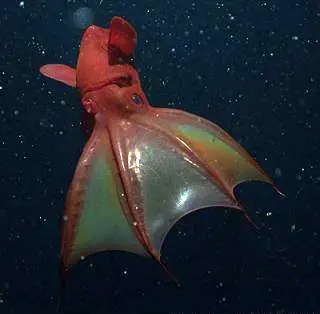
Have you ever seen a googly-eyed glass squid, aka Teuthowenia pellucida? A vampire squid? A glowing sucker octopus? Passages students haven’t either, and although seeing is believing, the photographs in The Deep are often so surprising that many viewers react by insisting they’re not real. Truly the last frontier on Earth, “With an average depth of 3800 meters, the oceans offer 99% of the space where life can develop . . . A staggering thought.” And while humans have sought to dissect and document every species they can get their hands on, thousands and thousands of organisms slip through scientists’ grasp because they inhabit depths rarely accessed. This gorgeous coffee-table sized book collects over 200 incredible photographs of these beings in their bioluminescent splendor and offers the reader a view of their dark and glowing world with basic facts, narrative captions, sophisticated essays, and an understated marker on the side of each page to indicate the depths at which each organism has been spotted. Readers will be be entranced, disbelieving, and full of questions. A perfect text to instigate inquiry, as well as a handy authentic and sophisticated text for teaching features of pictorials. Includes numbers of interest pertaining to the deep sea (pg 246), a one-page glossary, a one-page index, a one-page bibliography, and credits.

Nouvian, Claire Ed. The Deep. Chicago: The University of Chicago, 2007.

Tuesday, March 29, 2011

Cosmogirl! Words to Live By


“Women’s place is in the House-- and in the Senate.” juxtaposed a few pages away from “I love being a girl because I like making guys turn their head.” Hmm. While some of the quotes in this tiny book fall a little short of inspiration, I still strongly recommend this book because it has enough fluff to appeal to a reader looking for light reading combined with enough wisdom and provocative content to instigate deeper incidental thinking or thoughtful conversation. Each page features one to three quotes from individuals both famous and anonymously cited only by first name, age (teens), and the fact that she is a reader of Cosmogirl. This book could be a simple way to locate quotes to kick off a women’s history month inquiry project. The book is divided up into seven chapters covering It’s a Girl Thing, Love Lines, Spirit, Friends and Family, Tough Stuff, Dream it, Be it, and Life Lessons. With an introduction from the magazine’s editor-in-chief and an index to the famous folks quoted inside, the short 212 pages are more addictive than the cover might suggest.

Monday, March 28, 2011

Back in the Days by Jamel Shabazz


Get ready to enter a time warp as you open this book and step into New York City in the 1980s. Photographer Shabazz, who grew up in Brooklyn, knows how to capture the life of the streets: kids hanging out, couples and friends posing, and graffiti on the walls dare the viewer to challenge their authenticity. These pictures are so real, they could have been taken today -- but the older subway cars and the fashion give it away. These were the days of Sergio Valente jeans, Cazal glasses, and Puma and Adidas sneakers. In portrait after portrait, the subjects know they look good, and they work it for the camera, crossing their arms and sticking out their hips. My personal favorites are the ones showcasing matching outfits shared by friends, lovers and entire crews. DYFJ staff members almost always get a kick out of this book as they re-live the clothes of the eighties and talk to the students about how New York City used to look. This book is highly engaging and a real stress-free read.

Shabazz, Jamel. Back in the Days. New York: powerHouse Books, 2001.

Wednesday, March 23, 2011

Bayou: Volume One by Jeremy Love

Graphic novel, historical fiction, and fantasy all rolled into one eye-catching and compelling read, Bayou tells the story of Lee Wagstaff, an African-American girl living in Mississippi in 1933. When her white friend, Lily, is captured by Cotton-Eyed Joe, a fantastical creature, only Lee knows the truth, a truth that may possibly set her father free after he is accused of Lily’s disappearance. Lee crosses over into the fantasy world in hopes of bringing Lily back and is aided by Bayou, a friendly monster that vows to protect her. Tropes on southern history, dialect, folktales, religion, music and race relations are explored metaphorically, literally and visually on almost every page. Some pages are ripe with dialogue, while others simply let the artwork establish setting and mood while moving the plot forward. After racing through the first two volumes, this reader was left anxiously awaiting the release of the newest addition to the series. Students seem to be most drawn to the vivid full-color artwork and theme of injustice by their own curiosity of the highly charged setting.

Love, Jeremy. Bayou: Volume One. New York: DC Comics, 2009.

Thursday, March 17, 2011

Dogs (Eyewitness Companions) by Dr. Bruce Fogle


Always a hit with the dog lovers among us, this book is compact and concise, making it the perfect resource for quick reference. While it has plenty of factual information about the dog's origin as a species and its present state as a domesticated pet, the real draw is the breakdown of breeds. Divided into categories by size (small, medium, large, and extra large), each breed listed is described and illustrated with specific details that apply to each one. Most useful perhaps is the information regarding temperaments and time consumption for grooming and training. It is our go-to book at Summit when someone wants to show off what their dog looks like, or more often, what the dog of their dreams looks like. Also handy is the section in back about training, taking care of and keeping a dog as a pet.

Fogle, Bruce. Dogs. New York: Dorling Kindersley, 2006. Eyewitness Companions.

Wednesday, March 16, 2011

Ripley's Believe It or Not: Enter if You Dare

Conjoined crocodile twins, a 22-inch tall man, a faceless cat, a woman with an elephant trunk nose, a man with tattooed eyeballs: what do they all have in common? They can all be found in Ripley’s Believe it or Not: Enter if You Dare. All of the Ripley’s books are a huge hit with our students who are drawn in by the eye-popping full-color photos of strange-but-true oddities from around the world. The series is perfect for shared reading because the reader can’t help but express their reactions vocally, turning to their neighbor to ensure he or she is equally shocked and amazed. Our most reluctant readers are highly motivated to read the brief captions accompanying each photo by a desire to learn more about just what it is they are looking at. Available in hard cover only, teachers are encouraged to borrow Ripley's books for classroom use.

Barratt, Judy and Sandy McFall, Eds. Ripley’s Believe It or Not: Enter if You Dare. Orlando, FL: Ripley Publishing, 2010.

Tuesday, March 15, 2011

Yo’ Mama is So... by Hugh Payne


Hugh Payne wants you to know he has nothing against yo mama. He hopes she has a sense of humor. This little 256 page joke book averages four one-liners per page and is a perfect stress-free read for the reader who likes his white space riddled with laughs. My favorite part of this volume are the insults between famous people, like Golda Meir on Moshe Dayan : “Don’t be so humble, Moshe, you’re not that great” (p154). I can only hope that the student reader already knows who Meir and Dayan are, and if she doesn’t that this will lead to some wondering and research. Other sections educators can appreciate include the “Insults, courtesy of William Shakespeare” (p 209), a wonderful introduction to the Bard if there ever was one for Passages’ students about to dive into encountering Shakespearean English. Teachers will also and the epilogue, in which the author exhorts the reader to apologize when appropriate.

Wednesday, March 9, 2011

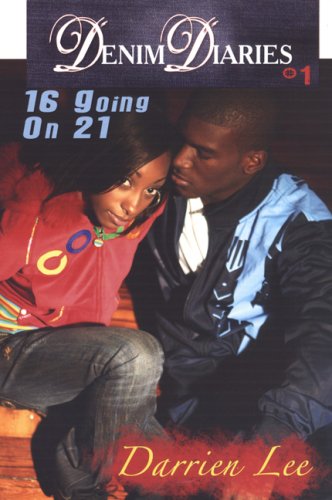
Denim Diaries 1: 16 Going on 21, by Darrien Lee

Good Girl falls for Bad Boy. Good Girl sneaks out of house, despite her mother’s warning, to attend Bad Boy’s party. Shots ring out, and the couple flees only to find blood on Good Girl’s shirt once they stop running. This is the scene presented to readers in the first few pages of Darrien Lee’s 16 Going on 21, the first volume in the “Denim Diaries” series. The Good Girl/Bad Boy construct becomes complicated as we learn more about both Denim and Andre’s back stories. Students looking for a romance high in drama will be drawn to the theatrical dialogue between Denim and Andre. Moralistic in tone throughout, the ending is left unresolved, creating a desire in the reader for the next book in the series.

Lee, Darrien. Denim Diaries 1: 16 Going on 21. West Babylon, NY: Urban Renaissance, 2009.

Monday, March 7, 2011

Played by Dana Davidson


Looking for a love story? This is a really good one with a twist. Ian is attractive and popular, and he considers himself a real player with the ladies. When he is challenged by the leader of the coolest crew in school (the very crew he is proud to be a member of) to get a very uncool girl to sleep with him and fall in love with him, he knows he has to play the game if he wants to keep the respect of his friends. As cruel as this premise sounds, at heart, Ian is not a terrible person, and he feels the guilt of his motions every step of the way as he puts the moves on unsuspecting, plain and brainy Kylie. As their “relationship” develops, Ian begins to see that Kylie is more than she appears and readers will root for him to do the right thing as he struggles to continue with his friends’ dare while his feelings become real. This is an uplifting story for anyone who has ever been played and a good lesson for the players.

Davidson, Dana. Played. New York: Hyperion, 2005.

Friday, March 4, 2011

Skulls by Noah Scalin


Spaghetti skull, acorn skull, mountain skull. Soy sauce skull, wire frame skull, seashell skull. How many different materials do you think you could use to illustrate one subject every day for an entire year? Artist Noah Scalin took on this project in the form of skulls, with an image posted once a day to his blog. After the blog gained massive public interest, a book was published showcasing 180 of the skulls Scalin created for the project, including short captions that describe the materials used in the process. This book is super accessible -- it’s visually appealing because of its small, square size, and every page features a skull or some skulls made in a multitude of media. Students can usually appreciate the absurdity in some, and the skill in others, but they will almost always give it a chance. This is a highly recommended stress free read.

And the blog lives on as fans all over the world continue to submit found skulls and their own handmade skulls. Check it out: www.skulladay.com

Scalin, Noah. Skulls. New York: Sterling Publishing, 2008.

Wednesday, March 2, 2011

Weird but True! 300 Outrageous Facts by National Geographic


What is bellybutton lint made out of? How many people holding hands would it take to encircle the equator? How much can a cloud weigh? In varied fonts and with a combination of digitally created illustrations and photographs, Weird but True delivers the answers to 300 questions you probably never actually asked but will find fascinating anyway. A few may leave you scratching your head like I was when I read “Some sand dunes bark” on page 171 or nodding your head in acknowledegement again, as I was, when I read “If you eat too many carrots your skin can turn orange” (pg 180)-- a harmless experiment you can try with a 6 month old baby. But most will leave the reader with a furrowed brow wondering away: “Human ears evolved from ancient fish gills” (pg 188). A handy index makes your favorite facts findable when you want to prove you’re not making something up, like “99% of people can’t lick their elbows” (pg 199) or “The year 2020 is the next time you’ll see a full moon on Halloween.” (pg 193).

National Geographic. Weird by True! 300 Outrageous Facts. New York: National Geographic Society, 2010.

Tuesday, March 1, 2011

Black and White by Paul Volponi


Marcus and Eddie don’t care about their mis-matched skin color: Marcus is black and Eddie is white. As best friends and co-stars of their high school’s basketball team, they only care about looking out for each other -- both on and off the court -- and they’ve got it all under control. So when they need a little extra cash to go on a school trip, they’re certain that they’re smart enough and smooth enough to get away with some quick and painless robberies. When one of the robberies goes terribly wrong and a community member, a judge who is “tough on crime” as luck would have it, gets injured, Marcus and Eddie are left to figure out a lot of things that had at one time seemed so simple. This book moves quickly in alternating chapters narrated by Marcus and Eddie and is full of thought provoking material. Marcus and Eddie never let their skin color define them before, but how are they supposed to feel now as their victims, the police, their team, and their once close families begin to do just that?

Volponi, Paul. Black and White. New York: Penguin SPEAK, 2005.

Monday, February 28, 2011

Anne Frank: Her Life in Words and Pictures, by Menno Metselaar and Ruud van der Rol


As many as one million people walk through the Anne Frank House, the museum that was once the Secret Annex that hid Anne Frank and her family, each year. In lieu of a field trip to this historic site, this book offers readers a visual visit to the museum. With an abundance of full color photographs of the famous diary as well as personal family photos of the Frank family and the Secret Annex, a summary of Anne’s diary contextualized in the contemporary political climate is punctuated by excerpts from the diary that add a personal voice to the retelling. Passages’ students have expressed a great deal of curiosity about the Holocaust, and on more than one occasion about Anne Frank specifically. Maybe it is the shockingly horrific nature of genocide, or a shared sense of persecution and imprisonment. Whatever it may be, this book has answered and raised many questions for students exploring it during their time in the library.

Metselaar, Menno and Ruud van der Rol. Anne Frank: Her Life in Words and Pictures. New York: Roaring Brook Press, 2004.

Thursday, February 17, 2011

101 Freaky Animals by Melvin and Gilda Berger


If you’ve never heard of babirusas, pangolins, okapis, narwhals, or cassowaries, you’ll want to look at this book. If you’ve never seen a flannel moth caterpillar, or a giant clam, or a hooded seal, or a red-lipped batfish, you’ll want to look at this book. Each page in this full-color paperback features a headline which includes the name of an animal and an interesting tidbit like “Sea Cucumbers Shoot Out Their Insides” (#79), or “Temminck’s Tragopans Inflate their Horns” (#95), accompanied by approximately five sentences in a fairly large font. The information, organized alphabetically by the animals’ names, varies and sometimes elaborates on the headline and sometimes gives additional interesting facts. The brevity of these paragraphs makes this book a great starting point for inquiry projects or discussions about questions and questioning strategies. This is a great pick for reluctant readers who are scoring around a fourth grade reading level on the STAR exam but aren’t interested in fiction.

Berger, Melvin & Glinda. 101 Freaky Animals. New York: Scholastic, 2010.

Tuesday, February 15, 2011

Guest Post: The Real Cost of Prison Comix, edited by Lois Ahrens with Comix by Kevin Pyle, Sabrina Jones and Susan Willmarth

Those who work at Passages Academy have shown themselves to be at the intersection between education and incarceration. In Teach Like A Champion, Doug Lemov suggests that the best way to teach students is to get to know them as individuals. One way to achieve this at Passages is to truly understand our students’ circumstances as court-involved learners.

The Real Cost of Prison Comix provides detailed information about the prison industrial complex, navigating this complex and how it relates to both teachers and students at our Passages school sites. The Real Cost of Prison Comix’ anecdotal and statistical information presented in graphic novel form also proved useful in the classroom as it engaged both emerging readers and those with deeper levels of comprehension. The book’s illustrations simplified sophisticated concepts, and thus made them more accessible.

Exploring the malevolence of the “school to prison pipeline” and its effects on families’ and communities’ health and fiscal well being, the book is one of the more transformational texts used in Passages Academy classrooms. The students are inspired to see their reality validated in print as they begin to consider how they can make changes to their lives and communities.

The Real Cost of Prison Comix is a rare piece of literature that can simultaneously both inform our craft and excite our students. - L.A. Gabay

Ahrens, Lois, Ed. The Real Cost of Prison Comix. Oakland, Ca: PM Press, 2008.

L.A. Gabay is a doctoral candidate in the Urban Education Program at the CUNY Graduate Center in New York. His published works can be found in “Teaching City Kids: Understanding and Appreciating Them” (2006), “The Praeger Handbook of Education and Psychology” (2007), “KICKS Magazine” (2009) and Sages’ “Cultural Studies ↔ Critical Methodologies” (2010).

Friday, February 11, 2011

Crush: Love Poems by Kwame Alexander

With Valentine’s Day on the horizon, many students have been looking for love poems to read and to share with their sweethearts. Alexander’s collection of love poems is a quick read with a little something for everyone. A few poems are about longing, a few are about heartbreak, and some are about mutual love. One of my favorites is “Awkward Poems,” a poem about having a crush on a friend: “Sometimes I wish we weren’t friends / then I could gaze into your bold eyes / and find answers to questions I’m afraid to ask.” A nice feature at the end of the book is the inclusion of poems by five poets Alexander admires, confirming that poetry is meant to be shared. Looking for more love poetry to recommend to students? See our earlier review of Love Poems by Pablo Neruda or ask us to show you more in the poetry section of our libraries.

Alexander, Kwame. Crush: Love Poems. Alexandria, VA: Word of Mouth Books, 2007.

Thursday, February 10, 2011

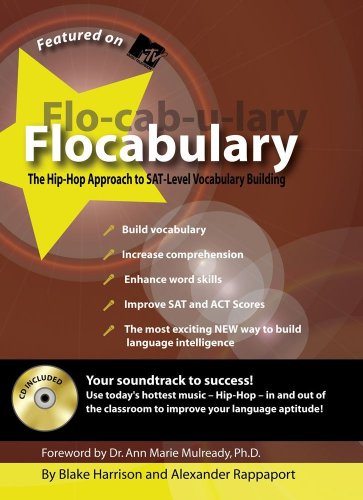
Flocabulary: The Hip Hop Approach to SAT-Level Vocabulary Building by Blake Harrison and Alexander Rappaport


An SAT prep book might sound like a hard sell to students seeking independent reading material, but Harrison and Rappaport’s efforts will not be wasted on any teen interested in improving his or her vocabulary. While the beginning of the book explains the technique, readers can dive right into the songs in chapter 2 and start improving their lexical stylings immediately. Each song is prefaced by a wordbank which lists all notable vocabulary words contained in the song. The list is followed by the song lyrics which run down the left side of the page while the right side offers extremely brief definitions line-by-line along with identifying the part of speech the term most commonly appears as. Oxford English Dictionary it’s not, but Flocabulary offers students more than etymologies. There’s synonym matching, sentence completion, and reading comprehension exercises following each original lyric. Will your students undertake these with no assignment or grade hanging over their head? Many will-- and even without the musical CD that accompanies the books-- because who doesn’t want to rhyme fiercely and out-metaphor Lil’ Wayne on the hall? For readers with CD player access, the CD can be the treasure because the rhythm, rhyme and music allow the listener to memorize the new vocabulary words almost effortlessly, the way one memorizes the lyrics to one’s favorite song.

Chapter 3 offers brief analyses of the songs-- best suited for ELA teachers and their ilk, Chapter 4 lists hip-hop resources. Chapter 5 provides answer keys to the 11 songs and Chapter 6 is a quick reference dictionary of the approximately 500 SAT words contained in the lyrics. The book’s website offers even more for the educator.

Harrison, Blake, and Alexander Rappaport. Flocabulary: The Hip-Hop Approach to SAT-Level Vocabulary Building. Kennebunkport: Cider Mill Press, 2006.

Wednesday, February 9, 2011

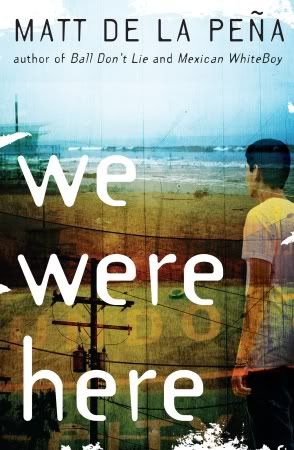
Guest Blog Post: We Were Here by Matt de la Pena


I know Miguel Castaῆeda. He went to my high school. I know Rondell Law. He’s been my student. Mong…well, he tends to be inconspicuous, but you’ve seen him around. Actually, you’ve known all of them at some point in your life. We never knew their stories, cause they never really talked about them, but we know them now. They’re the subject of Matt de la Peῆa’s book, We Were Here. In the form of a journal, Miguel narrates the layered stories these three young men share. The three first meet at a group home in central California where they will complete their sentences…at least in theory. Not a month into his time, Miguel takes Mong up on his offer to escape, and Rondell tags along. The three head for Mexico, largely on foot, and dramatics ensue. While still at the group home, The Lighthouse, Miguel had decided to take up reading, and, in preparation for his journey, swipes a handful of novels from the home library, as well as his, Rondell’s, and Mong’s official files. As the story unfolds, stories unfold for Miguel, too . He takes us through The Color Purple, Of Mice and Men, and The Catcher in the Rye. He identifies with various aspects of character or plot, engaging the reader in these auxiliary texts, we well. We also learn Mong's and Rondell's stories, both familial and judicial, and fall in love with each one. Eventually, as the reader earns his trust, Miguel tells us his story, which he tip-toes around for most of the book. Though they don’t end up in Mexico, all three boys meet with success, as does de la Pena in his novel. He kept me reading for some 300 pages, and even encouraged me to give The Catcher in the Rye another shot. --Julia Weber

Guest blogger Julia Weber is an English teacher at Passages Academy's Boys Town site.

Monday, February 7, 2011

I Can’t Keep My Own Secrets: Six-Word Memoirs by Teens Famous + Obscure, edited by Smith Magazine


The six-word memoir phenomenon is rumored to have begun when Ernest Hemingway was asked to write a story in only six words. He wrote, “For sale: baby shoes, never worn.” Outstanding six-word memoirs are those that force the reader to imagine the depth of the tale that inspired them. One example submitted to Smith Magazine’s website was, “Cursed with cancer. Blessed with friends,” which you may imagine evokes the image of an elderly person reflecting at the end of a long life, but was in fact written by a nine-year-old girl. Or, “I still make coffee for two,” which conjures an image of someone mourning the loss of a beloved spouse, but was actually written by a man in his twenties after a breakup. In this volume, Smith Magazine has collected 600 six-word memoirs solely by authors between the ages of 13 and 19. Students find some memoirs, like “Always listening, but never really heard,” easy to identify with. While others, like “My mom had my boyfriend deported,” ignite as many possible story lines as there are students in the room. Share these with your students, and more from Six-Word Memoirs on Love & Heartbreak by Writers Famous & Obscure and Not Quite What I was Planning: Six-Word Memoirs by Writers Famous & Obscure, and then ask them to pen their own six-word memoirs. Justin, age 15, a student at Crossroads, wrote, “Shoulda, woulda, but can not handle,” and, “Right now, no freedom, but faith.” What six words would you choose?

Smith Magazine, Ed. I Can’t Keep My Own Secrets: Six-Word Memoirs by Teens Famous + Obscure. New York: HarperTeen, 2009.

Friday, February 4, 2011

Pitch Black: Dont be Skerd by Youme Landowne and Anthony Horton

“I was born to people who didn’t want me. So they gave me away. But I guess the people they gave me to didn’t want me either. No one wanted me. That’s how I ended up on the streets alone and uneducated.” This is how Anthony Horton begins to tell Youme Landowne the story of how he made a home for himself in NYC’s subway tunnels. As storyteller, Anthony invites Youme down into his home in this black and white graphic novel. Letting the artwork tell much of the tale, the sparse text focuses on the lessons Anthony learned and the family he found underground. Students are drawn to this book because it is a true story, verifying the oft-rumored reality of NYC’s homeless living underground. A Brooklyn Eagle interview with Landowne works as a great supplemental text that addresses how these two artists collaborated. Highly recommended for readers of all levels looking for a quick and engaging read.

Landowne, Youme and Anthony Horton. Pitch Black: Don’t Be Skerd. El Paso, Texas: Cinco Punto Press, 2008.